Sunday, December 12, 2010

"I Love Fruitcake"


"I love fruitcake."
- Ashleigh Bentley (12/12/10)

Interested in Studying Islamism? Read Olivier Roy


This one's for my own reference. I find myself using my blog for my own benefit; viz., in this case, to cite a resource for further reading. Scott Thomas, in the new edition of Foreign Affairs, cites Olivier Roy's forthcoming Holy Ignorance: When Religion and Culture Part Ways, which argues that "globalization is facilitating the detachment of religion, culture, and territory, this unraveling religious traditions from particular cultures and nationalities. Roy points to global religious movements such as Salafism, a militantly literalistic form of Islam; Pentecostalism; and evangelical Christianity to contend that fundamentalism is particularly well suited to globalization because its claim of a universal truth is inherently disconnected from particular states and societies." (Thomas)

I checked Roy's book out on amazon.com and see it's coming out in a few weeks. I also noted his book Globalized Islam: The Search for a New Ummah. The reviews of this are incredible. For example:"Roy is one of the most important analysts of political Islam today." -- James Piscatori, fellow, Oxford Centre for Islamic Studies and Wadham College, University of Oxford."

  So, remember Olivier Roy if you're interested in Islamism.

Saturday, December 11, 2010

The Current, Growing Rise of Religion

$240 True Religion jeans
Tonight I'm reading the new edition of Foreign Affairs, which I purchased and downloaded on my Kindle. BTW, the Kindle is amazing!

I'm going to summarize (with maybe some thoughts of my own) Scott Thomas's "A Globalized God: Religion's Growing Influence in International Politics."
  • "Religion is on the rise around the world." I've probably read way too many books and articles and interviews by "the New Atheists" who seem to claim religion is on the demise, not the rise, and atheism is rising. We'll see. Which reminds me of a moment a few years ago when or community's atheist association had their meeting at Panera Bread here in Monroe. I was sitting a few tables away from them. At their meeting there were: 3. Three atheists were yucking it up about how stupid religious people are.
  • Thomas reiterates: "Around the world - from the southern United States to the Middle East - religion is on the rise. It is growing in countries with a wide variety of religious traditions and levels of economic development, suggesting that neither poverty nor social exclusion is solely responsible." I predict - religion will not only not be supplanted by irreligion or the "a-religious," but will always thrive. For one reason, at least I think, the human metaphysical impulse is with us to stay.
  • The current rising of global religion does not mean "religion" or certain religions are true, and irreligion is false. Neither is the opposite the case. If 500 people show up at n international atheist convention we do not thereby have evidence that atheism is true. This is mere sociological data. But it does fly in the face of the very few irreligionists who want irreligion to grow, and cite small growth statistics as evidence of the veridicality and "brightness" of a-religion and a-religionists.
  • "Religion will also incresingly be an urban phenomenon. The growing population in the developing nations will mostly settle in vast, burgeoning, and largely impverished metropolises - areas where religion is spreading. According to conventional wisdom, secularization became an inevtiable par tof modernization with the spread of education, science, technology and prosperity. But these new megacities are havens for religious revivals."
  • Demographic shifts are fueling the current global rise of religion. Christianity "is returning to its roots by becoming a post-Western religion dominated by the peoples, cultures, and countries of the global South."
  • Now note this: "The most dramaic religious explosion in the world today is the spread of Pentecostalism and evangelical Protestantism." Yup. I saw it recently in Kenya.
  • "Pentecostalism and evangelical Christianity appeal across class lines. Their message of God's love, hope, and consolation attracts the occupants of shantytowns in many megacities, and their inspiring themes of forgiveness and personal transformation through a sober, frugal lifestyle blends with middle-class values around the world." A few thoughts: 1) surely the Jesus-message of forgiveness and reconciliation is globally appealing; and 2) let's pray the pernicious prosperity gospel fades away since it's not exactly Jesus-friendly and frugal. See Donald Miller's excellent Global Pentecostalism: The New Face of Christian Social Engagement.
  • "Pentecostals and evangelicals will be a major religious, social, and political force in the coming century." But I thought the "religious right" was fading? It is. But not religion. And global pentecostalism and south-of-the-border evangelicalism is not to be equated with Jerry Falwell's "Moral Majority." For one reason, it is less politically active and more socially involved.
  • And Islam is "experiencing a genuine revival," one that extends beyond extremism. "According to the Gallup Center for Muslim Studies, Islam is thriving, with 86 percent of Turks, 90 percent of Indonesians, and 98 percent of Egyptians surveyed reporting that religion plays an important part in their lives." Could be. Yet I cannot help but remember how struck I was when visiting Istanbul by how few seemed to respond to the call to prayer and how many young people seemed to want the materialism of Western culture. Of course that does not mean they are irreligious. If pressed, I suspect most would rise up and defend Allah. But for the most part they would settle for a $240 pair of True Religion jeans.
  • Pentecostal and evangelical Christianity is exploding in China. For example, I personally know of an underground church in China that has, as a best estimate, 400,000 "members." (Dispersed in a gigantic small group network.) It is worth noting that this growth is "almost entirely indigenous." "If Christianity achieves the kind of cultural permeation of China that it has in South Korea - where it has reached over a quarter of the population - it could fundamentally alter China's political fabric."
  • "Northwestern China is now in the grip of an Islamic reawakening."
  • "In Russia Orthodox Christianity is enjoying a revival after 70 years of communist suppression." Thomas has some interesting support for this in his discussion of the political power and respect Russian Orthodoxy has.
I'll stop here for now. Time for bed... 

Friday, December 10, 2010

Persecution Can Bring Change


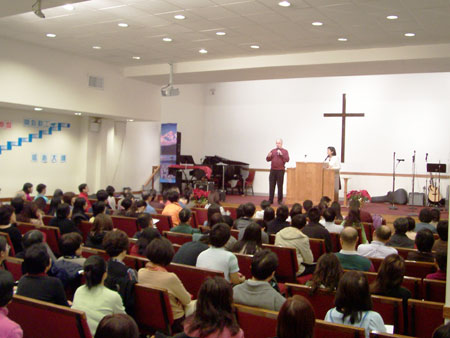
Here's a picture of me speaking in Faith Bible Church in New York City. I'll be going there to speak and teach Jan. 4-9. This powerful Chinese church has many people from the underground church in China. I've had some of them in my classes. It's very humbling to be with such real Jesus-followers who do so in the face of persecution.

Philip Yancey, interviewed here on his new book What Good Is God?, comments on the usefulness and reality of faith in God for Jesus-followers in persecuted nations. Yancey says that in China, for example, Christianity is different. Instead of praying "God, take away this burden," people pray "God, give me strength to bear this burden."

In America "church" is, for many, little more than a "social habit." But "in China, where you can be arrested and imprisoned for your faith, getting together with other Christians is a lifeline and you’ll risk anything for the privilege. No one attends church in China casually, or for a social advantage—quite the opposite."

Most Christians who read things like this may feel a little guilty about their own apathetic Christianity which translates into confessions like "I am so busy I just don't have time to pray," or "I'm so thankful to live in America and not China. They are so neurally locked into "Jesus as a social habit" that nothing is going to change.

But there is one thing that could bring change: persecution. Yancey says: "I once heard someone from a former Soviet country say that Christians there are praying for the return of oppression because under Communist days the church was pure and refined." And powerful, and threatening to the powers of darkness, like it now is in China. Like it was in the book of Acts.

Thursday, December 09, 2010

Rambling About Actual Infinites

One of my Logic students, Lindsay, asked some questions about the philosophy of mathematics. I pointed her to Stanford Encyclopedia of Philosophy's article. Now I'm reading it.

In the early 20th century three non-platonistic accounts of mathematics were developed: logicism, formalism, and intuitionism. It was unacceptable to think that numbers had an actual ideal existence in Plato's realm of the Forms.

I'm reading down to the section on intuitionism. "According to intuitionism, mathematics is essentially an activity of construction. The natural numbers are mental constructions, the real numbers are mental constructions, proofs and theorems are mental constructions, mathematical meaning is a mental construction, … . Mathematical constructions are produced by the ideal mathematician, i.e., abstracted from contingent, physical limitations of the real-life mathematician. But even the ideal mathematician remains a finite being. She can never complete an infinite construction, even though she can complete arbitrarily large finite initial parts of it. (An exception is made by Brouwer for our intuition of the real line.) This entails that intuitionism to a large extent rejects the existence of the actual (or completed) infinite; mostly only potentially infinite collections are given in the activity of construction."

Aha! The good old Craigian-Hilbertian "impossibility of an actual infinite." Or, perhaps not actually Hilbert's idea, since intuitionism's rejection of an actual infinite is based on the mathematician as a finite being who is, ipso facto, unable to complete an infinite series.

Hilbert was a "formalist." Natural numbers are not mental constructions as the intuitionists claimed, but are symbols. Note: if natural numbers have no ontological status then they are something like mental constructs, or maybe symbols. For Hilbert,symbols are abstract entities, "but perhaps physical entities could play the role of the natural numbers. For instance, we may take a concrete ink trace of the form | to be the number 0, a concretely realized ink trace || to be the number 1, and so on. Hilbert thought it doubtful at best that higher mathematics could be directly interpreted in a similarly straightforward and perhaps even concrete manner."

In that case, on Hilbert, an actual infinite is impossible because if numbers are symbols which can in principle be represented by physical entities, one could have a potential infinite but of course not an actual infinity of, say, ink traces.

See here, e.g.: "The question of how exactly Hilbert understood the numerals is difficult to answer. They are not physical objects (actual strokes on paper, for instance), since it must always be possible to extend a numeral by adding another stroke (and, as Hilbert also argues in “On the infinite” (1926), it is doubtful that the physical universe is infinite)."

Yes, It's Kevin Bacon


I have never, I think, posted about a TV ad. But now I must.

Yes, it IS Kevin Bacon. I can't take my eyes off that commercial. It funnier and deeper than all of "Benjamin Button." (Which is, of course, not saying very much.)

Nietzsche Was Not a Metaphysical Nihilist?

I saw these mints in Boston this summer.

Harvard philosopher Sean Kelly defines "nihilism" as: "the sense that it is no longer obvious what our most fundamental commitments are, or what matters in a life of distinction and worth, the sense that the world is an abyss of meaning rather than its God-given preserve." ("Navigating Past Nihilism") Kelly says this kind of nihilism "finds no sustained treatment in the works that Nietzsche prepared for publication during his lifetime." Which implies that many of us who have said that nihilism was very important to Nietzsche in the sense that Nietzsche struggled with it and strove to overcome it are not exactly right.

I'm listening. Initially I'm thinking that it seems unlike Nietzsche to give a "sustained treatment" of anything. Or, perhaps, we need to define "sustained treatment."

Kelly's new and forthcoming book, co-authored with the great philosopher Hubert Dreyfus, is All Things Shining: Reading the Western Classics to Find Meaning in a Secular Age. About this book Charles Taylor says: "Fascinating insights about the search for meaning in our time, and the threat of nihilism. All Things Shining raises fundamental questions about the religious and ethical developments of humanity since the Axial Age. This book tackles big issues, ones that really matter in our lives today." I'm still slow-cooking in Taylor's brilliant A Secular Age.

Philosopher Albert Borgmann says: “There is a world out there that is as concealed as it is crucial to the good life. Dreyfus and Kelly have lifted the veil with pedagogical skill and striking insights. It's a world of things shining that can lend grace and depth to our lives. The book is itself a shining thing.” Whoa! I deeply respect Borgmann, having worked through some of his texts, to include his brilliant Power Failure: Christianity and the Power of Technology.


I'm noting these reviews by a couple of really good thinkers, and concluding Kelly and Dreyfus's book will be a must-read. Now back to Kelly's article on Nietzsche and nilhilism. Here are the bullets as I see them.
  • When Nietzsche famously said "God is dead" he "could have meant is that the social role that the Judeo-Christian God plays in our culture is radically different from the one he has traditionally played in prior epochs of the West." That seems on target for me. Surely the "God" whom Nietzsche thinks has expired is the Judeo-Christian theistic God, who in my mind is the metaphysical foundation of value as understood in Europe at the time of Nietzsche. As Kelly says, at that time, a life well-lived was a Christian life. "Indeed, a life outside the Church was not only execrable but condemnable, and in certain periods of European history it invited a close encounter with a burning pyre."
  • Today in North America and Europe "religion no longer plays this role." Kelly is right again! While he doesn't use this term, the fact is that we now live in (in North America and Europe) a post-Christian culture. Whether or not we live in a post-religious culture will depend on how we define "religion." Surely, I think, there remains great and (for all practical purposes) universal metaphysical interest.
  • "God is dead, therefore, in a very particular sense. He no longer plays his traditional social role of organizing us around a commitment to a single right way to live. Nihilism is one state a culture may reach when it no longer has a unique and agreed upon social ground." I think Kelly is correct that, interpreting Nietzsche, God is "dead... in a very particular sense." But I would want to consider Nietzsche's nihilism as also possibly the idea that a culture or all cultures may have no social ground whatsoever. That would make things very bleak indeed. And if that were true then there's no "navigating" around it, and we are, as Nietzsche said, afloat on a sea with "an infinite horizon."
  • Kelly writes: "The threat of nihilism is the threat that freedom from the constraint of agreed upon norms opens up new possibilities in the culture only through its fundamentally destabilizing force." I don't think so. I need more evidence that what Nietzsche meant by nihilism meant only this. (Call this Nihilism 1.) I think Nietzsche can be read to mean the loss of a metaphysical foundation for "norms" at all. (Call this Nihilism 2.) Re. milder form of nihilism that can be navigated around Kelly says there is the opening up of  "a new sense of freedom." If this means we're without agreed-upon cultural norms but are now off on an adventure to discover some new ones, OK. But if the stronger version of nihilism is Nietzsche's meaning, then there is a kind of condemned-to-be-free situation but, as the "parable of the madman" can be read to say, we're on an adventure to nowhere.
  • But Kelly wants to read Nietzsche on Nihilism 1. He interprets Nietzsche from that viewpoint. So he can write:"Perhaps Nietzsche was wrong about how long it would take for the news of God’s death to reach the ears of men.  Perhaps he was wrong, in other words, about how long it would take before the happiness to which we can imagine aspiring would no longer need to aim at universal validity in order for us to feel satisfied by it.  In this case the happiness of the suburbs would be consistent with the death of God, but it would be a radically different kind of happiness from that which the Judeo-Christian epoch of Western history sustained."
  • Following an idea from Melville, Kelly thinks (and this is his godless hope): One can aspire "to find happiness and meaning, in other words, not in some universal religious account of the order of the universe that holds for everyone at all times, but rather in the local and small-scale commitments that animate a life well-lived.  The meaning that one finds in a life dedicated to “the wife, the heart, the bed, the table, the saddle, the fire-side, the country,” these are genuine meanings.  They are, in other words, completely sufficient to hold off the threat of nihilism, the threat that life will dissolve into a sequence of meaningless events.  But they are nothing like the kind of universal meanings for which the monotheistic tradition of Christianity had hoped.  Indeed, when taken up in the appropriate way, the commitments that animate the meanings in one person’s life ─ to family, say, or work, or country, or even local religious community ─ become completely consistent with the possibility that someone else with radically different commitments might nevertheless be living in a way that deserves one’s admiration."
  • With this possibility one thereby avoids the two extremes of "the monotheistic aspiration to universal validity, which leads to a culture of fanaticism and self-deceit, and the atheistic descent into nihilism, which leads to a culture of purposelessness and angst." Then, in a surprising move, Kelly says we can call this new option "polytheism." Because "there are nevertheless many different lives of worth, and there is no single principle or source or meaning in virtue of which one properly admires them all." I just find this odd and misleading.
Can one be happy without God? I believe so. Can one live an admirable life without God? To some degree, I am sure, especially if Nihilism 1 is true. But if Nihilism 2 is true the idea of living an admirable life strikes me as strange and desperate.

Finally, it is significant that recently J.P. Moreland and Dallas Willard have written on what it means to live life well. I expect them both to engage in this discussion soon.

    Jesus' Great-Grandmother Has NOT Been Identified

    OK - discover.com's article is: "Jesus' Great Grandmother Identified: Medieval legends suggest that Ismeria, a descendent of the tribe of King David, was the grandmother of the Virgin Mary."

    First of all, may heaps of academic shame fall on Discovery News for publishing this, which no scholar will believe, but which will influence the very few unscholared people who actually read it.

    Secondly, a big clue to the inanity of it all is" "Medieval legends suggest." "The great grandmother of Jesus was a woman named Ismeria, according to Florentine medieval manuscripts analyzed by a historian."

    Thirdly: "The legend of St. Ismeria, presented in the current Journal of Medieval History, sheds light on both the Biblical Virgin Mary's family and also on religious and cultural values of 14th-century Florence."

    In the fourth place (as I debated whether to write "Fourthly"): No "light is shed on the Biblical Virgin Mary's family" since "Lawless studied the St. Ismeria story, which she said has been "ignored by scholars." Well, it's a medieval legend, that's why! Jesus-culture-scholars agree that, the more recent the story-legend is, the less accurate it is. We're talking 14th and 15th century manuscripts here!

    Fifthly - "According to the legend, Ismeria is the daughter of Nabon of the people of Judea, and of the tribe of King David," wrote Lawless. She married "Santo Liseo," who is described as "a patriarch of the people of God." The legend continues that the couple had a daughter named Anne who married Joachim. After 12 years, Liseo died. Relatives then left Ismeria penniless." Joachim?

    Redeemer Ministry School: Laying a Foundation For a Life of Ministry

    If you are looking for a ministry school program that will provide a foundation that will last a lifetime then Redeemer Ministry School may be for you.

    We provide a 9-month intensive with three Trimesters.

    For example, courses for our Winter Trimester are:


    * Tuesdays, 9:30-1 Prophecy – (John Piippo & Josh Bentley)
    * Wednesdays, 9:30 – 1 - Kingdom of God II (Healing & Deliverance) (Josh Bentley)
    * Thursdays, 9:30 – 1 - Teaching/Preaching (John Piippo)
    *Fridays, 9:30 – 1 - Worship II (Holly Benner)

    In addition to these courses...

    * RMS students will travel with me to New York City Jan 3-8, where I will teach Spiritual Formation at Faith Bible Seminary (Chinese) + speak at their annual conference. RMS students will be immersed in Chinese culture, join in some worship projects with FBC, help FBC in some of their ministries, and lead a Friday evening worship experience for FBC.
    * Upon returning to Monroe RMS students will prepare for the arrival of Randy Clark and his team for Randy's School of Healing and Impartation - Jan. 12-15.

    RMS Spring Trimester courses are:

    * Leadership – Jim Hunter
    * Worship III – Holly Benner & Gary Wilson
    * Kingdom of God III (Historical Moves of God) – Josh Bentley
    * Apologetics - John Piippo

    AND... RMS students will prepare for an exciting week of the "Furious Love Event," with Darren Wilson, Heidi and Rolland baker, Greg Boyd, and many more.

    Our 2011-2012 RMS curriculum and events will prove again to be exciting and challenging. Why not join us?

    Lay a foundation for life.

    Wednesday, December 08, 2010

    The Apocalypse is Here

    I am really enjoying listening to Arcade Fire's "The Suburbs." It's very creative melodically and lyrically. It runs pretty deep, which means it won't sell as well as the many lesser musical offerings today.

    It's about the moments of dawning realization that your parents' American-dream-questing was both vain and destructive. Now there's a generation looking at the resultant rubble. This album is apocalyptic in that the apocalypse is already here.

    This is my first listen, and I am listening, and at times nodding my head in agreement. Listen also to the Beatles' influence, especially on "Deep Blue."

    First they built the road
    Then they built the town
    That's why we're still driving around and around
    And all we see are kids in buses longing to be free

    Endless suburbs stretched out thin and dead

    Well yeah! The utter vanity of stuff and the material life and, for that matter, the banality of the bad news of the "prosperity gospel."