Friday, August 30, 2024

Heaven, the Soul, and the Afterlife


This 4-session class will meet in person at Redeemer Church in Monroe, and will also be live-zoomed.


HEAVEN, THE SOUL, AND THE AFTERLIFE

RENEWAL SCHOOL OF MINISTRY

Dr. JOHN PIIPPO


You may have heard it said that some people are so heavenly minded that they are no earthly good.  But turn this on its head and we see that some people are so earthly minded that they are no heavenly good. In this class we will focus on a Christian understanding of heavenly-mindedness, and hope in, life after death.

We will respond to questions like these.

What happens to us when we die?

What will the afterlife be like?

How does the Bible describe the afterlife?

Why is it important to understand that you have a soul?

How can we know that persons have souls?

Will we be with our loved ones in eternity?

What will we do for all eternity?

How does belief in everlasting life inform how we now live on earth?

How do we talk with our children about death and the afterlife?

This is a four-week class. Monday nights. 8-9 PM EST. Begins Monday, Sept. 16, 2024. (9/16, 9/23, 9/30, 10/7)

Class sessions will be simultaneously in person at Redeemer Church in Monroe, Michigan, and live-zoomed.

Registration begins in August. $10 for the four class sessions.

INSTRUCTOR: Rev. John Piippo, PhD

John Piippo has taught spiritual formation, prayer, and presence-driven leadership in seminaries, conferences and retreats, around the United States and the world. John has written six books: Leading the Presence-Driven ChurchPraying: Reflections on 40 Years of Solitary Conversations with God, Deconstructing Progressive Christianity, 31 Letters to the Church on Discipleship, 31 Letters to the Church on Praying, and Encounters with the Holy Spirit (co-edited with Janice Trigg).

John currently is a Visiting Professor at Faith Bible Seminary (Chinese) in Flushing, NYC, and an Adjunct Professor at Payne Theological Seminary (A.M.E.) in Wilberforce, Ohio.

John was Adjunct Professor of Philosophy at Monroe County Community College for eighteen years (Logic, Philosophy of Religion, Western Philosophy)

John and Linda have been pastors at Redeemer Fellowship Church in Monroe, Michigan, since 1992. 

John has a PhD in Philosophical Theology from Northwestern University, and an M.Div. from Northern Seminary. 

John regularly blogs at johnpiippo.com.  

Why I Am Against Abortion


Image result for john piippo kids


(We must keep this ball in play.)

The reason I, and others like me, are against elective abortion is this: I/we believe the inborn conceptus/embryo/fetus is a human lifeNo human life is more defenseless and innocent than an inborn human life.

I believe it is morally wrong to kill innocent, defenseless human lives. I believe if you saw the inborn entity as an innocent, defenseless human life, you would feel the same as I and others do.

You would see abortion as human-killing. This would make you feel angry. This should make you feel angry.

I do not believe I, or you, have a moral right to kill innocent, defenseless human lives, no matter how they were conceived, no matter how inconvenient their existence is to us, no matter how unprepared we are to nurture them.

I see the following reasoning as immoral.

1. I am not prepared to care for you.
2. Therefore, I must kill you.

1. You do not fit into my life plans.
2. Therefore, I must kill you.

1. You are a product of rape.
2. Therefore, I must kill you.

1. I have the right to do what I want with my body.
2. You were part of my body. (This premise is false because incomplete.)
3. I did not want you as a body part.
4. Therefore, I killed you.


Here's one I heard this week.

1. People who are against abortion should care for unwanted babies.
2. People are not caring for unwanted babies.
3. Thus, people who are against killing babies are hypocrites.

Which leads to,

1. No one was there to care for you.
2. Therefore, we killed you.

If you are angry that not enough is being done to care for unwanted persons, perhaps God is calling you to do something about this, and not use it as some justification for killing persons. Thankfully, in Southeast Michigan, some people have taken this on. Several in our church family have responded to the call and are doing something for these unwanted babies.


***
See also...

Against Abortion: A Logical Argument


Thursday, August 29, 2024

Trust Disables the Agitated Heart


(Linda, at Weko Beach, Michigan)

In John 13 Jesus' disciples have just:


  •  seen Judas leave them, 
  • heard Peter confronted with his future denial of Jesus, 
  • and heard Jesus tell them he's leaving soon, by way of a horrible death. 

Understandably, this leaves their hearts "troubled," and they will encounter even more reasons to be disturbed in the hours to follow.

Knowing this, Jesus tells them, "Don't let your hearts be troubled. Trust in God. Trust in me." 


The word "troubled" can be translated "agitated." Some washing machines have an "agitator." It moves back and forth, back and forth. When a heart is agitated, it moves back and forth, back and forth. It is disturbed. Troubled.

Trust stops the inner agitator. 

Trust concerns an unknown future. It relates to things we have little or no control over. Which are: most things.


Trust and control do not go together. To do both is to be agitated.

The Greek word used in John 14:1 is pisteuo, which means: "personal relational trust" (Andreas Kostenberger, John, 425). I put my trust in someone, or something. I place my trust in a person, or persons. 


I have a friend who is a police office. He recently told me, "John, I don't trust anyone." I think he trusts me. It's taken him years to come to this. His work takes him into untrustworthy situations, every day. Trust implies risk. Can we trust this person?


No trust means no rest. No trust equals no peace. But where a person trusts, there is rest and peace. 


Where trust is, troubledness is not. Trust and troubledness do not logically coexist. Any place you are trusting is a place of non-agitation. 

This is good. We all need a refuge.

In life, trust in God; trust in Jesus. He then becomes the Quieter of our Souls. We find rest, in Him. 

Wednesday, August 28, 2024

Elective Abortion has Nothing to Do with Reproductive Health Care

(Bolles Harbor, Monroe)
(I'm keeping this ball in play.)

Crimestop means the faculty of stopping short, 
as though by instinct, 
at the threshold of any dangerous thought. 
It includes the power of not grasping analogies, 
of failing to perceive logical errors, 
of misunderstanding the simplest arguments 
if they are inimical to *Ingsoc, 
and of being bored or repelled by any train of thought 
which is capable of leading in a heretical direction. 
Crimestop, in short, means protective stupidity.

George Orwell
1984
P. 132

For example:
Abortion is Reproductive Health. 

Princeton jurisprudential professor Robert P. George, in Conscience and Its Enemies, argues that abortion has nothing to do with "reproductive health." So, the Reproductive Health Act, in an Orwellian move, is misnamed and, as such, misleading.

George writes:

"The question at issue in abortion is not “reproductive health” or health of any kind, precisely because direct abortions are not procedures designed to make sick people healthy or to protect them against disease or injury. Again, pregnancy is not a disease. The goal of direct abortions is to cause the death of a child because a woman believes that her life will be better without the child’s existing than it would be with the child’s existing. In itself, a direct (or elective) abortion—deliberately bringing about the death of a child in utero—does nothing to advance maternal health (though sometimes the death of the child is an unavoidable side effect of a procedure, such as the removal of a cancerous womb, that is designed to combat a grave threat to the mother’s health). That’s why it is wrong to depict elective abortion as health care." (Kindle Location 2777; emphasis mine)

Elsewhere George writes:

“A huge irony: The NY law authorizing the killing of babies in the third trimester PROVES that the aim of the abortion lobby is NOT the protection of maternal health in circumstances of hazardous pregnancy, but is rather the right to destroy an unwanted child whose existence poses no risk to maternal health (in any sense of the term ‘health’ that amounts to anything other than a rationalization for killing unwanted babies). The only reason to kill rather than deliver a child in the third trimester of pregnancy and gestation is that the woman (or someone who is pressuring her to abort) wants the child to be dead rather than alive. It's the child's *existence*, not the pregnancy, which poses the alleged, ‘health’ risk. The pregnancy can be ended (‘terminated’) by delivering the baby alive, rather than killing him or her. So do you see the see the sophistry in the argument for abortion here? It's glaring.”

In other words, if the mother's health is at risk, and the third-trimester child is **"viable" outside the womb, why not deliver the child rather than kill it? 

Because...   this baby is unwanted.

_____

* "Ingsoc" - The English Socialist Party, better known as Ingsoc, is the fictional political party of the totalitarian government of Oceania in Orwell's 1984.

** I see no good reason to accept "viability" as the tipping point for determining human value. "Viability" is another example of Orwellian "newspeak," meeting the ideological requirements of a secular political culture.

Monday, August 26, 2024

How I Abide in Christ


(April 17, 2020 - my front yard - SNOW!)

Jesus told his disciples that, if they abide in him, their lives will bear much fruit. "Abide" can be translated "to dwell."

Imagine Linda and I knock on your door. "We've come for a visit," I say. Presumably, you will let us in and put on the coffee. 

But if we knock on the door, and I say, "We've come to dwell with you," you are wondering if we are homeless.

To visit is a microwave, to abide is a slow cooker.

To abide in Jesus is to connect. Like a branch is attached to a vine. Jesus is the vine; I am the branch.

As I am a branch, the resources of the vine flow into me. I begin to produce the life of the vine. I produce VineLife.

To produce VineLife I must choose to do something. I cannot just sleep in my recliner while half-watching Netflix and expect to do what Jesus did. I must connect!

Here are ways I connect. And remember, when you connect to Jesus the Vine, your life will be fruit-bearing. It just will. You cannot be connected to Jesus and not be fruit-bearing. 

1. I meditate on Scripture. I read Scripture. When I read something that speaks to me, I assume this God, trying to tell me something. This makes me a slow reader! If you could see me reading Scripture you would see moments where I've got my eyes closed, my hand on my chin, and my body is still. 
When God speaks to me through a passage or verse in the Bible, I stop reading, and start meditating. I may write the verse in my journal. I often write it on a 3X5 card, place it in my pocket, and carry it with me.
For example, weeks ago, while reading through part of Proverbs, I came to this.


2. I keep a record of what God is saying to me. This is a spiritual journal. I often take time to re-read what God has been saying to me. I have gone through a lot of journals in the past fifty years! I recently bought a new one, which I like. Here it is.

3. I practice spiritual disciplines. The apostle Paul spoke of exercising in the spiritual gymnasium (going into "strict training"). Paul told me that, if I want to compete in the game of life, I must "exercise unto godliness." 
In 1981 a friend of ours, Dr. John Powell, gave me a copy of Richard Foster's Celebration of Discipline. John has been one of the most influential persons in my life (Linda's, too!). As I began to read this book, God was speaking to me. I read many books. But only a few have transformed my heart. This was one. My abiding life in Christ took a quantum leap forward! The connection-disciplines in this book became my spiritual DNA.   
The spiritual disciplines themselves don't produce the fruit. They provide the attachment. The Holy Spirit produces the fruit.

4. I pray. I have a praying life. I have done this for so many years Foster's book helped me here, too. He also wrote a beautiful book on prayer. (Prayer: Finding the Heart's True Home
In praying I speak to, and I listen to God. I have conversations with God. The discipline of choosing to pray has moved from my head ("I need to pray!") to my heart ("I pray to live!").
An excellent book on listening to God is Hearing God Through the Year: A 365-Day Devotional, by Dallas Willard.

In this season of my life I continue to read, slowly, Proverbs. And Psalms. I am also reading Ezekiel, slowly, from the Old Testament. And I am re-reading, slowly, the four Gospels - Matthew, Mark, Luke, and John.

One more suggestion. My book on prayer can be read devotionally. Praying: Reflections on 40 Years of Solitary Conversations with God.

I hope this helps - blessings!

Thursday, August 22, 2024

Undistraction Increases God-Attraction


                                                                (Masada, in Israel)


When I was a music theory major I had to take classes on individual instruments, 
one of which was piano. I had to learn some very basic piano skills. This, of course, 
required practice. 

The university music practice rooms were empty, except for a piano, a piano bench, 
and sometimes a chair for the teacher to occupy. Austerity was the rule. 
There were no pictures on the walls. It was the ultimate anti-sports bar environment 
(no multiple flat screen TVs). There was nothing to divert one's eyes and attention 
away from the focus, which was the instrument. 
You cannot learn the instrument without concentration.

I once had a student who was a Coptic monk. He lived at the Monastery of 
St. Anthony of Egypt of the Fourth Century. He called his room a "cell." 
His cell had only a bed and four walls that were bare except for a cross. 
A music practice room is like a monastic cell, each containing one thing, 
which is the object of one's focus.

Both rooms are spaces that promote purity of heart. They are places of least distraction; 
focused environments that are serious about purpose. There the distracted mind 
is channeled into the river where all things flow.

Jesus told his disciples to pray in their secret room (Matthew 6:6; tameion), 
with the door closed. These rooms were austere and bare-walled, except for 
perhaps symbols of a fish or a cross (see, e.g., James Charlesworth on the 
discovery of the house of Peter). 
The uncluttered prayer chamber facilitated focus on God. 
Undistraction increases the possibility of God-attraction.

Jesus often withdrew to lonely places where he prayed. 
(Luke 5:16) 

In such places praying is more effective.

Tuesday, August 20, 2024

Larry Sparks Interviews Me on Progressive Christianity


This interview happened two years ago (thank you Larry!). 

It's had 40,000+ views.

Thursday, August 15, 2024

Guard Your Mouth, Preserve Your Life


                                                                 (Redeemer sanctuary)

The book of Proverbs is a constant go-to devotional book for me. Proverbs has much to tell me about controlling my mouth. 

Those who guard their mouths preserve their lives; those who open wide their lips come to ruin. 

A fool takes no pleasure in understanding, but only in expressing personal opinion.

The words of the mouth are deep waters; the fountain of wisdom is a gushing stream.

 A fool’s lips bring strife, and a fool’s mouth invites a flogging.

The mouths of fools are their ruin, and their lips a snare to themselves. 

The words of a whisperer are like delicious morsels; they go down into the inner parts of the body. 

Death and life are in the power of the tongue, and those who love it will eat its fruits.

 A word fitly spoken is like apples of gold in a setting of silver. 

Proverbs 13:3; 18:2, 4, 6–8, 21; 25:11


Tuesday, August 13, 2024

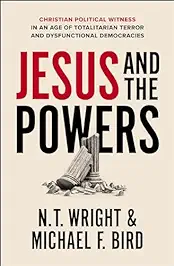
My Beach Reading: Jesus and the Powers


Linda and I are doing some short trips to Michigan beaches this week. We're celebrating anniversary #51. We love sitting together on the sand by the water, talking, snacking, dozing...  and reading.


Here's my beach reading.


Editorial Reviews

Review

'In a time when Christians face pressure to either remain silent about God's kingdom or conquer their opponents in its name, Wright and Bird call the church to choose neither. Christians have a vital role to play in politics at all levels of government. Yet as Wright and Bird explain, those who bear the name 'Christian' represent Jesus in their service and sacrifice, boldly speaking truth to power when necessary, neither in dominating their neighbors nor capitulating to evil. Can Christians defend pluralism and liberal democracy and remain faithful to King Jesus? Not only is it possible, Wright and Bird explain why they must.' -- SAMUEL L. PERRY, professor of sociology, University of Oklahoma, coauthor of The Flag and the Cross: Christian Nationalism and the Threat to American Democracy

'Wright and Bird help us situate where the church sits between presidents and principalities. Keeping politics out of Christianity is impossible, for Christianity is inherently political. Too many books on politics shortchange the biblical text. This book brings you back to the first century and then back again to the twenty-first century with tools pertaining to our public witness.' -- 
PATRICK SCHREINER, associate professor of New Testament and biblical theology, Midwestern Baptist Theological Seminary, author of Political Gospel: Public Witness in a Politically Crazy World

'An excellent, short pilgrimage in biblical political theology! With divisions and animosities running high within and among nations and with autocrats increasingly in charge, we need this book acutely.' -- 
MIROSLAV VOLF, professor of theology, Yale University Divinity School, founding director, Yale Center for Faith and Culture

'The rise of Christian nationalism in the United States, the rise of Buddhist nationalism and the coup in Myanmar, Russia's invasion of Ukraine, and the Israel-Palestine conflict all pose moral challenges in how Christians should faithfully witness to Jesus as the global lord of freedom. N. T. Wright and Michael Bird, whose lives have both been shaped by world empires in some way, have written a timely book on Jesus and the powers. Using the Bible as source and the kingdom of God as a theological foundation, they innovatively demonstrate how Jesus and his disciples' political witness against powers in the first century should be used as a contextual guide for the contemporary church's public witness against political powers of the regimes for the common good in the twenty-first century. This brilliant book is a fresh contribution to New Testament political theology today. It offers readers a nuanced understanding of the relationship between Christ, the kingdom, the church, and politics. This book is academic yet accessible, political yet pastoral. I highly recommend it to anyone working in the global academy, grassroots church, and public society.' -- 
DAVID THANG MOE, Rice postdoctoral associate and lecturer in Southeast Asian Studies, Yale University, review editor, International Journal of Public Theology

'Tom Wright and Michael Bird's individual contributions to New Testament scholarship, church life, and practical Christian living are immeasurable. This dynamic duo teams up again to draw attention to the relevance of Jesus and the Bible for our divided and fracturing world. Unthinkable only a decade ago, the very fabric of democracy is under threat. What was once stable and reliable is now in danger of collapse. Although this may be new to us today, it is not new to God's people. In some ways, topics and emphases in Scripture that were important for the earliest church are now relevant again. Wright and Bird help us reorient ourselves to implications of the gospel message for today's climate. Topics discussed include the kingdom of God, power, and the relationship between the church and secular authority. Wright and Bird's purpose is neither to promote some political agenda nor inform Christians how to vote. Circumstances and the Bible demand a more nuanced approach. Rather, they wish to help us understand the implications of the gospel for our daily interaction with the world and to act accordingly. In the end, this is a call for Christian action and a source of hope for the church today.' -- 
JOSEPH D. FANTIN, professor of New Testament, Dallas Theological Seminary

'Many Christians are asking afresh whether the Bible can be helpful for us in the 2020s to be fully committed followers of Jesus, on the one hand, and yet also be engaged in the political realm, on the other hand. The authors of this book have spent much of their lives attempting to understand the New Testament and here bring their decades of academic expertise, accumulated wisdom, and Christian convictions to bear on some of the most difficult but relevant questions at this nexus today, in particular how the church should retain its witness to the gospel while interfacing with the state and its various kinds of governments. Their invitation to explore what faithfulness means between Christian separatism and Christian nationalism is a gift especially to believers that hold Scripture to be normative for Christian faith and practice in a pluralistic world.' -- 
AMOS YONG, professor of theology and mission, Fuller Seminary

'Jesus and the Powers helps us think clearly and deeply about what Christians are called to be and do in our present day. It casts a vision that takes seriously God's call to engage in the work of service, sacrifice, and reconciliation to the benefit of everyone around us--in Wright and Bird's words, to 'build for the kingdom.' Any fellow Christians wrestling with the question, 'Where do we go from here?' would do well to receive what is shared within these pages.' -- 
ANDREW L. WHITEHEAD, associate professor of sociology, Center for the Study of Religion and American Culture, Indiana University-Purdue University Indianapolis, author of American Idolatry: How Christian Nationalism Betrays the Gospel and Threatens the Church

'Almost every Christian today struggles at some level to understand the political implications of the gospel: What have kingdom concerns to do with cultural crises, or the good news with the daily news? Under what circumstances is civil disobedience warranted? Can a Christian wholeheartedly support any political system? In Jesus and the Powers, you will find Mike Bird and Tom Wright neither fence-sitting nor drumbeating, but guiding Christians thoughtfully, practically, and jovially through a minefield of contemporary political and social questions with a careful commitment that draws deeply on the wisdom of the Bible.' -- 
CHRISTOPHER WATKIN, associate professor of French studies, Monash University, author of Biblical Critical Theory: How the Bible’s Unfolding Story Makes Sense of Modern Life and Culture

'At a time when discussions about Christian nationalism and debates over religion and politics too often involve more heat than light, Jesus and the Powers offers something different. Drawing on their expertise in biblical theology and on two millennia of global Christian history, Tom Wright and Mike Bird present a defense of liberal democracy that pushes back against the extremes of the Left and the Right. There are no easy answers here, but readers across religious and political spectrums will find much to grapple with in this sharply written text, and perhaps also a framework for the pursuit of mutual human flourishing in a polarized age.' -- 
KRISTIN KOBES DUMEZ, professor of history, Calvin University, author of Jesus and John Wayne: How White Evangelicals Corrupted a Faith and Fractured a Nation

'Jesus inaugurated his ministry by proclaiming the coming of the kingdom of God. What does that long-ago event have to do with us today? Everything, say the authors of Jesus and the Powers. The fundamental character of authentic Christian political activity, they argue, is 'building for the kingdom.' Using their skills as esteemed New Testament scholars, the authors first illuminate what Jesus would have meant by 'the kingdom of God' and then explore how present-day Christians can build for the kingdom. I know of no other book that comes even close to locating, so insightfully and in such rich detail, Christian political activity within the context of the coming of the kingdom. Given what is happening in politics today, their call for Christians to engage as workers for the kingdom could not be timelier.' -- 
NICHOLAS WOLTERSTORFF, Noah Porter Professor Emeritus of Philosophical Theology, Yale University

'This is an ambitious book of the sort that only two seasoned theologians and (equally important) true lovers of Jesus could conceive of and write. And it is a book Christians need in this time of war, political turmoil, and threats to human flourishing around the world--many of these, the fruit of arrogant earthly empires. What should the church's response be to such profound brokenness? And what should the response of individual Christians be? The book's arguments marry political theology with sound history, both ancient and modern, all to show that 'the kingdom of God is not from this world, but it is emphatically for this world.' History shows that other lords and kings will rise and fall, trampling others underfoot in the process, but there will always, only be one lord and king. And that is a call to action for us all.' -- 
NADYA WILLIAMS, author of Cultural Christians in the Early Church: A Historical and Practical Introduction to Christians in the Greco-Roman World

'In Jesus and the Powers, N. T. Wright and Michael F. Bird draw on a wide array of historical, biblical, and theological resources to offer a much-needed contribution to discussions regarding Christian faith and politics. They present a broad theopolitical vision of how the church should relate to empire that will exhort, challenge, correct--and at times likely provoke--their readers. Their arguments reach an international audience and transcend the particularities of contemporary politics to point readers back to the heart of Christian life and witness: serving Jesus our king and advancing the kingdom of God.' -- 
AMY E. BLACK, professor of political science, Wheaton College

'In our unsettled and polarized world, it is as easy to be tempted by the solutions offered by those on the extremes as it is to put our heads in the sand. Bird and Wright remind Christians that Jesus truly is king and the hope of the world, and they encourage us toward steady faithfulness when it is easy to be swept away by the shifting winds of historical and political circumstance. Read this book, remember 'the old story,' and pursue public faithfulness while resting in truth.' -- 
VINCENT BACOTE, professor of theology, director of the Center for Applied Christian Ethics, Wheaton College

About the Author

Michael F. Bird is Deputy Principal and Lecturer in New Testament at Ridley College,?Australia. He is the author of numerous scholarly and popular books on the New Testament and theology, including, with N. T. Wright, The New Testament in Its World (2019).


N. T. Wright is the former bishop of Durham and senior research fellow at Wycliffe Hall, Oxford University. He is one of the world’s leading New Testament scholars and the award-winning author of many books, including?After You Believe,?Surprised by Hope,?Simply Christian,?Interpreting Paul, and?The New Testament in Its World, as well as the Christian Origins and the Question of God series.


Sunday, August 11, 2024

What Love is Not. What Love Is.

                                                         (Cross, in Redeemer's sanctuary.)

Two years ago, at Redeemer, Tim Curry and I co-preached on "Love: What It Is; What It Is Not." (Message HERE.)

I began by sharing how Tim and I have seen our church family expressing and manifesting the love of God, Our church family is one that loves by serving one another, and serving beyond the walls of the church building. For many of our people, servanthood is a lifestyle. It is their character, We have not yet fully arrived, but we are being formed into the character of Christ. (Galatians 4:19)

"Love" is an often-used, often misunderstood, often abused word. Over 100 million songs have been written about love. 60% of all songs ever written are about love. Last week I think I looked at all of them. My conclusion is that ninety-nine million are about self-gratification. They are, in Pauline language, flesh-indulgent.

They are contrary to the ways of the Holy Spirit. (Galatians 5:17) 

The biblical Greek word for 'love' is agape. Agape, and its other forms (e.g., the verb agapao), appears 320 time in the New Testament. Philieo (friendship-love) appears fifty-five times. What about eros, the word for sexual desire? Eros does not appear, at all, in the New Testament.

Eros is massive in the "love" songs of today. So many are about the gratification of desire. But desire is not central to love, because desire is consumptive. When I say "I love Klondike bars, what I'm really saying is, "I want to consume Klondike bars." 

Agape love is poles apart from desire-fulfillment. John Stott defined agape love as the sacrifice of self in the service of another. In other words, it is a voluntary giving of yourself. This is the Galatians idea of agape as a fruit of the Spirit. Agape love is profound concern for the well-being of others, with no expectation of getting something in return, with no expectation of even getting a “thank you.”

For followers of Jesus, what is the meaning of "love?" At this point in yesterday's sermon Tim and I pointed to the large wooden cross in our sanctuary. And said...

...This is love...,

...There is no greater love.

The connection between agape and servanthood is solidified in Galatians 5:13.

Do not use your freedom to indulge the flesh,

Instead, use your freedom to serve one another, humbly, in love.

The agape love of God is radical, revolutionary, and dismissive of all cultural narcissistic "loves." It is, as Paul writes, "contrary" and antithetical to flesh-desire. 

When it comes to knowing love and loving others with agape-love, I am not turning to the flesh-songs of today. The love of God, which is real love, foundational love, and about which there is no greater love, is essentially other-centered.

Greater love [agape] has no one than this: 

to lay down one’s life for one’s friends.

Saturday, August 10, 2024

Pastors Enter Into The Grief of Others


                                                                  (Our grandson Levi.)

I became a youth pastor in 1971. I've been pastoring ever since - for fifty-one years.

A major part of a pastor's job description involves being with grieving people. We are caregivers and comfort bringers to suffering people.

A pastor enters into the grief of others. We have been trained to do this. Many pastors do this with excellence. 

Not a week goes by without one or more grief-stricken people contacting Linda and I for help. In this, we are not exceptional. Every pastor does this.

Here are some of the ways I have done this, over five decades. I present this to you as non-exceptional pastoral ministry. Every pastor who views their calling as a shepherd to others knows about this. Every shepherd-pastor has a list like mine. 

We do funerals. 

We meet and pray with people who have lost loved ones. 

We weep with those who weep.

We comfort parents who have lost children.

We comfort young people whose siblings overdosed and died.

We are with families and friends who have lost someone to suicide.

We respond in the middle of the night to crisis phone calls.

We meet with victims of murder.

We meet with murderers.

We visit people in prison.

We care for the suffering and dying.

We have been with people as they took their last breath.

We spend a portion of our time with the hospitalized.

We counsel adulterers and their survivors.

We rescue marriages and families.

We cry with the victimized.

We help the helpless.

We bring hope to the hopeless.

We have time to talk with hurting people.

We pray with people.

We befriend outcasts.

We agonize over the sufferings of others.

We counsel those grieving their moral failures.

Sometimes we are just there, with grieving people, saying little, or nothing.

We do none of this perfectly.

Every pastor I know does these things, and more.


***

SEE ALSO...

To Love Deeply Is to Suffer Deeply