Saturday, January 25, 2020

DISCIPLESHIP: PART 2 - THE LORDSHIP OF CHRIST (Sermon)

(Redeemer)

Is it possible to have Jesus as Savior, but not as Lord? I give my answer in my January 19 sermon. You can listen to it HERE.

Friday, January 24, 2020

Thursday, January 23, 2020

Pseudo-Independence As a Sign of Depression


I've seen the following several times: X ends their marriage and declares to the virtual world "I am now free!" X's cyber twins applaud the announcement of X's Independence Day. X celebrates this for some days, responding to the congratulations.

I saw another one of these rituals recently. Why did I doubt, in this recent case, that X was really "free?" [I counseled X many years ago.]

Brown University medical psychiatrist Peter Kramer writes that, "To act from independence is one thing, from compulsion, another." (Peter Kramer, Against Depression, 91) The difference between the two is the difference between free will and the determinism that mental illness imposes.

What often seems like an act of independence out of one's free will is actually the polar opposite (or a variation thereof); viz., of bondage. That's what I thought about X. Was X really not free, and just responding to an unsatisfied urge to placate their depression?


Thomas Merton once wrote that anyone who smokes a cigarette every time they feel the urge to do so is not free, but enslaved. The person who has sexual intercourse every time they feel the urge to do so is not free, but in bondage to their urges. As I write this I am desiring a bowl of ice cream. Should I leave the keyboard, and hustle to the freezer, am I free?

One sign of freedom is the ability to choose against one's urges or feelings. In such cases one is not psychologically, or clinically, compelled. 


Kramer tells the story of a woman named "Mariana" who appears, to her suitor "Harry," to march to the beat of her own drum. Kramer writes: "Often, these traits signal independence. They indicate confidence...  [But] In this instance, I thought, the identical behaviors signal illness."


It's hard to judge between the two. How many times, in ministry, have I been fooled?! Yet I have seen the real thing.


Usually, my clarity about X's freedom comes after months and years of changed behaviors. I don't spend a lot of time trying to judge whether the person is free or not, but over the years a number of misjudgments cause me to be more cautious. The person who on a Sunday morning declares their freedom is, at times, exhibiting a knee-jerk reflex.

People who shout about their "freedom" from sexual promiscuity while being oblivious to their bondage. Conversely, people announce their liberation from sexual fidelity. Their friends misread the social cues as signs of an independent person, which is like looking at water and pronouncing it wine. 


Kramer writes: "The social response to depression gives rise to paradox and oxymoron" (93). The depressed,  psychologically determined person, in their self-proclaimed freedom, appears liberated.


This is pseudo-independent behavior, false freedom. Kramer says it is often a signal of depression.


***

I write about prayer as God-dependency in my book

 - Praying: Reflections on 40 Years of Solitary Conversations with God. 

Wednesday, January 22, 2020

Killing More Babies in the New York Times

(Trees in my backyard)

To Ylanda Gault, having an abortion is the emotional equivalent of having dimples, or having a mole on one side of her face. So she says in today's New York Times, in "I'll Never Be Ashamed of My Abortion.

This upsets me. It trivializes those of us who believe abortion is the taking of an innocent person's life.

The reason I am saddened by articles like this is because I believe the inborn life is a person. Now note this. If the inborn life is a person, then abortion is killing a person. If the inborn life is not a person, we kill non-persons all the time. The real issue is over the status of the inborn life, irregardless of their developmental level.

Here is how Gault's article reads to me, as I substitute "kill my baby" for her euphemistic freedom-to-abort words.


  • I'll never be ashamed of killing my baby.
  • Like so many women of reproductive age, I've killed my baby.
  • I, and I alone, made the decision to kill my baby more than a decade ago so that I could be the best mother I could be to the two children I already had.
  • Roe v Wade guaranteed a woman's freedom to kill her baby.
  • Despite what some politicians would have us believe, most Americans support that right to kill their babies.
  • We must not allow some warped, anti-feminist ideology to take away our freedom to kill our babies.
  • What’s most important is that we stand together and stand up against the beat-down on sexual and reproductive health (the right to kill our babies) in this country.
  • If our constitutional right to safe, legal baby-killing is not upheld, more than 25 million Americans of reproductive age could lose the freedom to decide if and when to kill their babies. 
  • What I took for granted — the freedom to kill their babies  — is a right my daughters and their daughters may well be denied.
  • This is not complicated or political. When you have bodily autonomy and the freedom to kill your babies, you are able to thrive.
  • Nearly 15 years after killing my baby, I am at peace. I now have three children, ages 12 to 20. The most important gift I can give them is the best me I can be. My daughters and my son know I killed their sibling just as they know I have a mole on one side of my face, and dimples.
  • Research shows the most common post-baby-killing  feeling is relief. Ninety-five percent of us do not regret killing our inborn children
Gault says she is not ashamed of killing her baby. For the many who believe abortion is taking an innocent human life, we are both ashamed and grief-stricken.

***
See also:


Against Abortion: A Logical Argument


Monday, January 20, 2020

Saturday, January 18, 2020

A New Discipleship Movement in the Church?

(Back of street sign, in Ann Arbor.)

Tired of the Entertainment Church?

Tired of the Consumer Church?

Both are geared to keep the people happy and coming back, so as to maintain the infrastructure.

Many young followers of Jesus may be tiring of this. That's good!

Joseph Mattera, writing in Charisma Magazine, believes things may be changing in 2020. Wouldn't this be hopeful? Mattera writes:

"The crowd-based CEO model of church continues to disillusion young people looking for true community, authenticity and a people to call family. Those viewing the profound discipleship movement that is christianizing nations like China and Iran (without big buildings, budgets, social media marketing, paid staff and worship teams) are longing for the same kind of biblical pattern in Western churches.
I believe 2020 is the year when more and more leaders will attempt to build "disciple making movements" rather than mere convert-based churches. The corporate business model of doing church—which took off in the 1980s—has proven that, irrespective of the crowds they garner, they usually fail at disciple making. Jesus proved that focusing on disciple making was the key to building the largest and most effective movement the world has ever seen!
This will be the year when disciple making will gain the traction needed to eventually challenge the assumptions of the "CEO convert driven" model of church."

Thursday, January 16, 2020

You Are the Answer to Someone Else's Prayer


Related image
Jerusalem

 Often, while praying, my mind wanders to a person. I feel God placing this person on my heart, as a burden. This can mean I am the one God is going to use as God's answer to that person's prayer. 


For example, several years ago, I felt led to pray for X. While praying, I did not know that X had just left his work space, found a place where he could be alone in his office building, and was praying. 

X's spouse had a sexual affair with another man. She filed for divorce. X wanted to secure help for their marriage. She refused. 


That morning X received a phone call from his father. "Your mother has cancer. She's not expected to live much longer." X felt his knees buckle, his breathing difficult, the weight too much to bear. X had to get alone with the only One who could make a way where there seemed to be no way. X prayed, "God, help me... Help us!"


I was alone, in my backyard by the river, sitting in my prayer chair, as X was appealing to God. I already knew about X's evil-assaulted marriage. As I was prayed the thought came to me, "Call X now." I did. I believed this thought was coming from God, to me.


I have learned, over years of praying, listening, and risking, that God often comes as an interruption, in my "wandering mind." What could I lose from calling X to check in? This was a no-fail spiritual situation.


I called X. He answered, "I can't believe you called me. I couldn't stay in my work space, and had to get alone with God. I was asking God for help. And then you called!"


We agreed this was no coincidence. It was the orchestrating work of the Holy Spirit. I was God's answer for X, at the time.


When you pray, listen for the voice of God. When an interruptive thought comes, check it out. You begin to discover that such things can be from God. This increases your faith and expectation. You are being used by God to help others in their prayer-cries for mercy.


This is God saying, "I hear X's cry. I am going to answer X's prayer by placing the thought of X in John's mind."


***
My two books are:

Praying: Reflections on 40 Years of Solitary Conversations with God

Leading the Presence-Driven Church

Tuesday, January 14, 2020

The Dangers of Preaching

(Jax, Josh's cat)

One of my pastor friends saw I was leading our church in a week of reading The Sermon on the Mount (Matthew 5, 6, and 7.

He wrote me and said:

"Dangerous. Counter-cultural. Got me in trouble when I preached through it. I would do it again. May the radical words of Jesus read you even more as you read them."

Dangerous? Yes.

A pastor could get "voted out" (what a silly thing) of his church.

Counter-cultural? Correct.

Can get you in trouble? It did for Jesus, right?

Letter to My Redeemer Family (1/14/20)

(My back yard, when snow used to fall in Southeast Michigan.)

(I sent this letter to my Redeemer family this morning.)

Good morning Redeemer family! 
 
I am taking time this morning to slowly read Matthew, chapters 5, 6, and 7. I just read the NIV translation Sunday night and yesterday. Now, I'll read in The Message.
 
I read slowly. I often stop on a verse, and ponder it. If I feel God is speaking to me through this verse, I'll write it down in my spiritual journal. God is already speaking to me about some things!
 
I am praying for YOU as you do this with me.
 
 
AND...
 
Holly's Worship class meets again this Thursday, 6:30.
 
REDEEMER YOUTH - Linda Piippo (my wonderful wife, and new grandmother!) will speak to our youth on "Take Your Ground." 7 PM.
 
MY SECOND MESSAGE ON DISCIPLESHIP will be this Sunday morning.
 
Followed by our ANNUAL CHILI LUNCHEON AND COOK-OFF. (A package containing my secret chili ingredient arrived yesterday!)
 
God is so good, isn't He? Blessings!
 

PJ


Monday, January 13, 2020

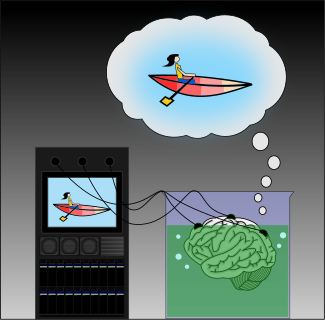
You Are Not a Brain Connected to a Computer


Image result for brain in a vat

In the first "Matrix" movie we are given a version of the old "brain in a vat" problem. Neuro-philosopher David Chalmers writes:

"The Matrix presents a version of an old philosophical fable: the brain in a vat. A disembodied brain is floating in a vat, inside a scientist's laboratory. The scientist has arranged that the brain will be stimulated with the same sort of inputs that a normal embodied brain receives. To do this, the brain is connected to a giant computer simulation of a world. The simulation determines which inputs the brain receives. When the brain produces outputs, these are fed back into the simulation. The internal state of the brain is just like that of a normal brain, despite the fact that it lacks a body. From the brain's point of view, things seem very much as they seem to you and me." (Chalmers, The Matrix as Metaphysics)

How do we know we are not really just a brain hooked up to a computer? I now believe I am typing on my laptop's keyboard. I believe I see letters formed on the computer screen. But if I am only a brain in a vat, all this is as unreal as Neo's beliefs that he lives in a city, has hair, and works in an office.

Philosopher Evan Fales gives this proof that neither I, nor you, are brains being manipulated by a computer. ('BIV' stands for "brain in a vat.")

1. If I were a BIV, I could not think the proposition: “I am a BIV.” 
2. I can think the proposition: “I am a BIV.” 
3. Therefore, I am not a BIV.


(In L. Walls and Trent Dougherty. Two Dozen (or so) Arguments for God: The Plantinga Project. Evan Fales, "The Putnamian Argument (the Argument from the Rejection of Global Skepticism) [also, (O) The Argument from Reference, and (K) The Argument from the Confluence of Proper Function and Reliability] PUTNAM’S SEMANTIC SKEPTICISM AND THE EPISTEMIC MELT-DOWN OF NATURALISM: HOW DEFEAT OF PUTNAM’S PUZZLE PROVIDES A DEFEATER FOR PLANTINGA’S SELF-DEFEAT ARGUMENT AGAINST NATURALISM.")

The argument is logically sound. That is, if the premises are true, the conclusion follows deductively.

Premise 1 is true. A proposition is a statement that is either true or false. If I am a BIV I could not, in principle, think (know) I am a BIV, since all I think is manipulated and illusory.

Premise 2 is true. In the same way, I can think "I am a unicorn,: or "I am a tree frog."

Fales explains:

"This argument wouldn’t offer a defense against BIV skepticism if metaphysical realism were true. According to the metaphysical realist, there is a way the world is, independently of what we think, a way that satisfies some One True and Complete Description. That one true description is what one would know if one had, as it were, a God’s-eye view of the world. (From such a perspective as that, it might turn out that I am, after all, a BIV. But if I am, then I couldn’t have the thought that I’m a BIV. To be sure, it would be possible for me to have a thought that is notionally the same as the God’s-eye thought that I, Evan, am a BIV. But my thought wouldn’t represent, or express, the same proposition, because, if I am a BIV, I wouldn’t be able to think about vats— or brains, for that matter.)"

Therefore - and it is indeed good news - you are not a brain in a vat.