Monday, January 06, 2025

Part of My Ministry is Meeting with People Who Have Questions


                                                                        (Monroe, MI)

(Adapted from my book Deconstructing Progressive Christianity.)

One complaint progressive Christians have is that they were never allowed to question beliefs about God, and other biblical matters. One thing we see when progressives chat on social media is bitterness about their former churches, and how oppressive the pastors and leaders were. Sadly, some of that is true. 

For me, as a philosopher-theologian [PhD, Northwestern U., 1986], I invite questioning. Imagine 50+ years of meeting with people who  want to ask questions about Christian beliefs, such as the existence and nature of God. I never turn them down. 

Philosophy is the discipline that demands questioning. Of everything. Of the meta-issues (do I exist; metaethical matters; epistemological obstacles; how do words refer; etc.) 

We philosophers are trained to evaluate, and not to affirm, until the evaluation is sufficient. So, I question many things, including progressive Christianity. I am skeptical about the metanarrative progressive Christianity offers me. I read Richard Rohr and John Shelby Spong and Brian McLaren and Rachel Held Evans and Marcus Borg and you-name-them, and I question them. I question the postmodern claim that we cannot know objective truths, which would mean, we can’t know about God. (And which devalues science.) 

Progressive Christians who love questioning should rejoice that I am doing this! (p. 77)


Sunday, January 05, 2025

Transitioning to a Presence-Driven Church: Step One


(Grand Haven, Michigan)

When I do a "Presence-Driven Church conference or retreat, some ask the question, "What do we do now?" Here is how I see this.

Step One in transitioning to a Presence-Driven Church is this: the pastors/leaders  must engage in the ongoing abiding life. 

Do not view these teachings as tools for ministry. Rather, see yourself as instruments of righteousness being formed by the Father's hands. This is all about relationship with God, not programming the church. You need to spend time alone with God, otherwise you will not really understand, and you will not be credible.

Seek God, spend much time with God, for the sake of your own restoration and transformation. Begin to live in constant, abiding renewal.

Along the way, share stories of what God is doing, transformationally, in you. 

It is crucial that you not try to program this, or strive to make things happen. This is a slow-cooker, not a microwave.

In my experience, many Westernized pastors do not do this. And, among those who attend my classes and seminars, most do not continue in this. They fall back into the rut of, "I don't have enough time to pray."

For many pastors the praying life will be a revolutionary change. There will be resistance. Therefore, begin today, not tomorrow. Carve out relational time with God. This "step" is to continue and grow and increase until the day you stand fully in God's presence.

Remember how God spoke to you at the conference? Remember how restoring and renewing your solitary times with God were? It can be the same today. God did not remain at the conference center. He, Immanuel, is with you, presently. Trust and abide in him.

Don't force the issue with your people. Do not try to make things happen. Of course you want to share your experience with your people. But I suggest deepening the experience in yourself first. Pray, today, like you did at the conference. Do not bypass this step. (Refer to my book Praying about this.)

Slow-cook in God's presence, for weeks. Re-familiarize yourself with your God. "Forget about yourself, concentrate on Him, and worship Him." Tend the fire within.

With greater, growing familiarity, comes increasing discernment. Discernment is in direct proportion to familiarity. God will show you what to do, and when to do it.

Lead by being led. The Lord is your shepherd. You will not be wanting. And, you will bear much fruit.

Find another (or more) pastor-leader, and share together your experiences with God.

Then, along the way, discernment increases. God will lead you to lead your people into the abiding life, into God's beautiful, empowering presence.

When God says "Now!" preach, and teach, out of John chapters 14 & 15. 

***
My leadership book is Leading the Presence-Driven Church.

Thursday, January 02, 2025

How to Help a Troubled Marriage

(Downy woodpecker in my backyard)

One of my "go-to" books for marriage counseling is Hope-Focused Marriage Counseling: A Guide to Brief Therapy, by Everett Worthington. 

Worthington says "troubled marriages usually show weaknesses in love. Love is being willing to value your partner and being unwilling to devalue your partner. Generally, troubled marriages are those in which each partner devalues the partner and fails to take opportunities to show and tell the other how much the partner is valued.

A troubled marriage is one in which partners devalue each other and fail to take every opportunity to value each other. Generally, also, as love has lessened people lose confidence that the marriage can ever improve, and their demoralization and loss of hope prevent them from working on changing the relationship. 

Marriage Solutions 

Do the following, as a beginning.
 
□ Regain a willingness to work on improving your relationship and sustain that willingness long enough so that the marriage can bounce back. The worse off your marriage is now, the longer you must be willing to work to change it before you give up. 

□ Focus on the good things that you do. If you focus on the successes and try to ignore the failures for a period, you’ll regain a sense of faith in the relationship and confidence that it can improve. 

□ Increase your efforts to value your partner in love at every opportunity, and increase your efforts to avoid devaluing your partner. To improve, love your partner more by valuing him or her."  (Worthington, p. 82)

What is "love?"


"Love as being willing to value the other person 
and being unwilling to devalue that person."

Worthington, p. xxix

Wednesday, January 01, 2025

Which Church Is Yours: Dragon, or Lamb?


Image result for john piippo
(Monroe County)
Pastors - I recommend reading:

Letters to the Church, by Francis Chan (See also this recent interview with Chan)

The Way of the Dragon or the Way of the Lamb: Searching for Jesus' Path of Power in a Church that has Abandoned It, by Jamin Goggin and Kyle Strobel

And one more - my book Leading the Presence-Driven Church. 

All three are about Spirit-led, Spirit-driven, Spirit-empowered churches. All three come out of deep concern for the American Consumer-Driven Church.

Goggin and Strobel, in their interview with Eugene Peterson, describe the American Church as following the "way of the dragon." Peterson writes:

"We choose: we follow the dragon and his beasts along their parade route, conspicuous with the worship of splendid images, elaborated in mysterious symbols, fond of statistics, taking on whatever role is necessary to make a good show and get the applause of the crowd in order to get access to power and become self-important." (In Goggin, p. 138)

Here is "the way of the lamb":

"Or we follow the Lamb along a farmyard route, worshiping the invisible, listening to the foolishness of preaching, practicing a holy life that involves heroically difficult acts that no one will ever notice, in order to become, simply, our eternal selves in an eternal city. It is the difference, politically, between wanting to use the people around us to become powerful (or, if unskilled, getting used by them), and entering into covenants with the people around us so that the power of salvation extends into every part of the neighborhood, the society, and the world that God loves." (Peterson, in Ib.)

Goggin and Strobel write:

"The way of the dragon is fixated on the spectacular, obsessed with recognition and validation, intoxicated by fame and power. The way of the Lamb is committed to worship, pursues God in the ordinary, and is faithful in hiddenness. The dragon devours and dominates, while the Lamb humbly and sacrificially serves." (Ib., p. 139)

They summarize the two ways as follows.

First, the way of the dragon . . .   


  • The pastor uses the church as a platform for personal fame, fortune, and influence.   
  • The pastor views ministry as an arena of performance, where some win and some lose.   
  • The pastor uses the people of the church as tools to accomplish their big dreams.   
  • The pastor relegates prayer and care, the heart of pastoral work, to “lower-level” staff because they don’t have time to waste.   
  • The pastor views other pastors primarily as competition. 


Second, the way of the Lamb . . .   


  • The pastor gives their life for the sake of the church, regardless of what they gain.   
  • The pastor views ministry as an arena of love and service, not winning and losing.   
  • The pastor embraces their congregation as people to know and love, not tools to use for other ends.   
  • The pastor views prayer and care as the centerpiece of their work, rather than an interruption.   
  • The pastor views other pastors not as competition, but as fellow shepherds on the journey whom they need for encouragement and wisdom, and who they are called to encourage and love.

Monday, December 30, 2024

Four Biblical Resolutions for the New Year

 I have written these on a 3X5 card and am carrying them into the new year.


Sunday, December 29, 2024

The Cure for Entitlement and Victimization


Sleeping Bear Dunes, Michigan


(There are many true victims. This post is not about them.)

I recommend John Townsend's book The Entitlement Cure: Finding Success in Doing Hard Things the Right Way.

One of the bitter fruits of entitlement is externalization. Townsend writes: "People with an attitude of entitlement often project the responsibility of their choices on the outside, not the inside. The fault lies with other people, circumstances, or events. They blame others for every problem." (p. 61)


The worship songs of externalization are...


"It's Them, It's Them, It's Them, O Lord, Standin' in the Need of Prayer," and...

"Change Their Hearts, O God." 

Externalization-people fail to look at their part in their problems. "Instead, they default to answers outside their skin. The result? They tend to be powerless and unhappy. They tend to see life through the eyes of a victim. And their suffering is unproductive — it doesn’t get them anywhere." (Ib.)

The classic victim mentality is:


"Yes, I did what was wrong. But you forced me to do it." The "victim" persists in recruiting other people for the self-justification of evil. In this they destroy others, along with own soul.

Entitled people rarely say "thank you." Because they are deserving. Instead, they blame

"Blame," writes Townsend, "is a first cousin to entitlement." 
The constant blamer is the perpetual victim. 

The antidote to this bondage is to take responsibility for your own choices and attitudes. Be open to seeing yourself as the problem. Reject a global victimization that views yourself as someone who is always being "done to," and own your own part in your problems. 

Forgive those who have trespassed on your heart. 

Take responsibility for your own trespassing.

Saturday, December 28, 2024

How I Prepare for a Sermon


(I re-post this periodically to keep it in play.)


1.  I print out the biblical text and carry it with me throughout the week.

2.   I meditate on the text. I read it over and over and over. I let it get into me. As I am doing this, God speaks to me. I write down what God says to me.

3.   I ask these questions:
a.   What is the text saying?
b.   What is the text saying to me?
c.   What will this text say to our people?

4.   I study the text.
a.   I use biblical commentaries.
b.   The rule is: not just any commentary will do. Find trusted Jesus-following scholars who have invested their lives in studying the text. I have a list of trusted names. For suggestions, see 
c.   When God speaks to me while I am studying the commentaries, I write it down.
d.   I take notes on the commentaries. These notes appear in my sermon notes.

5.   As I am doing these two things – meditation on the text, and study of the text – I type out the sermon, often word-for-word, that God wants to speak through me.

6.   I take these notes and walk with them…, reading them over and over…  take drives in the car with them…  go to the state park overlooking Lake Erie and preach them (see photo above.). It always happens that, while doing this, God preaches to me. This gets emotional for me. I feel passion building towards the text, and what God has said, and what God is saying to me, and what God is going to say on Sunday morning.

7.   When I preach on Sunday morning, I want to know that I have given my entire self to preparing for this message. I never step up to preach without having given it my all. Average sermon preparation time each week is 10-20 hours. (Because, I cannot get away from it. It consumes me!)

8.   I feel a holy responsibility in preaching. I do not want to lead my people in the wrong direction. Therefore I study long and hard. And, I pray the text,

9.   I always have the expectation that God is going to show up, and make my mere human words into words from Him, for us all.

10.               With my focus on meditating on the text, and studying the text, and praying the text, my belief is that God, in the sermon, will give me and my people words from Him that are rooted in Scripture but provide extrabiblical revelation – viz., “now-words from God.”

11.               As I preach, I give God the right to lead me, even into things that I have not yet thought of. Usually, God does a fair amount of slicing and dicing my message into His message.

12.               If my people are spoken to by God, rather than being impressed with some “great sermon,” then I know the real thing has happened.

13.               I assume and expect God will do something through the preached Word. I am alert and attuned to this. Sometimes, even while preaching the message, I don’t know what God will do when the message is done. At other times I have a strong sense of what God wants to do, and I lead my people in this. In no way do I think I’m going to end the message with an “Amen” and then say “We’re out of here.” The preached word is going to bear fruit in people’s lives, immediately. The preacher needs to respond to this, and lead their people. 

Thursday, December 26, 2024

My Favorite Devotional Books


Over the years I have used several devotional books. The one that has been most valuable to me is:

A Guide to Prayer for Ministers and Other Servants, by Reuben Job and Norman Sawchuck.

 Others I find valuable are...

A Year with C. S. Lewis: Daily Readings from His Classic Works, by C.S.L.

Seeking the Kingdom: Devotions for the Daily Journey of Faith, by Richard Foster

You Are the Beloved: 365 Daily Readings and Meditations for Spiritual Living: A Devotional, by Henri Nouwen

Bread for the Journey: A Daybook of Wisdom and Faith, by Henri Nouwen

God Is With You Everyday: 365-Day Devotional, by Max Lucado

A Year with Thomas Merton: Daily Meditations from His Journals, by Thomas Merton

Hearing God Through the Year: A 365-Day Devotional, by Dallas Willard

Faith that Matters: 365 Devotions from Classic Christian Leaders, by Eugene Peterson, Brennan Manning, A. W. Tozer, et. al.

My Utmost for His Highest (Updated Language Edition), by Oswald Chambers

I have these devotional books lined up and waiting for me every morning. On occasion, time permitting, I read them all.

I am interested in Kevin DeYoung's devotional book - Daily Doctrine: A One-Year Guide to Systematic Theology. Yes, DeYoung is a Reformed theologian. I've read a few things he has written - excellent. I am not a Reformed theologian. If I only read things that I totally agree with I would end up reading nothing, not even myself. 

My three 31-day devotional books are...

31 Letters to the Church on Praying

31 Letters to the Church on Discipleship

The Great Invasion: Thirty-One Days of Christmas


Saturday, December 21, 2024

Horizontal Church vs. Vertical Church (The Presence-Driven Church)

Image result for johnpiippo church
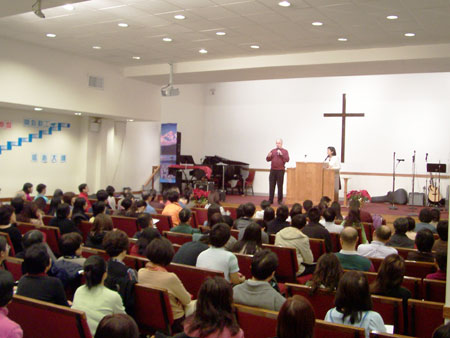
(Preaching at Faith Bible Church in New York City (Flushing))

The Vertical Church is a people group of Jesus-followers who desire nothing more than God's earth-shattering presence, and who experience that presence whenever and wherever they gather. The presence of God is the glue that holds them together. This is the meaning of Jesus' words about "whenever two or more gather, there I am in their midst." That's all that's needed: Jesus in our midst.

The Horizontal Church needs more than "Jesus in our midst," even to the exclusion of Jesus, leaving only us and "our midst." Here people have been seduced by the god of relevancy. Many are good people who have been mis-discipled. They have been taught - by culture - to rely on their own natural charisma to attract consumer-seekers. 

Much energy and money is spent on catering to the prevailing cultural ethos and its chronos-mentality; hence, there are temporally choreographed services because people (it is assumed) will pull out their cell phones if the earth-shattering presence of God hovers among them for more than an hour. The Horizontal Church unwittingly adds to Scripture, and has Jesus saying, "whenever two or more gather, with a fair trade coffee bar and stage lighting and short services and apps and creative add-ons, there I am in their midst, if only for an hour."

Horizontal churches burn people out in striving to measure up to the ever-shifting bar of cultural coolness. Even name changes and stage lighting cannot rescue these sinking vessels. (Vertical Church is not essentially about external makeovers, not that serving coffee or tight blue jeans are evil.)

James McDonald has written: 

"Eventually everyone vacates church where God is not obviously present and working. Getting people back to church is pointless unless God comes back first— that’s what Vertical Church is all about!
Ritual church, tradition church, felt-need church, emotional-hype church, rules church, Bible-boredom church, relevant church, and many other iterations are all horizontal substitutes for God come down, we all get rocked and radically altered, Vertical Church.
The problem is you can’t fake glory. You can’t manufacture it, or manipulate it, or manifest it at will. Only God Himself can bring glory into a church, and when He does, communities get shaken and lives get changed, and the fame of Jesus Christ curls continuously upon the shore of human hearts like a Hawaii 5-0 wave. Church is supposed to be a tsunami of glory every Sunday, and that is what we gather for." (MacDonald, Vertical Church: What Every Heart Longs for. What Every Church Can Be, Kindle Locations 104-105)

McDonald says, "In Vertical Church God shows up, and that changes everything."


***
I know McDonald has his problems. But he is correct about vertical and horizontal churches.

Thursday, December 19, 2024

Search Me, O God


University of Michigan campus. "Angry Neptune," by Michele Oka Doner.

Search me, O God, and know my heart.
- Psalm 139:23

You have searched me, Lord, and you know me.
You know when I sit and when I rise;
You perceive my thoughts from afar.
You discern my going out and my lying down;
you are familiar with all my ways.
Before a word is on my tongue
You, Lord, know it completely.
You hem me in behind and before,
and you lay your hand upon me.
Such knowledge is too wonderful for me,
too lofty for me to attain.

- Psalm 139:1-6

I have gone to quiet places and sat silently before God for countless hours, requesting God to search me and know me. I cannot know myself fully. I am easily deceived about myself, thinking I am one thing while I am another.

Theistic philosopher Dallas Willard writes:

"The hidden dimension of each human life is not visible to others, nor is it fully graspable even by ourselves. We usually know very little about the things that move in our own soul, the deepest level of our life, or what is driving it. Our "within" is astonishingly complex and subtle - even devious. It takes on a life of its own. Only God knows our depths, who we are, and what we would do." (Willard, Renovation of the Heart, 17)

At least I am aware that there is a profound epistemic gap between my feeble cognitive abilities and an omniscient God. This compels me to do the one thing I can, which is:

Get before God and pray, "Search me."