Saturday, August 13, 2022

Sabbath Is More than Just a Day


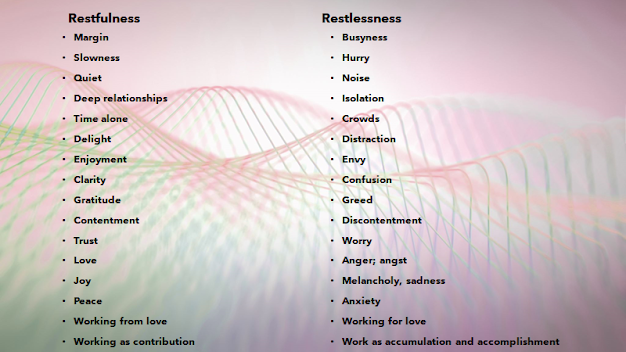
A few years ago Linda and I read The Ruthless Elimination of Hurry: How to Stay Emotionally Healthy and Spiritually Alive in the Chaos of the Modern World, by John Mark Comer. It's so good!

Comer has a great chapter on "Sabbath." He writes:

"Sabbath is more than just a day; it’s a way of being in the world. It’s a spirit of restfulness that comes from abiding, from living in the Father’s loving presence all week long." (p. 149)

He gives this template contrasting a life of restfulness with a life of relentlessness.


Thursday, August 11, 2022

Our 49th Wedding Anniversary


Linda and I bought this pair of coffee cups on our honeymoon at Chicago's Marriott O'Hare.


August 11, 1973 - Linda and I were married.

Today we're taking the day to celebrate 49 years of marriage.

We thank and praise God for this!


Salvation as Existential Spaciousness

(My back yard)

Are you saved? Rescued? Redeemed?

I was saved when I was twenty-one. I was walking from my apartment on the campus of Northern Illinois University. A series of personal failures and a dramatic, unexpected encounter with God led me to this moment. Something was happening inside me. I was praying. 


I had not prayed in a long time. Maybe ten or fifteen years. I did not pray because I did not believe praying would do anything. Praying meant nothing to me. On the first day of my salvation this changed.


I prayed, "God, if you are real, and you can help me with the mess I have made of my life, I will follow you." That was the moment when I got saved. That was my initiation into the environment the Bible refers to as "salvation."


Salvation is not simply a decision made at an individual point in time. It is better understood as being ushered into an alternative world of existential spaciousness. Philip Yancey writes:


"Eugene Peterson points out that “the root meaning in Hebrew of salvation is to be broad, to become spacious, to enlarge. It carries the sense of deliverance from an existence that has become compressed, confined and cramped.” God wants to set us free, to make it possible for us to live open and loving lives with God and our neighbors. “I run in the path of your commands, for you have set my heart free,” wrote the psalmist."" (Yancey, Vanishing Grace: What Ever Happened to the Good News?, p. 80)


God saved me from my solitary confinement. For that I am eternally grateful. What I formerly thought was freedom was bondage; what I viewed as bondage was freedom. I am free, in so many emotional, spiritual, and psychological ways. 

Sunday, August 07, 2022

Two Books I Am Reading this Week, On a Beach


                                                          (Linda, Weko Beach, Michigan)

This week Linda and I head to a Lake Michigan beach area to celebrate our 49th wedding anniversary.

We love sitting on the beach, and reading, and talking, and just enjoy a getaway and being  with each other. 

I'm taking two books with me.                         

First, I am re-reading (for the third time) C. S. Lewis's Till We Have Faces. I love this book! I have it in paperback. This is a book I want to hold while reading it. 

The second book is my "heavy" read for the week: The Morality Wars: The Ongoing Debate Over the Origin of Human Goodness. This is a collection of essays on metaethics. Metaethics is an area I continue to read in. The Table of Contents is below.

But soon...  coffee, a book, a beach, a great lake, meals together, with my gift-of-a-wife Linda...


The Morality Wars: A Discussion on Why We Are Good Louise Mabille

Part I: The Naturalists

1. A Science of Good and Evil Sam Harris

2. The Origins of Morality in the Human Psyche Bert Olivier

3 .Morality as Delusion Michael Ruse

4 .Return to the Enlightenment Susan Neiman

Part II: The Ambivalents

5. No science of morality Steven Weinberg

6. Misunderstanding Moral Psychology Jonathan Haidt

7. The Use and Abuse of Naturalism for Morality Louise Mabille

Part III: The Theists

8. My God-Given Conscience Henk Stoker

9. Theism as Meta-Ethical Foundation for Morality William Lane Craig

10. Morality as Based on Natural Law Richard Howe

11. Ethics Needs God Paul Copan

12. Biologizing Ethics and the Destruction of Morality John Lennox

Saturday, August 06, 2022

40 Evidences That You May Have Left Your First Love


                                                             (Flower, on our deck.)


This is from Nancy DeMoss Wolgemuth.

40 Evidences That You May
Have Left Your First Love

  1. You can go hours or days without having more than a passing thought of Him.
  2. You don’t have a strong desire to spend time with Him.
  3. You don’t have a strong hunger for the Word; Bible reading is a “chore”—something to mark off your “to do” list.
  4. Spending time in prayer is a burden/duty rather than a delight.
  5. Your worship is formal, dry, lifeless, merely going through the motions.
  6. Private prayer and worship are almost non-existent . . . cold and dry.
  7. You are more concerned about physical health, well-being, and comfort than about the well-being and condition of your soul.
  8. You crave physical food, while having little appetite for spiritual food.
  9. You crave human companionship more than a relationship with Christ.
  10. You spend more time and effort on your physical appearance than on cultivating  inner spiritual beauty to please Christ.
  11. Your heart toward Christ is cold and indifferent; not tender as it once was, not easily moved by the Word, talk of spiritual things, etc.
  12. Christianity is more of a checklist than a relationship with Christ.
  13. You measure spirituality (yours/others’) by performance rather than the condition of the heart.
  14. Christianity is defined more what by what you “do” than who you “are” (“doing”  vs. “being”).
  15. Your obedience and service are motivated and fueled by expectations of others or a desire to impress others, more than by passion for Christ.
  16. You are more concerned about what others think and pleasing them, than about what God knows and pleasing Christ.
  17. Your service for Christ and others is motivated by a sense of duty or obligation.
  18. You find yourself becoming resentful over the hardships and demands of serving Christ and others.
  19. You can talk with others about kids, marriage, weather, and the news, but struggle to talk about the Lord and spiritual matters.
  20. You have a hard time coming up with something fresh to share in a testimony service at church or when someone asks, “What’s God been doing in your life?”
  21. You are formal, rigid, and uptight about spiritual things, rather than joyful and winsome.
  22. You are critical or harsh toward those who are doctrinally off-base or living in sin.
  23. You enjoy secular songs, movies, and books more than songs or reading material that point you to Christ.
  24. You prefer the company of people who don’t love Christ, to the company and fellowship of those who do.
  25. You are more interested in recreation, entertainment, and having “fun” than in cultivating intimacy with Christ through worship, prayer, the Word, and Christian fellowship.
  26. You display attitudes or are involved in activities that you know are contrary to Scripture, but you continue in them anyway.
  27. You justify “small” areas of disobedience or compromise.
  28. You have been drawn back into sin habits that you put off when you were a young believer.
  29. “Little” things that used to disturb your conscience, no longer do.
  30. You are slow to respond to conviction over sin—or you ignore it altogether.
  31. You enjoy certain sins and want to hang onto them. You are unwilling to give them up for Christ.
  32. You are not grieved by sin—it’s no big deal to you.
  33. You are consistently allured by certain sins.
  34. You are self-righteous—more concerned about sin in others’ lives than in your own.
  35. You are more concerned about having the right position than the right disposition.
  36. You tend to hold tightly to money and things, rather than being quick to give to meet the needs of others.
  37. You rarely give sacrificially to the Lord’s work.
  38. You rarely have a desire or burden to give, when you hear of legitimate financial needs within the Body, your church, or a ministry.
  39. Accumulating and maintaining material “things” consumes more time and effort on your part than seeking after and cultivating spiritual riches.
  40. You have broken relationships with other believers that you are unwilling or have not attempted to reconcile.
SO...? 
To the angel of the church in Ephesus write: "The words of him who holds the seven stars in his right hand, who walks among the seven golden lampstands."
I know your works, your toil and your patient endurance, and how you cannot bear with those who are evil, but have tested those who call themselves apostles and are not, and found them to be false.
I know you are enduring patiently and bearing up for my name’s sake, and you have not grown weary. But I have this against you, that you have abandoned the love you had at first.
Remember therefore from where you have fallen; repent, and do the works you did at first. If not, I will come to you and remove your lampstand from its place, unless you repent . . . .
He who has an ear, let him hear what the Spirit says to the churches. To the one who conquers I will grant to eat of the tree of life, which is in the paradise of God."
(Rev. 2:1–7)

Thursday, August 04, 2022

Social Media - Come to the Coliseum


                                            (Fireworks at Monroe County Fairgrounds)

Johnathan Haidt is one of my favorite culture-analysts. His Coddling of the American Mind remains one of the most helpful books I've read in the past few years.

I collect Haidt's essays. I am looking forward to his coming book Life After Babel: Adapting to a World We Can No Longer Share. Haidt previews the book in this interview, and in his recent essay "Yes, Social Media Really Is Undermining Democracy (despite what Meta has to say)."

In America we are in a post-Babel world, a world where we no longer understand one another. We are numerous tribes, with different narratives (mostly non-reflexive). This is a world of "“toxic polarization”—signaled by declining “respect for counter-arguments and associated aspects of the deliberative component of democracy.”" 

Our social media platforms are mostly "echo chambers," where we only hear the sound of our own voices. "Researchers who measure echo chambers by looking at social relationships and networks usually find evidence of “homophily”—that is, people tend to engage with others who are similar to themselves. One study of politically engaged Twitter users, for example, found that they “are disproportionately exposed to like-minded information and that information reaches like-minded users more quickly.”"

"A major feature of the post-Babel world is that the extremes are now far louder and more influential than before. They may also become more violent. Recent research by Morteza Dehghani and his colleagues at the University of Southern California shows that people are more willing to commit violence when they are immersed in a community they perceive to be morally homogeneous."

I find Haidt's analogy of a coliseum spot-on. Social media platforms are Roman coliseums, to which we are all invited to both engage in and behold the human carnage. Sadly, as I see it, Christians accept the invitation as well. 

Haidt writes:

"The fear and cruelty of the post-Babel era are a result of its tendency to reward public displays of aggression. Social media has put us all in the middle of a Roman coliseum, and many in the audience want to see conflict and blood. But once we realize that we are the gladiators—tricked into combat so that we might generate “content,” “engagement,” and revenue—we can refuse to fight. We can be more understanding toward our fellow citizens, seeing that we are all being driven mad by companies that use largely the same set of psychological tricks. We can forswear public conflict and use social media to serve our own purposes, which for most people will mean more private communication and fewer public performances."

Which is why I discourage Jesus-followers to reject slaughtering those with whom they disagree, for a bloodthirsty audience to behold. But will this happen? As for now, it looks like... not.   

Monday, August 01, 2022

The Myth of Progress


The term 'progressive,' as a modifier linked with 'Christianity', is misleading, even false.

“Progressive” is not a word that fits into a Christian eschatological worldview.

Humanity, throughout history, has not morally and spiritually progressed.

The term "progressive" implies some kind of advancing, a moving forward towards some goal. My understanding of Christianity is that, while individuals and even communities can improve morally and spiritually (= Christ's character being formed in them), there will be nothing morally new under the sun until Christ returns.

This is because of the human sin problem. Every new generation has to deal with this. The next generation, and the generations beyond that, will not have progressed beyond this. (Note: I read one self-identifying progressive who thought humanity has progressed and will further advance so much that we can question whether or not we even need a Savior.)

Let's look more closely at the idea of "progress." Progress only makes sense in relation to a "goal." Such as: "I have made progress in my weight loss strategy. I am closer to my goal weight of 180 pounds." 

There are countless examples of this kind of progress. Someone’s goal is to play guitar like Eddie Van Halen. They take lessons. They practice. They are improving. They are making progress towards this goal.

“Progressive” implies “advancement”; “moving forward.” Towards some goal.

Someone else is constructing a house. Today they began digging the foundation. Next week they pour the cement. They are making progress toward the goal of building a house. That can be good. (It depends on what the house is used for.)

But "progress," in itself, is not always good. For example, I am overweight. My doctor has advised me to lose twenty pounds. But instead, my goal is to gain even more weight. This morning I step on the scale, and see I gained ten pounds over the holidays. Progress! Let us all cheer, and celebrate and affirm John's story! But, arguably, that’s not a progressive story to be celebrated. (FYI – I did not gain ten pounds over the holidays!)

Someone else researches the internet. Their goal is to build a bomb that will destroy buildings in downtown Nashville. Today they began constructing the bomb. They are making progress. They are moving forward. They are advancing toward their goal. Remember that 'forward' and 'backward' only make sense in relation to a goal.

What is the goal of progressive Christianity? And who sets this goal? In reading the literature of those who self-identify as progressive Christians, it’s not always clear to me that it is Christ. Perhaps, the goal for humanity is Love? For a Jesus-follower, it’s true that love is great, and greater than faith and hope. But I see the goal of history as Christ, not Love. Love is not greater than Christ. (See here.) 

My understanding of Christianity is that, in the lifetime of every person, the goal is the formation of the character of Christ in us, individually and collectively. As I read and talk with some who refer to themselves as progressive Christians, I hear them elevating Love and Desire-fulfillment to heights that should be reserved only for Christ. (For Desire-fulfillment as a "progressive" idea, and how this has come about historically, see especially Carl Trueman, The Rise and Triumph of the Modern Self.)

I see every generation of humanity as having a sin problem, which can only be addressed by the cross of Christ. My studies and observations indicate that humanity has not progressed, and will not progress, beyond that. And, my sense is that some progressive Christians are not thrilled about talking of sin. Affirmation? Yes! Desire-fulfillment? Yes! Sin? Meh...

I do not see the word 'progressive' as being part of what N.T. Wright describes as the "five act play" that is the Bible. Yes, in eternity we shall be like Jesus. But, in this present age, we are not progressing morally and spiritually. I view it as phenomenally difficult to demonstrate moral progress, over the years. Have we gotten better? Are we getting better?  The term “progressive” implies that we are. 

Yes, I know that Steven Pinker thinks that humanity, over time, has gotten kinder and gentler. I, and many others who have reacted to Pinker, do not. (See here.) Violence has declined, says Pinker, because humanity is getting less and less violent. 

This reminds me of what was perhaps the height of progressive optimism, in the early twentieth century. The Enlightenment belief was that human reason was now progressing to make a better world. And then came World War 1. And theologian Karl Barth was moved to write his commentary on Romans, with its teaching that all humanity sins and falls short of the glory of God. And then, Germany changed (progressed?) from a democratic republic in 1932 to a racist tyranny in 1934. And then, according atheist and scholar David Berlinski, the 20th century progressed into being the most murderous, violent in human history. (See Berlinski, The Devil’s Disciple: Atheism and Its Scientific Pretensions. See also footnote [1] below.)

But… we have massively progressed technologically, right? Correct. But it is still humans who use and wield technological artifacts. A hammer is a piece of technology. Its appearance advanced us, assisting in doing things like building furniture and ships and homes and you name it. But the human being holding the hammer could also use it to hurt and destroy. I see morally unadvanced, non-progressed humanity as still doing that, only with greatly advanced artifacts with massive destructive capabilities.

I don’t think progress is necessarily good, in itself. When you hear the word "progressive" you should not automatically think "positive." Yes, we seem programmed to think that way. But truthfully, it all depends on the goal. And here is where the word “progressive” is of no help to me, because it functions as a euphemism that should not be attached as a modifier to the term 'Christianity'.  

I know the word "progressive" is politically popular. But I don't like it, because I see it as mythical at best. Jeffrey Burton Russell, in Exposing Myths About Christianity, writes:

“The predominant superstition of our times is Progress. Belief in lower-case ‘progress’ is reasonable, for progress can be made toward definable goals in specific fields, such as electrical engineering, plumbing or surgery. But people often believe in upper-case Progress, as in “The Progress of Humanity.” This is a superstition. Upper-case Progress implies moving toward an undefined capital-G Goal.”

One of the myths about Christianity that Russell exposes is that progress was something Jesus was trying to bring about. Scholar Terry Eagelton calls this the “ideology of Progress.” Russell writes that “the natural goodness of humanity is an illusion based neither in history nor biology, and the empty center of most Progressivism is the delusion that radical evil does not exist. Progressivism can become utopianism, which always sacrifices liberty for its ends, as Stalin did. Those who deny evil will be overtaken by it.”

Ahhh... the natural goodness of humanity. What an anti-Hobbes idea! What an anti-Freud idea! And, what an anti-Christ belief. From such a belief comes the ideology of affirmation. But, I ask, who in their right Christological mind could believe that Christ came, not to rescue us out of bondage to sin, but to affirm us?

Progressive Christianity is too utopian for me. Many, including me, believe that we are “regressing” in our humanity. To call progressive Christianity too utopian is to locate its roots in Hegel and Marx, who both thought humanity was inexorably progressing, but who disagreed on the engine driving the progression, as well as the goal or outcome.  Anyone want to join me in a "Regressive Christianity" movement?

Again, if the goal of life is to embrace the Lordship of Christ and have his character formed in us, I think one can view our time as one of regression, division, and polarization. In fact, I, and many others, see progressive Christianity as divisive (e.g., I am aware of some young people who identify as progressive Christians and tie this in with their newfound belief that the Old Testament is just a bunch of made-up stories. I'll say more about this in my third post.) 

Is humanity progressing? Or regressing? Or decadent and stagnant? (See New York Times writer Ross Douthat's recent The Decadent Society.) You need to know this has always been a topic of discussion among scholars. The answers are not obvious. If we are talking about moral and spiritual development or regression, it is far from obvious that some kind of progressive movement is actually happening. I submit to you that it is not. And I can see, without much effort, that progressive Christianity is aiding the regression. (See footnote [2] below.)

In all this I am saying that I could never refer to myself as a progressive Christian because it commits a mistake… a category mistake… when the two words are placed next to each other. This is not a matter of mere semantics. The kingdom of God, said Jesus, was "not of this world." Therefore, the kingdom of God was not the end-result of an ever-progressive earthly kingdom.

I have a suggestion. I began following Jim Wallis in the early 1970s, when he began publishing what was to become the magazine Sojourners. Wallis is one who is often cited as a "progressive" Christian. But in the Times interview, Wallace says he would rather be called a "follower of Jesus."

Me too.

It's time to get rid of the term "progressive Christianity." And self-refer as "follower of Jesus." This would lead to interesting discussions, to include the morality of Jesus (see here, e.g.) and the relationship between Jesus and the Old Testament. Some progressive Christians, many of them unthinkingly, are on the "dismiss the Old Testament" bandwagon. Let's just focus on Jesus." The problem is, when you focus on Jesus, you see Jesus as not dismissing an authoritative Old Testament.  

Finally, in the term “progressive Christianity,” the word ‘progressive’ is a modifier. It modifies the word ‘Christianity.’ ‘Progressive’ is a euphemism. It puts a happy spin on Christianity. It also feels like a judgment on those who are not “progressive.” which provides another reason as to why I could never call myself a progressive Christian.

(For more, see my book Deconstructing Progressive Christianity, chapter 13.)


[1] On atheism (esp. atheistic existentialism) there is no goal in life. Thus, humanity is not progressing towards anything, nor is it regressing away from anything. Nor is it decadent. This leads to things like Theatre of the Absurd, and Camus’s Sysiphus, and Becket’s Waiting for Godot.

[2] For an interesting, illuminating article on whether or not humanity is "progressing," see atheist John Gray's excellent review of The Evolution of Moral Progress: A Biocultural Theory, by Alan Buchanon and Russell Powell. 
Thursday, July 28, 2022

Books for My Encounters Seminary Class


Here are books I referred to in my "Encounters with the Holy Spirit" class for Faith Bible Seminary.


Lee Strobel, The Case for Miracles: A Journalist Investigates Evidence for the Supernatural

Craig Keener, Miracles Today: The Supernatural Work of God in the Modern World

Craig Keener, Miracles: The Credibility of the New Testament Accounts

Craig Keener, Gift and Giver: The Holy Spirit for Today

Craig Keener, Spirit Hermeneutics: Reading Scripture in Light of Pentecost.

Gordon Fee, God's Empowering Presence: The Holy Spirit in the Letters of Paul

Grant Mullen, Emotionally Free: A Prescription for Healing Body, Soul, and Spirit

Wayne Grudem, Systematic Theology: An Introduction to Biblical Doctrine

Charles Kraft, I Give You Authority: Practicing the Authority Jesus Gave Us

Charles Kraft, Defeating Dark Angels: Breaking Demonic Oppression in the Believer's Life

Gregory Ganssle, ed., God and Time: Four Views

Wang Yi, Faithful Disobedience: Writings on Church and State from a Chinese House Church Movement

Randy Clark, Baptized in the Spirit: God's Presence Resting Upon You With Power

Gary McGee (Ed.), Initial Evidence: Historical and Biblical Perspectives on the Pentecostal Doctrine of Spirit Baptism


BOOKS BY JOHN PIIPPO

Leading the Presence-Driven Church

Praying: Reflections on 40 Years of Solitary Conversations with God

Encounters with the Holy Spirit (co-edited with Janice Trigg)