Thursday, July 28, 2022

"In" and "With" as Keys to Living the Jesus-Life


(Monroe County Community College)


A key to living the Jesus Life is found in two little words - "in," and "with."

Paul, in his letters to the various Jesus-communities, uses the phrases "in Christ" and "with Christ," and their variations, over 200 times (e.g. "in him," Christ "in us," and so on).

"In" is a container metaphor. When I am "in" the room, I share in the room's environment. When "out" of the room, I do not experience what is happening in the room.

Every Jesus-follower is "in Christ." This means union with Christ. I am in Christ and Christ is in me. Just as the resources of a vine flow into its branches, so do Trinitarian resources flow into every branch who abides in Jesus. 

Consider "with Christ." 

  • Jesus-followers have died with Christ, 
  • have risen with Christ, 
  • and will appear in glory with Christ on his return. 
  • When Christ died sin was defeated; 
  • Therefore I, in Christ, am dead to the rule and reign of sin. 
  • Sin has, for Christ and therefore for me, lost its power. 
  • When Christ was raised death was defeated; 
  • therefore, because he lives, I also live and am alive in Christ. 
  • Where he moves I move; 
  • where he goes I go. 
  • I am a new creation, living out of a new ontological status. 
Sadly, the default, flesh-system of "religion," is to ignore this core Gospel reality, and instead preach the Moral Code and the utilization of human flesh-power to keep it (what Richard Foster has called "will worship"). Craig Keener says the best imitations of Christ are just “flesh.”" (Keener, here)

"In," and "with," tell us that living the Jesus life is not about trying harder. N.T. Wright writes:

One aspect of Christian maturity, and certainly one of the road signs on the road to Christian holiness, is that the mind must grasp the truth: ‘you died, and your life has been hidden with the king, in God!” Once the mind has grasped it, the heart and will start to come on board. And once that happens the way lies open to joyful Christian holiness. Don’t settle for short cuts.” (NTW, C for E, 176; emphasis mine)
It's not imitating Christ, but union with Christ that makes the difference. It's about Christ, living in me and doing his transforming work in me, and I in him, rather than striving to copy him by using will power. (Think of the guilt and shame this produces in the church.)
Wright says: 

"The possibility is staggering: that I, a creature, might have my life linked—actually, organically, eternally linked—to the Son of God himself. Like a freight car coupled with an engine, where Jesus goes, I go. What happens to him, happens to me. I follow him and share his life, his character, his suffering, his future, his inheritance, even his reign with the Father.
While this reality, known as the doctrine of "union with Christ," has received a lot of attention throughout Christian history, it is often ignored in the modern church. But it is incredibly good news for those of us who wrestle with the uncertainty and disappointment of life on earth. Because we are "in Christ," because his life is ours, our fundamental life story has already been written."

Orient your heart and mind to things above, to Christ. Set your hearts and minds on who you are, by faith and through grace, in Christ.

In.

With.

Christ in you, the hope of glory. The actuality is staggering.

***
For more, check out former Fuller Theological Seminary professor Lewis Smedes, Union with Christ: A Biblical View of the New Life in Christ.

Wednesday, July 27, 2022

Normal Churches Pray for the Sick, with Expectation


Image result for john piippo praying
(Praying for someone at Redeemer)

(I am re-posting this for my seminary students.)

If your loved one was sick, would you pray for them? If so, what would you pray? Perhaps, for them to get better?

At Redeemer we pray for sick people to get better. 

We view healing as comprehensive, and in this way very Hebraic. 

This comprehensiveness is seen in how Eugene Peterson translates Isaiah 53:3 in The Message:

 The fact is, it was our pains he carried —    
our disfigurements, all the things wrong with us.

"All the things wrong with us." The atoning sacrifice of Christ has covered all our bases. The Atonement covers sin, yes, and so much more (a lot of which is the logical outcome of our sin). 

This affects how "church" is supposed to happen. Since God cares for the whole person - body/soul/spirit - he gives the church spiritual gifts that edify the whole person, individually and corporately.

What should a church look like? Is there a model, a paradigm, for "church?" I believe there is. It is seen in the book of Acts, and the letters of Paul, the book of Hebrews, etc. If there has ever been a normal church, it is the early church. If a church measures itself against anything, it is the early church.

Much of the American Church seems far from this. It is beset with abnormalities. Many American churches feel like going to a tennis match, expecting to see racquets and fuzzy yellow balls and a court bisected by a net, but instead seeing people standing around reading essays about tennis. 

A Jesus-follower in the first century would go to church expecting prayers for the sick, demons being cast out, the spiritual gifts manifesting, and maybe even a dead person brought back to life. What they would see in many American churches today bears no resemblance to that. 

Why would such things normally be expected? Because...
  • Jesus did these kind of things
  • Jesus said his followers would do these kind of things
  • The Church was birthed in these things
  • These things were understood in relation to the Atonement, in which "all the wrong things with us" were borne, by Christ, on the cross.
If a Church does not experience miracles, signs, spiritual gifts, deliverance from demonic oppression, and wonders, then it is abnormal, in terms of the original template. Something is missing.

Theologian Roger Olson writes:

"Most contemporary American evangelical Christians only pay lip service to the supernatural whereas the Bible is saturated with it. To a very large extent we American evangelicals...   have absorbed the worldview of modernity by relegating the supernatural, miracles, scientifically unexplainable interventions of God, to the past (“Bible times”) and elsewhere (“the mission fields”)." ("Embarrased By the Spirit?")

Last Sunday we prayed for sick people to be well. I talked with a number of people who told me they had pain, and after praying for them the pain was gone. People were smiling, saying that chronic pain had been taken away. They were praising God for what only he can do!

I think this is good, don't you? This kind of thing should happen in church, right? How weird to be in a church where expectation is low, even nonexistent, even to be avoided, and there are no expectant, faith-filled prayers for sick people who are there. 

How bizarre if a church is embarrassed by doing this. What if, horror upon horror, we bring a friend to church and they see people praying for the sick, and are freaked out by it! Or, attracted by it?

Olson writes:

"We [in the American Church] pray for the sick—that God will comfort them and “be with them” in their misery. We pray that God will give their doctors skill as they treat them. But we avoid asking God to heal them. We avoid any mention of demons or demonic possession and strictly shun exorcism as primitive and superstitious—except when Jesus did it. We look down on churches that anoint the sick with oil and pray for their physical healing. We suspect they are “cultic” and probably encourage ill people not to seek medical treatment. We (perhaps rightly) make fun of evangelists who claim to have prayed for God to re-route hurricanes but never ourselves pray for God to save people from natural disasters. We have gradually adopted the idea that “Prayer doesn’t change things; it changes me” and, like Friedrich Schleiermacher, regard petitionary prayer as something for children."

I experience cognitive dissonance when 1) I read stories of the first century church in the Bible; and then 2) I am in churches where virtually nothing about the first-century church happens and, more than this, is dismissed as dangerous and "weird." Which is weird, to me.

Last weekend, during our worship experience, someone spoke in tongues, followed by an interpretation. As a young Jesus-follower, who had never read the New Testament, some people told me that things like speaking in tongues and prophesying and engaging demons were bizarre. This put me in a strange position, since the Bible I was reading said tongues and prophecy and healing were given to the church, by the Holy Spirit, for its edification. I concluded that the cessationists were wrong. I went one night, alone, into the sanctuary of the Lutheran church I was raised in, knelt at the altar, and prayed, "God, I want everything you have for me, including the spiritual gifts you have given to us."

Olson writes:

"My experience is that the richer and more educated we evangelicals... become the less likely we are to really believe in and expect miracles. We relegate the supernatural to the inner work of persons believing that God can change people's hearts, but we do not really believe God intervenes in the physical world. Yet the Bible is full of examples of God's interventions in the physical world, it commands us to pray for such, and evangelical (and Catholic) Christians in the Global South almost all believe in and pray for God's miraculous interventions - especially in healing the sick."

Many American Christians have given in - unconsciously - to a reductionist, anti-supernaturalist worldview. They say they live by biblical truths, while practically denying how those truths played out in the early church. Why? Not because of intellectual reasoning, but because they want their religion to be "respectable."

Are there abuses by Christian pastors on TV? Of course. But the following reasoning fails:

1) There are abuses by people who believe in the spiritual gifts.
2) Therefore, the spiritual gifts are to be avoided, or are even non-existent.

That is irrational. The baby is thrown out with the bathwater.

Next Sunday morning at Redeemer we'll pray for the sick. Underscore the word we. This is our "normal." The expectation level will be  high. 

The reality of God showing up in love and power feels biblical to me. It's beautiful. It's better than words alone. For the kingdom of God is not a matter of talk, but of power. (See here.)

Thursday, July 21, 2022

Every Text Is a Cautionary Tale

(Goldfinch approaching one of my backyard feeders)

Every biblical text is a cautionary tale.

Every statement is a cautionary tale.

Which means: WARNING! EVERY TEXT CAN BE MISINTERPRETED!

Any text can be cherry-picked and politicized.

In a recent discussion on my views of healing and the Atonement, a responder was concerned that my perspective could slip into a prosperity gospel position. I assured them that I am not into the heretical prosperity gospel.

I am, however, interested in correctly interpreting Scripture, and even language, for that matter.

We must first ask, what is the text saying? We have to be able, as best we can, to get the text right, and not impose, e.g., a Western worldview on the text. (Thus, the hermeneutical question is not "What does the text mean to you?" 

Once we believe we get the text right - e.g., in my case, comprehensive healing is in the Atonement (1 Peter 2:24) - then we simply present it. We present the correctly (we hope) interpreted text without worry that our presentation could be misinterpreted. Because - of course our presentation could be misinterpreted! It is a guarantee that it will be misinterpreted.

This human reality cannot prevent us from putting forth our understanding. If we operated out of fear that our position could be misinterpreted, then we would present nothing.

Every text is a cautionary tale.

Tuesday, July 19, 2022

Three Podcasts I Listen To


                                                    (Moon over Walgreens parking lot, Monroe)

Here are three podcasts I like, and listen to.

Justin Brierley's Unbelievable?

Sean McDowell's Think Biblically.

Alisa Childers

Monday, July 18, 2022

"Grace" As the Concrete Manifestation of the Activity of God

                                                   (Sawyer House, Monroe, Michigan)

The theme of the Fall 2010 Journal of Spiritual Formation & Soul Care is "Dallas Willard and Spiritual Formation." I bought it when it came out, and refer to if occasionally. 

I am grateful for Willard and his Kingdom-labors. He is a brilliant philosopher, an excellent writer and communicator, and passionate Jesus-follower. In the area of spiritual formation his contribution is huge.

In the Introduction Willard's definition of "grace" is given. "Grace is God acting in our lives to bring about what we do not deserve and cannot accomplish on our own." (126) That final phrase makes this, for me, compelling.

I know that "grace" has the core meaning of "gift." A gift is, precisely, something I have not earned and thereby do not deserve. But God's grace is also purpose-driven. The gift of grace is given so that God might work through me to accomplish Kingdom-things I could not have done by my own wisdom and strength. In this sense God's grace manifests itself. The spiritual gift of prophecy, e.g., is the divine enrichment of our speech and knowledge so as to share words that are not reducible or attributable to our own abilities.

To only emphasize grace as something done to me is to treat it passively. To add to this the idea that grace "accomplishes" God-things is to see it as dynamic and active. "Grace" is the concrete manifestation of the activity of God in the life of a submitted Jesus-follower.

The Work of the Holy Spirit, in God's People


                                                       (Cover painting by Nicole Griffith)

(I make reference to HSRM – Holy Spirit Renewal Ministries. Much of what we have learned about the Holy Spirit has come from Attending HSRM’s annual summer conference, and our association with HSRM pastors and leaders. The following is from my book [co-edited with Janice Trigg], Encounters With the Holy Spirit.)


THE WORK OF THE HOLY SPIRIT, IN GOD’S PEOPLE

The Holy Spirit takes us further and deeper into God’s kingdom realities. The Holy Spirit invites us to more growth in Christ. In The Chronicles of Narnia C. S. Lewis describes heaven as a place where our experience is “further up, further in.” The Holy Spirit prepares us for eternity by taking us further up and further into God’s beautiful kingdom, in our pre-heavenly existence. (8)

The Holy Spirit moves prophetically. When the Holy Spirit manifests among us it is not only for our present experience. It can be a preparation for something the Spirit will have for us in the future. In this way the Holy Spirit trains and equips us for ministry in the days ahead.

The Holy Spirit speaks through other believers to strengthen, comfort, and encourage us. That’s what, in the early church in the book of Acts, the variety of Spirit-manifestations were for. How good it is to be part of a Jesus-fellowship where this happens.

The Holy Spirit produces staying power. The presence of God’s Spirit equips us to host his presence every day.

The Holy Spirit comes with healing power. Most of what I know about praying for healing has been acquired through HSRM.

The Holy Spirit builds family. The Spirit creates meaningful, life-giving togetherness. This is why I call our summer events “more than a conference, it’s a family!”

The Holy Spirit desires to conference with the greater body of Christ, and calls us to meet together. For example, one of our summer conference speakers was the leader of the Roman Catholic Charismatic Renewal of Wisconsin.

The Holy Spirit is fully available to children. HSRM teaches the same material to kids who attend the conference, with age-appropriate presentations.

The Holy Spirit assures us that we are sons and daughters of God. In a world where people are struggling to find their identities, even resorting to identity-creation on social media, the Holy Spirit seals us with who we are, in Christ.

The Holy Spirit produces boldness in us.

And, as my HSRM colleague Dr. Clay Ford writes, the Holy Spirit…

… gives us life.

…illuminates our intellects.

…sanctifies our emotions.

…refines our character.

…instills godly values and reverence for God’s Word.

…motivates our wills and empowers our witness.

…moves our hearts.

…enables a relationship of love and trust with God.

…enables us to perceive the spiritual dimension of life and to navigate effectively in it.

…makes God’s presence real to us and inspires our worship of him.

…fills us with love and makes us a family.


John  Piippo and Janice Trigg, Encounters with the Holy Spirit (pp. 9-10). WestBow Press. Kindle Edition.


Sunday, July 17, 2022

Galatians 1:1-10 - Some Quotes to Understand the Text


Here are some of the quotes I referred to in today's message on Galatians 1:1-10. As I prepare for these Galatians sermons, here are the main resources I am using to get the meaning of Galatians right. (HERE.)


Craig Keener - "Galatians addresses hearers who are already believers. Paul’s argument is not against Judaism but against a faction of Jewish believers in Christ… who insist that “Paul’s Gentile converts must accept the Jewish law” if they are to belong to God’s people. The gospel of grace in Christ is supplemented with the system of Moses. This is a gross perversion of the Gospel…   and a totally different message."

Scot McKnight says the heart of the Galatian problem is: "a gospel of grace at war with a gospel that minimizes Christ."

McKnight - "Legalism, according to Galatians, was a religious system that combined Christianity with Mosaism in a way that demanded total commitment to Israel’s law as the climax of one’s conversion to Christ. This “deeper commitment to the law,” according to Paul, was a subversion of the adequacy of Christ’s work and an abandonment of the Holy Spirit as God’s way of guiding Christian ethics. In other words, the legalism of the Judaizers is more than a problem: it has become a new message, a different gospel. It is this implication—that it is a different gospel—that forces Paul to action."

McKnight - "We must be on guard against the idea that every rule or regulation in Christian living is a necessary form of Galatian legalism. Legalism – for Paul - was wrong not because laws are somehow wrong, but because legalism supplanted Jesus Christ and the Holy Spirit. There are many commands and rules that are helpful; for Christian development." 

Dallas Willard - “Grace is not opposed to effort; it's opposed to earning. Effort is action; earning is attitude.”

Tim Keller - In [Galatians] chapter 5, Paul has laid out two errors, both of which oppose the gospel: losing freedom by seeking salvation through keeping rules (moralism); and abusing freedom by rejecting the idea of rules at all (hedonism)."

Tim Keller - o   In verse 7 [of ch. 1], Paul says that any teaching which adds keeping Mosaic ceremonial law to faith in Christ “perverts” the gospel. Literally, the word he chooses to use means “reverses." This is illuminating. If you add anything to Christ as a requirement for acceptance with God—if you start to say: To be saved I need the grace of Christ plus something else—you completely reverse the “order” of the gospel and make it null and void.

McKnight (again) - "Here we are at the heart of the Galatian problem: a gospel of grace at war with a gospel that minimizes Christ."

N. T. Wright - The true Gospel declares that God’s single, unique action in Jesus has dealt with sin and launched the new age, the new world, the new creation. The rival “gospel” of the newly arrived teachers isn’t about that good news at all. It isn’t a variation on the theme; it is a different theme altogether. It isn’t an announcement that the new age has begun. It is simply a message about how to survive in the old age. And Paul says that anyone who announces such a thing, pretending that it’s the same thing as the genuine message of Jesus, must be under a “ban.” They are the ones, he says, that you should avoid. 


Friday, July 15, 2022

Preaching Through Galatians - My Resources


At Redeemer we have begun, on Sunday mornings, preaching through the biblical book (letter) of Galatians.

In studying the text I draw on the following resources. I am immersed in the text, and in these study tools!

The Bible I use is: NIV Cultural Backgrounds Study Bible.

The Greek Bible I use is found at: https://greekbible.com/.


The commentaries I am using are: 

Craig Keener, Galatians: A Commentary

 Scot McKnight, Galatians

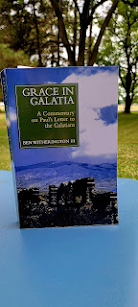
Ben Witherington, Grace in Galatia: A Commentary on Paul's Letter to the Galatians

N. T. Wright, Galatians

Tim Keller, Galatians for You


Plus, Ladd's theology, various studies of the apostle Paul (to include what has been called the "new perspective" on Paul), etc.

My Favorite Conversion Song


My favorite conversion, repentance, salvation, rescue, come-to-Jesus song, is Bruce Cockburn's "All the Diamonds."

It never fails, when I listen to it, tears..., thanksgiving..., joy.