Tuesday, March 15, 2022

The Atonement Is Not "Morally Outrageous" (No "Cosmic Child Abuse" here)


(Sterling State Park, Monroe)

One common belief in the incoherent, confusing atmosphere of progressive Christianity, is the rejection of Christ's death on a cross as an atoning sacrifice. That, says a progressive ethos, is a despicable example of "cosmic child abuse."

Simon Gathercole writes:

"What I try to do in Defending Substitution is to show that substitution is actually an integral part of what is meant in the atonement in the New Testament. Attempts to say that it is philosophically dubious or that it is morally outrageous—the classic rhetoric about cosmic child abuse or whatever—is just so much useless rhetoric and simply demonstrates the presuppositions and prejudices of scholars rather than having anything particularly to do with the New Testament."

But of course.

(In N.T. Wright, Simon Gathercole, and Robert Stewart. What Did the Cross Accomplish? A Conversation About the Atonement, p. 35)

Monday, March 14, 2022

Atonement and the Scandal of the Cross


When I watched the movie "The Passion of the Christ" there were many parts of it that I found it difficult to look at. I concluded that the actual event of the crucifixion of Christ was worse than the movie. (If you are interested, see Mel Gibson's Passion and Philosophy: The Cross, the Questions, the Controversy, containing essays by Dallas Willard, Paul Moser, et. al.)

Fleming Rutledge writes:

"It takes some effort of the imagination to understand the singular degree of public disgust caused by crucifixion as a method of execution. Yet we must make this effort in order to understand more fully the meaning of the Greek term skandalon (“stumbling block,” “pitfall”) that the apostle Paul uses, as in the phrase “the skandalon of the cross” (Gal. 5:11). Most of us are conditioned to think of Jesus’ death as the scandal, when in fact it is not the death in itself but the mode of death that creates the offense." (Rutledge, The Crucifixion: Understanding the Death of Jesus Christ, p. 72)

Saturday, March 12, 2022

Atonement and Substitution


                                                     (Church of the Nativity, Jerusalem)

At the heart of the atoning death of Christ on a cross is the concept of substitution. New Testament scholar Simon Gathercole writes:

"The miracle of the gospel is that this link between our sin and our death has been broken. Christ died for our sins. Substitution is there at the heart of the gospel. Christ died so that we don't need to die. Christ bore our sins so that we don't need to bear them."

(From Simon Gathercole and N.T. Wright, What Did the Cross Accomplish: A Conversation About the Atonement.)

Friday, March 11, 2022

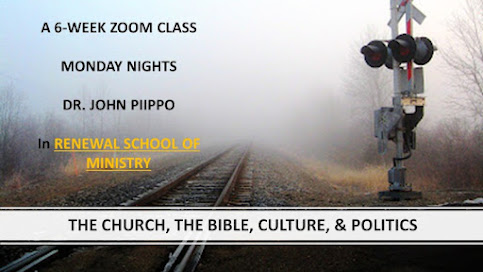
The Church, the Bible, Culture, and Politics - A 6-session Zoom Class


Would you like to learn about and discuss the church's relationship to politics and culture without without getting into heated, unfruitful, uninformed anger-sessions on social media?

Want to engage in some intelligent discussion about political issues?

Why not spend six 1 1/2 hour sessions with me, for only $10, and take my online class, "The Church, the Bible, Culture, and Politics." I will share in-depth responses to these and other questions, using Scripture and church history.

We live in a post-Christian culture. How do we remain faithful, even influential, in our world?

What does it mean to not be "conformed to this world?" (Romans 2)

What does our faith have to say about our relationship to political systems?

What are the reigning political systems in this post-Christian world?

How have followers of Jesus, throughout history, related and responded to government?

Six 1 1/2 hour zoom sessions. Monday nights. 8-9:30 PM EST.

First class - March 21.

Offered by Renewal School of Ministry.

Register HERE


Christianity, Culture, and Politics - A Select Bibliography


The Atonement of Christ - Some Resources


                                                         (It's snowing today at our house.)

In my PhD program (Northwestern University) I was required to take four PhD qualifying exams. When I passed those, I became a PhD Candidate, who was ABD ("all but dissertation"). 

One of my exams was in ancient Christology (the study of Christ). I took this exam because knowing Jesus, both about him and experience of him, was my great, central passion. This passion has not diminished; indeed, it has increased. 

My Jesus Quest has been, and remains, both intellectual and experiential. Along the way I have studied New Testament scholars and scholarly theologians. One of several things they share in common is belief in the atoning death of Christ on a cross. 

As I thankfully approach yet another Good Friday and Resurrection Sunday, I focus again on the Atonement. And sadly, some Christians have been influenced by progressive Christian writers [not necessarily scholars] who deny the atonement so as to render it more palatable to postmodern, secular culture. So, in my church context, I have been making blog posts on the Atonement, and will continue to do so through Good Friday.

For my personal studies I am reading (in some cases, re-reading), the following texts. Reading these shapes me devotionally, intellectually, and experientially. They escort me to the throne room of what I most deeply believe.

Crucifixion: Understanding the Death of Christ, by Fleming Rutledge

The Nature of the Atonement: Four Views, James Beilby, Paul Eddy, Thomas Schreiner, Greg Boyd

What Did the Cross Accomplish: A Conversation About the Atonement, Simon Gathercole, Robert Stewart, N. T. Wright

The Atonement, William Lane Craig (I've not read Bill's newer book Atonement and the Death of Christ: An Exegetical, Historical, and Philosophical Exploration.)

The Day the Revolution Began: Reconsidering the Meaning of Jesus's Crucifixion, N. T. Wright

Atonement - Jesus Died In Our Place


(Jerusalem)

ATONEMENT IDEAS from Fleming Rutledge's The Crucifixion. (See here.)

  • “As a result of the original sin of Adam, the entire human race has been mired in sin and incurred the wrath of God.

  • God cannot overlook sin as though it had not occurred. Sin must be punished.

  • Jesus, the only-begotten Son of God, entered into the place of sinners and took the punishment on himself.

  • On the cross, particularly as shown in the cry of dereliction, Jesus submitted to the curse upon sin and underwent God’s judgment.

  • By deflecting the wrath of God onto himself, Jesus took it away from humanity.”

Rutledge writes:

The plain sense of the New Testament taken as a whole gives the strong impression that Jesus gave himself up to shame, spitting, scouring, and a degrading public death beyond the eyes of the whole world, not only for our sake but also in our place. (p. 529).


There is something deep in the human psyche that responds to the idea of substitution – someone who dies in my place so that I may live – and the loss of it from the preaching and teaching of the church  [AKA progressive Christianity] would be grievous. (466)


Thursday, March 10, 2022

Putin's Religious Roots, and His War Against Ukraine


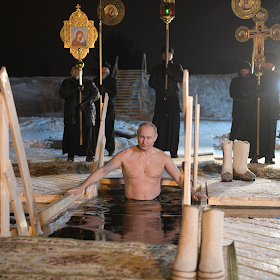
(President Putin immerses himself in the icy waters at Lake Seliger during Orthodox Epiphany celebrations in January,

See here. ALEXEI DRUZHININ/KREMLIN VIAREUTERS)

A case is being made that, at the root of Putin's hatred towards Ukrainians, lie his religious roots. 

There are MANY articles and studies on Putin and Christianity.
For beginners, I suggest reading these in the order they are in.


For a counter-article, see this. https://www.theglobeandmail.com/opinion/article-putins-invasion-of-ukraine-has-nothing-to-do-with-religion/ 

Wednesday, March 09, 2022

Now Reading...


I read multiple books at a time. This partly explains why I suffer in other areas (e.g., home repair; exercise; TV trivia; etc.).


Two books I am now reading are...

Fleming Rutledge, The Crucifixion: Understanding the Death of Jesus Christ. O... M...  G. I'm only fifty pages into the book, and see why Christianity Today gave it a "Book of the Year" award.

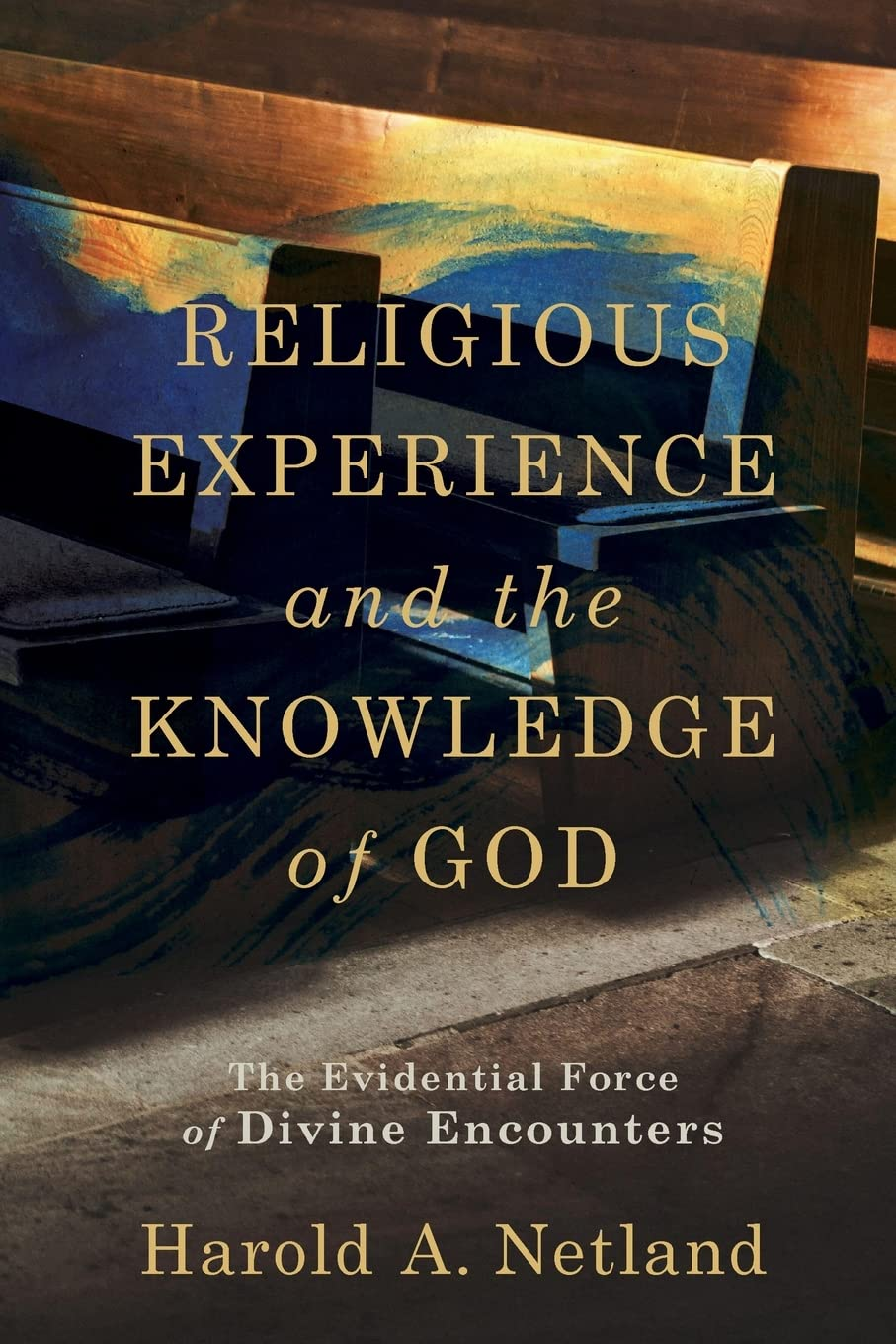
Harold Netland. Religious Experience and the Knowledge of God: The Evidential Force of Divine Encounters. While I value logic and critical thinking (having taught logic for eighteen years at Monroe County Community College), I believe experience, not theory, breeds conviction. This book is deepening that thought in me. See CT's interview with Netland here.


Atonement Lies at the Heart of the Christian Faith


                                                                    (Door, in Jerusalem)

Some progressive Christians argue that humanity has never been separated from God. If that were true, then our sin has not separated us from God. The implication of this is universalism; viz., the idea that all persons are saved. (See my book Deconstructing Progressive Christianity, ch. 8.)

This reasoning eliminates the idea that Christ died an atoning death to forgive the sin that has separated us from God.

The problem with this "progressive" thinking is that it's not what the Bible teaches. 

For example, Romans 4:25 states that Christ “was put to death for our trespasses and raised for our justification.” By Jesus' atoning, sacrificial death, we can be reconciled to God. William Lane Craig writes, 

"Reconciliation is the overarching theme of the NT, and other important NT motifs such as the Kingdom of God, salvation, justification, and redemption are subservient to it. Atonement in this sense thus lies at the heart of the Christian faith." (Craig, The Atonement, p. 4)

Tuesday, March 08, 2022

Atonement as At-One-Ment


                                                       (Sterling State Park - Monroe)

We see the word 'atonement' in Romans 3:25-26.

25 God presented Christ as a sacrifice of atonement, through the shedding of his blood—to be received by faith. He did this to demonstrate his righteousness, because in his forbearance he had left the sins committed beforehand unpunished— 26 he did it to demonstrate his righteousness at the present time, so as to be just and the one who justifies those who have faith in Jesus.

William Lane Craig writes:

"The word “atonement” is unique among theological terms, being a derivation, not from Greek or Latin, but from Middle English, namely, the phrase “at-onement,” designating a state of harmony. The closest New Testament (NT) word for atonement in this sense is katallagÄ“ or reconciliation, specifically reconciliation between God and man. Reconciliation is the overarching theme of the NT, and other important NT motifs such as the Kingdom of God, salvation, justification, and redemption are subservient to it. Atonement in this sense thus lies at the heart of the Christian faith."

- Craig, William Lane. The Atonementp. 4.