Wednesday, July 19, 2017

Too Dumb to Understand What God Is Making Out of Me


Image may contain: 3 people, indoor
In Detroit

7:30 AM. I'm awake. I begin the day by reading from Psalms and Proverbs.

Then, I read the daily entry from A Year with Thomas Merton: Daily Meditations From His Journals. 

I read these comforting words:

"There is only one way to peace: be reconciled that of yourself you are what you are, and it might not be especially magnificent, what you are! God has His own plan for making something else of you, and it is a plan which you are mostly too dumb to understand."

Good morning.

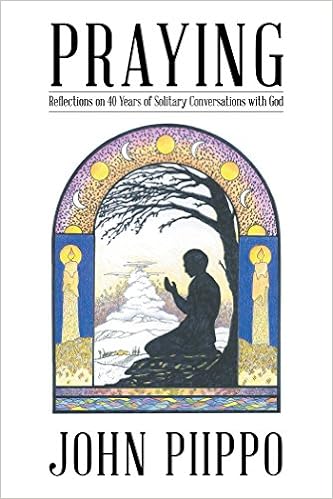
My Book - Praying: Reflections on 40 Years of Solitary Conversations with God


My book Praying: Reflections on 40 Years of Solitary Conversations with God, is available in paperback and as a Kindle book here. 

I have written a simple Study Guide to Praying. This guide is not published as a book, but is available free as a Word file. It is designed for both individual and group use. 

If you would like a copy of the Study Guide please send me an email - johnpiippo@msn.com. 


My book Leading the Presence-Driven Church will be out this fall.

Sunday, July 16, 2017

Sermon Notes - Forgiveness as a Gateway to Healing


Image result for john piippo redeemer

Especially for my Redeemer family - These are some of my notes and quotes from this morning's sermon - "Healing and the Atonement - Forgiveness As a Gateway to Healing."

Plus - some of the resources I quoted from are at the end of the notes.


Today…   Forgiveness is a gateway to physical and inner healing.
The one point I am going to make: forgiveness of sins and healing go together.
         
***
A REMINDER - The Comprehensive Nature of the Atonement.
1 Peter 2:24 - “He himself bore our sins” in his body on the cross, so that we might die to sins and live for righteousness; “by his wounds you have been healed.”
The Message - His wounds became your healing.
How wide is the healing?
I think…   it is for everything on heaven and earth that needs to be healed.
The need for healing is comprehensive.
Isa. 1:5-7
          Your whole head is injured,
    your whole heart afflicted.
6 From the sole of your foot to the top of your head
    there is no soundness—
only wounds and welts
    and open sores,
not cleansed or bandaged
    or soothed with olive oil.
7 Your country is desolate,
    your cities burned with fire;
your fields are being stripped by foreigners
    right before you,
    laid waste as when overthrown by strangers.
So… a whole lot of healing is needed.
          Healing of nations. Healing of cities.
          Healing of the creation.
          Healing of persons, from their head to their toe…
                   …  of physical bodies…,   healing of hearts…  
… healing on the outside, and on the inside…
…  healing and restoration of the soul…

What has God done about this? Well…   that’s 1 Peter 2:24.
God has provided healing once and for all through the Son’s atonement, which begins with God the Father sending the anointed One
…  (Jesus the Christ)…
… to preach good news to the poor…
… to proclaim freedom for the prisoners
and recovery of sight for the blind,
to release the oppressed,
to proclaim the year of the Lord’s favor. (Lk 4:18-19; Is 61: 1) 

THIS IS WONDERFUL…   but it’s not wonderful to Satan.
This is where the battleground is… a battleground over our souls, our minds, our bodies, our families, our communities, our nations…
Unfortunately, there are hindrances to our healing.
We’ve talked about things that hinder the comprehensive healing that is in the atonement.
          Cessationism…   Dualism…   Naturalism…  Hierarchism

This morning…   something else – a different sort of thing – that comes against comprehensive healing.
          UNFORGIVENESS
Unforgiveness affects us physically.
          I know this from experience.
          King David knew it from experience – Ps. 32
When I did not confess my sins, I was worn out from crying all day long. Day and night you punished me, LORD; my strength was completely drained, as moisture is dried up by the summer heat. Then I confessed my sins to you; I did not conceal my wrongdoings. I decided to confess them to you, and you forgave all my sins (Ps. 32: 3-5).
One of God’s rules of the universe… is that unconfessed, unrepented, undealt-with sin… puts people in captivity…
          …their hearts… in their souls…  even affecting their physical bodies.

Charles Kraft - Unforgiveness is like emotional and spiritual cancer.
As it spreads, it blocks emotional and spiritual healing and can lead to a kind of spiritual death.
It can even be one of the root causes of numerous serious physical illnesses.

That’s what is going on in Matthew 9 – the healing of the paralyzed man
Walter Brueggemann  – “This story is a specific instance where two major features of Jesus’ ministry come together – forgiveness and healing.”
Jesus stepped into a boat, crossed over and came to his own town. 2 Some men brought to him a paralyzed man, lying on a mat. When Jesus saw their faith, he said to the man, “Take heart, son; your sins are forgiven.”
This paralyzed man…   his sickness is related to his unforgiven sin.
          Not every sickness is caused by sin.
          But surely are.
                   Unforgiveness is not good for us… physically or emotionally.
Jesus said to the paralyzed man, “Get up, take your mat and go home.” 7 Then the man got up and went home. 8 When the crowd saw this, they were filled with awe; and they praised God, who had given such authority to man.
Jesus healed this man to show that He, the Son of Man, has the authority to forgive sins.
If He could heal the disease, He could also heal the cause of the disease, the sin.

In Ps. 103:3 we see a connection between forgiveness and healing.
"He forgives all my sins and heals all my diseases.”

***
A main part – of the comprehensive nature of the Atonement…   is the forgiveness of our sins.
          The forgiveness of our sins produces a great healing.

John Arnott – “When people forgive themselves and others, powerful emotional healing comes to them as they step into the grace and mercy of God. As we pray for emotional healing, it is common to see
wonderful physical healings taking place in the wake of forgiveness.”

Charles Kraft - I can’t estimate the large number of people, for whom I have prayed, that have received emotional, physical or spiritual healing almost immediately when unforgiveness was dealt with.
On several occasions, people have come to me with extreme tightness and pain across their shoulders. But when they forgave the person they were angry at, the symptoms left immediately.
One woman’s whole personality and outlook on life changed when she gave up her unforgiveness toward scores of people against whom she held bitterness.

Kraft - Unforgiveness is the most frequent block to freedom, and the cause of much difficulty for those who come for ministry. The habit of holding things against self, others or God results in the unforgiving person being bound up in captivity to the Enemy. This is why Jesus had so much to say about the necessity of forgiving.
David Seamands calls forgiveness “the most therapeutic fact in all of life.”

***
What is forgiveness?
2 – You reinterpret the person who wronged you in a larger format.
This is to help us avoid creating a "caricature" of the person who wronged us.
"In the act of forgiving, we get a new picture of a needy, weak, complicated, fallible human being like ourselves."
3     – You develop a gradual desire for the welfare of the person who injured you. (Compassion, empathy)
Benefits of forgiveness (From Robert Enright, 8 Keys to Forgiveness)

Why do you forgive?
1.   You forgive because you have been forgiven much.
2.   You forgive because Jesus commands you to forgive.

Why does Jesus command us to forgive one another, just as we have been forgiven?
          Forgiveness can restore relationships.
          It will release others from their indebtedness to us.
          It brings healing to us.

Robert Enright’s (U. of Wisconsin) research has discovered that forgiving others  produces strong psychological benefits for the one who forgives. They include:
·        Reduction in psychological depression
·        Reduction in anxiety
·        Reduction in unhealthy anger
·        Decrease in posttraumatic stress symptoms
·        Increased quality of life
·        Increased focus
·        Increased self-esteem

What Forgiveness is not
  • To forgive is not to forget (deep hurts can rarely be wiped out of one's awareness).
  • Forgiveness does not require two people (reconciliation takes two people, but an injured party can forgive an offender without reconciliation).
  • forgiveness does not excuse hurtful behavior.
    • Forgiveness takes the offense seriously, not passing it off as inconsequential or insignificant.
  • To forgive is not to trust.

Forgiveness is a personal transaction that releases the one offended from the offense.

Forgiveness is a gateway to healing.
          To physical healing.
          To emotional healing.
Forgiveness… is beautiful… it is so powerful!
Forgiveness is hard…

E.g. – Leannda (Chelsie) Bruck
She gave the convicted murderer who killed her youngest daughter a Bible and although she will never forget the tragic events these past few years, Leannda Bruck said in court that she has forgiven Daniel Clay.
“Today with the strength of Jesus Christ, I forgive Daniel Clay, because if I don’t, all that has happened the last 2 and three-quarters years will destroy the rest of my life,” she said.
“I do not want my Lord to ask why I could not offer forgiveness to Mr. Clay.”
I do not want the rest of my life to be destroyed.
Sin is its own punishment because it eats us up from the inside.
          It is not God’s joy to punish us for our sin; it is His joy to cure it.

Mack was raised in an abusive home, where his father, a very religious man, beat him severely many times.
There is a scene… where Mack gets a wider vision of heaven as thousands of souls appear pear in a meadow at night.
They look to Mack like multicolored lights.
And he sees angels and other heavenly beings, including a majestic Jesus.
During this event (whether vision or reality) Mack encounters his abusive father and they embrace tearfully.
Mack forgives his father just as the heavenly Father has forgiven him.
Apparently, at some point Mack's father accepted God's forgiveness, because he is among the heavenly host.

RESOURCES
Robert Enright, The Forgiving Life


Saturday, July 15, 2017

Epiphanies of God in Le Temps Vierge


Tree on fire, in my backyard

Thomas Merton learned that "the epiphany of God in time can come to us at any moment, anywhere, whether we are praying or not. It can come at work, on the road, in any situation, because it is a deep and secret movement of the divine spirit within our own, the felt sense of God's own self-discovery in us." (Kathleen Deignan, Thomas Merton: A Book of Hours, 34)

It doesn't just come to anybody. It comes to the prepared. It comes to those in relationship with God. Ongoing engagement in the spiritual disciplines, as a way of connection-maintenance, makes us more susceptible to God-interruptions.

"The life of contemplation prepares us for such intervals of divine encounter, creating a new experience of time: "le temps vierge" - one's own time felt at once abundant fullness and profound emptiness." (Ib., 34-35)

The spiritual disciplines - such as contemplation - create an empty space in our hearts, which God comes to fill with his presence. Deignan writes: "It is an incomparable point of contact with mystery by which we pass through the center of our own nothingness and enter into infinite reality to awaken as our true self." (Ib.)

Lest this sound like a bunch of words, I can attest to the experiential reality of many inbreakings of God, unprovoked by myself. They are expected (i.e., I have expectation), yet unexpected (they always comes as a gift).

God with us, right?

In experience.

The age to come, breaking through this present darkness.

Speaking on Inner Healing at Redeemer

Image result for john piippo redeemer

At Redeemer God has us camping around 1 Peter 2:24. We've been there since March.

By his wounds, you have been healed.

The Hebraic understanding of this is, I believe, comprehensive. Yes, it surely includes forgiveness of sins. But, as Isaiah chapter one tells us, our sickness is comprehensive, from head to toe. Because the sickness is comprehensive, the requisite healing is as well. It includes forgiveness of sins, physical healing, healing of communities, healing of systems, healing of nations.

There is comprehensive healing in the Atonement. (For a theological statement, see Bruce Reichenbach's contribution to this, see The Nature of the Atonement: Four Views.)

Tomorrow morning (7/16) we will begin a series of messages on inner healing. Sometimes this is called healing of damaged emotions. As Charles Kraft has said, many suffer deep wounds, hence the need for deep healing.

Tomorrow morning I will focus on what is perhaps the most therapeutic thing we can do to bring deep healing of emotional wounds. Today I am praying that God will make my message more than simply human words, but will accompany it with his power.

If you know of a friend who would benefit from hearing this or receiving prayer for healing, please invite them. 10:30.

Friday, July 14, 2017

Eugene Peterson Contradicts Himself

Chicago

I have read everything Eugene Peterson has written, except for his new book, which I am reading now.

I have read a few of his books more than once. I have read The Contemplative Pastor three times. I wish every pastor would read it!

I feel I know Peterson, though I have never met him.

I did talk with him on the phone once. I was trying to get him to come and speak at a pastor's conference. He was grateful for the invitation, but could not come. He was doing very little speaking. He told me, "I am out of gas."

Peterson, to me, is one of our few genuinely prophetic voices. I am interested in Normal Church. So is Peterson. His prophetic critique of the American Consumer Church is beautiful, scriptural, unrelenting, loving, truthful, and searing.

I am amazed at his interpretation of the Bible called The Message. Peterson is a great scholar. He did doctoral work at Johns Hopkins under the brilliant Semitic scholar William F. Albright. That is the equivalent of studying guitar under Segovia, or soccer under Pele. It is like eating ice cream with Ben and Jerry.

I don't know Peterson personally, but I have loved him for a long time. It's easy to see why Christians like Bono love him.

I was, therefore, saddened when the recent interview appeared, and Peterson affirmed gay marriage. The interviewer asked:

If you were pastoring today and a gay couple in your church who were Christians of good faith asked you to perform their same-sex wedding ceremony, is that something you would do?

EP: Yes.

I concluded that, even though I disagreed with his choice, I would not stop reading and re-reading his books. If reading books depended on the character of a person, then I would read no books. Even if you wrote a book, I would not read it, because I know your character has not yet been fully formed into Jesus-likeness.

Then, yesterday, Peterson wrote an article for the Washington Post. In this more recent piece Peterson says,

"To clarify, I affirm a biblical view of marriage: one man to one woman. I affirm a biblical view of everything... With most interviews I’ve done, I generally ask for questions in advance and respond in writing. That’s where I am most comfortable. When put on the spot by this particular interviewer, I said yes in the moment. But on further reflection and prayer, I would like to retract that."

And I was glad. And endeared to him even more.

But why did he say 'yes' to gay marriage, then retract the affirmation and say 'no'?

This is an important question to understand, because it is the kind of question you and I are unable to answer. Pursuing it, therefore, is the height of nonsense. Peterson gives a reason. This is more than good enough for me. I believe him. I have read everything he has written, and find his retraction congruent with his character, which is not perfect. Understand deeply, before you judge.

But why, why, why did he do this? Perhaps because Christian bookstores were threatening to remove his books? I think, probably not. But how could I know? How could you know? You and I don't have epistemic access to the mind of Eugene Peterson. I barely have epistemic access to my own mind.

But why did Peterson wait a few days before writing his response? Maybe, just maybe, he went slow. Maybe he prayed about it. Maybe he contemplated before he opened his mouth again. Maybe he was broken by it. Maybe he got on his knees before God and asked God what he could do to make this right? How do I, or you, know? How could you know? One thing I know: I am uninterested in psychoanalytic speculation about why Eugene Peterson said X, and changed it to not-X. That, to me, is vanity, graceless, and a waste of my time.

I am thankful he clarified things.

But... he contradicted himself!  Ohhh..., don't get me started on that one! I am a professional contradiction collector, catching incoherencies and inconsistencies like butterflies, pinning them in my journal to use in my logic classes. If I had the chance to dialogue with you long enough, I am confident you would give me some stunning, exemplary specimens to display before my students (anonymously, of course).


I see people open their mouths to say one thing, only to later say another thing. I've done it myself. We are like Peter, who thrice said, about Jesus, "I do not know the man!" To save his cowardly life! Then, later, he retracts this.

I have read too much Peterson to even begin thinking he is waffling. I have seen too much Piippo to recognize hypocrisy. If logical consistency and walking in non-hypocrisy and non-contradiction is what is required to be a spokesperson for God, then no person qualifies. Except Jesus.

Thank you, Eugene, for clarifying things.

I love you and am praying for you, that you would know that your life is not defined by your failures, but by who you are in Christ, by faith, by the grace of God.


***
My new book is Praying: Reflections on 40 Years of Solitary Conversations with God.


My book Leading the Presence-Driven Church should be out in the next few months.


Thursday, July 13, 2017

Eugene Peterson on Gay Marriage

Image result for eugene peterson
Eugene Peterson writes, in today's Washington Post:

"To clarify, I affirm a biblical view of marriage: one man to one woman. I affirm a biblical view of everything."

"Popular Author Eugene Peterson: Actually, I would Not Perform a Gay Marriage"

What Happens When We Die?


Today, someone asked me, "What happens to a person when they die?"

First, note that every world view has an answer to this question. Atheism says, when you die, that's the end of you. Hinduism says when you die, you will be reincarnated into another form of life. This form of life will either be lower than you now are, or higher than you now are. This depends on your karma; i.e., on whether your good deeds outweigh your bad deeds, or vice versa. Buddhism says there is not really a substantial "you." What you call "I" is but the coming together of five "skandhas" (matter, feelings, perceptions, mental constructs, and consciousness). When you die, these five things scatter.

What I believe, as a follower of Jesus, is this. When I die, I will go to heaven. Temporarily.

Biblically, “heaven” is a temporary holding place. That is "life after death." The Bible gives us few clues about this. Paul says, in Philippians 1:21-23,

For to me, to live is Christ and to die is gain. 22 If I am to go on living in the body, this will mean fruitful labor for me. Yet what shall I choose? I do not know! 23 I am torn between the two: I desire to depart and be with Christ, which is better by far.

So, immediately after death, I shall be with Christ, in heaven. And that, of course, is good.

While that is important and interesting, what the New Testament is more concerned with is what N. T. Wright calls “life after life after death.” Or, the "after-afterlife." Here we have far more about our ultimate destination upon being physically resurrected.

Our final destination, entered into upon the final resurrection, will be in the new heaven and new earth. We will be part of the restoration of all things, which God saw as good.

For Wright our final destination should affect our lives in the here and now. He says because he believes in God’s kingdom of justice and peace, it gives him focus to work on God’s kingdom coming in the present. In this regard remember that The Lord’s Prayer was never understood to be a purely future hope. Unlike the total-paradisiac-future of Islam, the Christian hope includes redemption now.

This is the “age to come” invading “this present age.” (See Ladd's eschatology here.) And, while the age to come will come in its fullness at the final resurrection of the dead, the in-breaking of the kingdom (heaven coming to earth) has been happening since the earthly life of Jesus and the resurrection of Jesus.

So, to sum up:

  • When a Jesus-follower dies they go to heaven, to be with the Lord.
  • Heaven is not our ultimate destination. It is a holding-place, until the final resurrection.
  • At the final resurrection God will re-make our physical bodies.
  • We will live, in a state of everlasting time, in God's newly restored creation. This will be the unifying of heaven and earth. When "the times reach their fulfillment" God will "bring unity to all things in heaven and on earth under Christ." (Ephesians 1:10) 

Judgmentalism and Making Judgments

Squirrel, in my back yard

A belief is a judgment that something is true, that a certain state of affairs obtains.

Beliefs are expressed in statements.

A statement is a sentence that is either true or false. A statement makes a claim that a certain state of affairs obtains, or does not obtain.

If a statement is true, it is true for everyone. In logic there is no such thing as subjective truth. To think that something is "true for you" but "false for me" is to fall into the rabbit hole of irrationality. 

Consider, e.g., the statement The lights in this room are now on. That is a belief, expressed in a statement. The statement is either true or false. If it is true (= the expressed state of affairs, viz. the lights being on, obtains), then it is true for everyone.

Of course there are things that are relative to persons. For example, John thinks sushi is good, but Jim thinks sushi is bad. But note this. When these two states of affairs are expressed in statements, the statements themselves, if true, are true for everyone.

Because everyone has beliefs, everyone makes judgments. This is unavoidable.

Since every judgment is either T or F, every judgment (statement) marginalizes. If the statement The lights in this room are now on is true, then if I think the statement is false I am wrong. All statements make truth claims. All statements either embrace or exclude. 

Some people (many, I think) mistake the making of judgments with an attitude of judgmentalism.

Let's say, for example, that X thinks There is nothing wrong with doing heroin. But I believe It is wrong to do heroin. These two statements express beliefs X and I have. Both cannot be right. One of us is wrong. In fact, I think X is wrong about their belief. To say this is not to be "judgmental" or some kind of "judging person." It is only to make a judgment, and judgment-making is unavoidable and necessary and helpful in navigating through life.

Let's say X does heroin, and asks me, "What do you think about doing heroin?"

I respond: I believe (here comes a statement) It is wrong to do heroin.

X feels angry and tells me, "Stop judging me! You are so judgmental!" 

No, that can't be right. I only expressed a belief, only made a judgment.

X has committed the mistake of confusing the making of a judgment with a judgmental attitude. This now becomes a problem with X, and not me. In fact, when X says You are so judgmental, they have made a judgment about me which, in this case, is false.

Judgment-making is unavoidable and necessary to live this life. But judgment-making is not equivalent to being judgmental. The first is a matter of logic, the second is a matter of attitude.

***
My new book is Praying: Reflections on 40 Years of Solitary Conversations with God.

Wednesday, July 12, 2017

Science Deepens My Worship of God

Image result for john piippo dragonfly
Common whitetail dragonfly, in my back yard

It has been my privilege to know many scientists. They are my brothers and sisters in Christ. At University Baptist Church in East Lansing, and The Baptist Student Center, we had professors and doctoral students in every imaginable scientific field, from biochemistry to physics, chemistry to microbiology, and engineering to medicine.

One of my joys was to have many deep, interactive times with them discussing the Bible, and reading books together (when Richard Dawkins's The Blind Watchmaker came out, I and four doctoral students read and discussed it.).

One of my observations was this. These scientists were people of deep faith in God and Jesus. Science, for them, was not a way to fill in gaps in knowledge. Science was, rather, exploring the beauty of how God does things. Scientific research deepened their experience of the transcendent beauty and awesomeness of God.

This idea is deeply rooted in the history of science. For the astronomers Copernicus, Kepler, and Galileo, studying the heavens was tantamount to studying the mind of God. From this perspective, there is not only no fear of what one might discover, but great expectation that new discoveries will bring new worship of God. The creation is the handwork of God. Therefore, to unpack the creation is to know more about God.

The great physicist Max Planck wrote, "It was not by any accident that the greatest thinkers of all ages were deeply religious souls, even though they made no public show of their religious feelings." (In Gordon Leidner, Of God and Dice: Quotes from Eminent Scientists Supporting a Creator Kindle Locations 332-333)

Physicist Werner Heisenberg said, "The first gulp from the glass of natural sciences will turn you into an atheist, but at the bottom of the glass God is waiting for you." (Ib., Kindle Locations 339-340)

"Science," wrote Louis Pasteur, "brings men nearer to God." (Ib., Kindle Location 373)

Owen Gingerich is professor emeritus of astronomy and of the history of science at Harvard University and a senior astronomer emeritus at the Smithsonian Astrophysical Observatory. Gingerich writes: "I believe the book of nature .. suggests a God of purpose and a God of design. And I think my belief makes me no less a scientist." (Ib., Kindle Locations 739-740)

As for me, I walk back to the river on our three-and-a-half acres, with my camera. I started out as an undergraduate in engineering, before switching to philosophy, thereby losing a summer home in the Hamptons. Now, I'm an amateur photographer of God's handiwork. I still have a lot of science in me, and read scientific literature constantly. At night, especially when the skies are clear and, for me, preferably cold, I tell Linda, "I'm stepping outside for a few moments and looking up."

Science looks within, and looks up, causing me and my scientist friends to agree that the heavens declare the glory of God.