Saturday, April 10, 2010
Betrayal (Tomorrow Morning at Redeemer)
Tomorrow morning at Redeemer I'll preach on the story, as recorded in all 4 gospels, of Judas' betrayal of Jesus in the Garden of Gethsemane. I've poured a lot of hours into this message. Judas is one of the most-written-about minor figures in the Bible, and a lot of ink has been spilled speculating about him. There are a couple of themes I will especially be drawing out. And, as usual, I have learned so much in sermon preparation this week that I feel I could spend an entire year in this story!
Pray for Thailand...
(A shop window in the opulent Siam Paragon mall in Bangkok. "Red shirt" political protesters shut down this mall for the last six days.)
My profile picture was taken when I was in Bangkok last November. Today Thailand is in trouble. 15 killed so far, hundreds injured, probably more to come. There's great political unrest. Pray for our friends Jeff and Annie, their family, Nightlight...
Flannery O'Connor
Here's a nice essay on the hyper-brilliant Flannery O'Connor. It was my privilege and blessing, in the 1980s, to be introduced to and read most of O'Connor's works (thank you W.P. & S.B.). In O'Connor we see the supreme value of the fictive imagination in conveying things that the steel nets of "literal" language cannot express.
Friday, April 09, 2010
Tonight at Newport Beach Cafe
Tonight we resume meeting at Newport Beach Cafe! Worship will be led by Luke Jaskowiak and Josh Bentley preaches - 9pm.
Thursday, April 08, 2010
Fear, Trembling, and the Unfinished Business of Sozo
(Door, Church of the Holy Sepulchre, Jerusalem)
Life is the task of a lifetime. Kierkegaard satirizes people who think they come to a point where they have finished life. He writes:
"When they have arrived at a certain point in their search for truth, life takes on a change. They marry, and they acquire a certain position, in consequence of which they feel that they must in all honor have something finished, that they must have result... And so they come to think of themselves as really finished... Living in this manner, one is relieved of the necessity of becoming executively aware of the strenuous difficulties which the simplest of propositions about existing qua human-being involves." (Concluding Unscientific Postscript, 18-19)
C.S. Lewis describes life after life on earth as a continual growing "further up, further in." Paul encouraged us to "work out our salvation with fear and trembling." Kierkegaard picks up on this and writes his book Fear and Trembling. Faith, for Kierkegaard, is "the task of a lifetime, not a skill thought to be acquired in days or week." (F&T, 5) A good part of Kierkegaard's work is motivated by his antipathy to Hegel's idea of a logical "System" that achieves perfect rational clarity.
Faith, for example, is forged through trials. One continues to believe in spite of an Hegelian logic that tells us otherwise. Faith, by definition, means to step forward into the nonlogical (deductive-wise, that is). Logic strives to resolve paradox (dialectically, as in Hegel); faith embraces it to achieve its object. Abraham, for Kierkegaard and Judeo-Christianity, becomes the "father of faith," as he acts against all Western logic in moving to sacrifice Isaac. Paradox, trial, and logical uncertainty become the crucible that forges people of faith.
This does not happen in some instant. It takes all of life to become a person of faith. Even Jesus "grew in wisdom and stature." Sozo-ing is not simply making some "decision" to follow Christ; it is more an experiential reality to be entered into and lived out as one actually follows Christ, rather than a theory to be rationally believed in.
Live daily into the knowing and experiencing of Christ.
Life is the task of a lifetime. Kierkegaard satirizes people who think they come to a point where they have finished life. He writes:
"When they have arrived at a certain point in their search for truth, life takes on a change. They marry, and they acquire a certain position, in consequence of which they feel that they must in all honor have something finished, that they must have result... And so they come to think of themselves as really finished... Living in this manner, one is relieved of the necessity of becoming executively aware of the strenuous difficulties which the simplest of propositions about existing qua human-being involves." (Concluding Unscientific Postscript, 18-19)
C.S. Lewis describes life after life on earth as a continual growing "further up, further in." Paul encouraged us to "work out our salvation with fear and trembling." Kierkegaard picks up on this and writes his book Fear and Trembling. Faith, for Kierkegaard, is "the task of a lifetime, not a skill thought to be acquired in days or week." (F&T, 5) A good part of Kierkegaard's work is motivated by his antipathy to Hegel's idea of a logical "System" that achieves perfect rational clarity.
Faith, for example, is forged through trials. One continues to believe in spite of an Hegelian logic that tells us otherwise. Faith, by definition, means to step forward into the nonlogical (deductive-wise, that is). Logic strives to resolve paradox (dialectically, as in Hegel); faith embraces it to achieve its object. Abraham, for Kierkegaard and Judeo-Christianity, becomes the "father of faith," as he acts against all Western logic in moving to sacrifice Isaac. Paradox, trial, and logical uncertainty become the crucible that forges people of faith.
This does not happen in some instant. It takes all of life to become a person of faith. Even Jesus "grew in wisdom and stature." Sozo-ing is not simply making some "decision" to follow Christ; it is more an experiential reality to be entered into and lived out as one actually follows Christ, rather than a theory to be rationally believed in.
Live daily into the knowing and experiencing of Christ.
Tuesday, April 06, 2010
Tuesdays With A.W. Tozer
(Bolles Harbor, Monroe, MI)
Christianitytoday.com's "Out of Ur" will be featuring the thoughts and writings of A.W. Tozer via Margaret Feinberg. Check every Tuesday for the next several weeks.
Tozer had no seminary education but was a deep and profoundly insightful Jesus-follower. I've read The Pursuit of God and The Knowledge of the Holy, and would do well to revisit them in the future.
Feinberg writes: "Though he lacked formal theological training, Tozer became a pastor of a small church and continued to pastor for more than four decades. What made Tozer extraordinary was his approach to prayer and faith. He became enthralled by God in a way few men or women do-though many hope to. In his first editorial, he wrote: “It will cost something to walk slow in the parade of the ages, while excited men of time rush about confusing motion with progress. But it will pay in the long run and the true Christian is not much interested in anything short of that.”"
Now that... is beautiful...
Feinberg adds: "Simply put: Tozer makes me hungry for God."
Me too.
Christianitytoday.com's "Out of Ur" will be featuring the thoughts and writings of A.W. Tozer via Margaret Feinberg. Check every Tuesday for the next several weeks.
Tozer had no seminary education but was a deep and profoundly insightful Jesus-follower. I've read The Pursuit of God and The Knowledge of the Holy, and would do well to revisit them in the future.
Feinberg writes: "Though he lacked formal theological training, Tozer became a pastor of a small church and continued to pastor for more than four decades. What made Tozer extraordinary was his approach to prayer and faith. He became enthralled by God in a way few men or women do-though many hope to. In his first editorial, he wrote: “It will cost something to walk slow in the parade of the ages, while excited men of time rush about confusing motion with progress. But it will pay in the long run and the true Christian is not much interested in anything short of that.”"
Now that... is beautiful...
Feinberg adds: "Simply put: Tozer makes me hungry for God."
Me too.
Peter Hitchens's Story - From Atheism to Christian Theism
Peter Hitchens, brother of atheist Christopher Hitchens, brings out his new book The Rage Against God this June.
Here's from the book's back cover:
"Here, for the first time, in his new book The Rage Against God, Peter Hitchens, brother of prominent atheist Christopher Hitchens, chronicles his personal journey through disbelief into a committed Christian faith. With unflinching openness and intellectual honesty, Hitchens describes the personal loss and philosophical curiosity that led him to burn his Bible at prep school and embrace atheism in its place. From there, he traces his experience as a journalist in Soviet Moscow, and the critical observations that left him with more questions than answers, and more despair than hope for how to live a meaningful life. With first-hand insight into the blurring of the line between politics and the Church, Hitchens reveals the reasons why an honest assessment of Atheism cannot sustain disbelief in God. In the process, he provides hope for all believers who, in the words of T. S. Eliot, may discover 'the end of all our exploring will be to arrive where we started and know the place for the first time.'"
Here's from the book's back cover:
"Here, for the first time, in his new book The Rage Against God, Peter Hitchens, brother of prominent atheist Christopher Hitchens, chronicles his personal journey through disbelief into a committed Christian faith. With unflinching openness and intellectual honesty, Hitchens describes the personal loss and philosophical curiosity that led him to burn his Bible at prep school and embrace atheism in its place. From there, he traces his experience as a journalist in Soviet Moscow, and the critical observations that left him with more questions than answers, and more despair than hope for how to live a meaningful life. With first-hand insight into the blurring of the line between politics and the Church, Hitchens reveals the reasons why an honest assessment of Atheism cannot sustain disbelief in God. In the process, he provides hope for all believers who, in the words of T. S. Eliot, may discover 'the end of all our exploring will be to arrive where we started and know the place for the first time.'"
How the New Atheism Contributes to the Interest in Theism
Madeleine Bunting has a piece in today's Sydney Morning Herald called "Atheists win a battle but may lose the war." Richard Dawkins and others, in spite of Dawkins's "sheer philosophical illiteracy," has actually helped to make "God" popular and discussable again. Bunting writes: "Perhaps New Atheism's publishing success is a case of winning a battle and losing the war - the main religions are currently experiencing massive expansion across most of the world."
Bunting says: "The great mistake the atheists made is to claim that religion started out as a clumsy stab at science - trying to explain how the world worked - and is now clearly redundant. That misses the point entirely: religion is not about explaining how an earthquake or flood happens; rather it offers meanings for such events." Yup. But note, please, that out of Christianity much science came and continues to come, from Kepler's idea that studying the heavens was studying the mind of God, to Francis Collins's reading the "language of God" in DNA. I have seen this up close and personal, in the lives of the many actual scientists who are friends and fellow Jesus-followers.
Bunting says: "The paradox of New Atheism is that in its bid to make religion unacceptable, it has contributed to making it a subject that is worth talking about again."
I agree. Which is why, for me, I am happy to see atheist signs on buses. When I write that, I mean it - no need to psychologize me on that one and argue that I am now trying to use some silly "reverse psychology" so as to get atheists to think "O my (non-) God! Our signs are actually encouraging theists, so we must remove them immediately!" No. It makes my philosophy classes so much more interesting. Yet I will add, sadly, that in spite of the relative media attention to the bus signs and the clattering of the New Atheists, most of the students in my classes have still not heard of them. I have ideas why this is the case...
Anyway - thanks to the New Atheists, "God hasn't attracted this intensity of debate in decades." And that... does make the philosophical life a lot more fun.
Bunting says: "The great mistake the atheists made is to claim that religion started out as a clumsy stab at science - trying to explain how the world worked - and is now clearly redundant. That misses the point entirely: religion is not about explaining how an earthquake or flood happens; rather it offers meanings for such events." Yup. But note, please, that out of Christianity much science came and continues to come, from Kepler's idea that studying the heavens was studying the mind of God, to Francis Collins's reading the "language of God" in DNA. I have seen this up close and personal, in the lives of the many actual scientists who are friends and fellow Jesus-followers.
Bunting says: "The paradox of New Atheism is that in its bid to make religion unacceptable, it has contributed to making it a subject that is worth talking about again."
I agree. Which is why, for me, I am happy to see atheist signs on buses. When I write that, I mean it - no need to psychologize me on that one and argue that I am now trying to use some silly "reverse psychology" so as to get atheists to think "O my (non-) God! Our signs are actually encouraging theists, so we must remove them immediately!" No. It makes my philosophy classes so much more interesting. Yet I will add, sadly, that in spite of the relative media attention to the bus signs and the clattering of the New Atheists, most of the students in my classes have still not heard of them. I have ideas why this is the case...
Anyway - thanks to the New Atheists, "God hasn't attracted this intensity of debate in decades." And that... does make the philosophical life a lot more fun.
One Can't Use "Ontological Argument" Reasoning to Prove the Existence of a Maximally Great Pizza
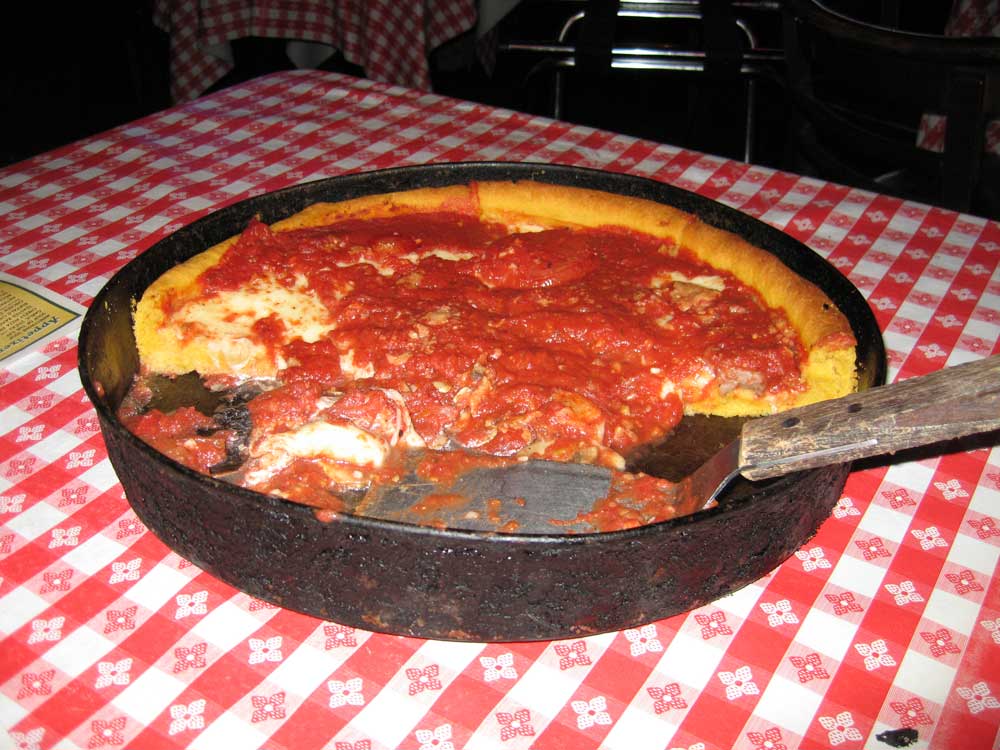
(Gino's East Pizza in Chicago. It falls just short, gratefully, of a maximally great pizza. I can barely look at this picture without salivating. It is: the world's greatest pizza.)
William Lane Craig here comments on his recent debate with atheist philosopher Victor Stenger. Craig presented a version of the ontological argument for God's existence. Stenger critiqued it by saying that, using the same kind of reasoning, one could prove the existence of a maximally great pizza.
Initially, because I am a pizza connoisseur from the Chicago area who has been transplanted into the pizza-barren-wasteland of Southeast Michigan, I am interested in the idea of a maximally great pizza. But Craig's response tells me I should not be so interested, since a maximally great pizza would be a necessarily existing pizza and, therefore, could not be eaten. If that is true (which it would be, as regards a maximally great pizza), then it would not be a pizza, since an essential attribute of "pizza" is "a food to be eaten."
Craig's point is that the idea of "maximally great pizza" is fundamentally incoherent. It's just Gaunilo's mistake again, re. his "perfect island." Neither islands nor pizzas nor any contingent things have intrinsic maximums. So Stenger's criticism of the ontological argument fails.
William Lane Craig here comments on his recent debate with atheist philosopher Victor Stenger. Craig presented a version of the ontological argument for God's existence. Stenger critiqued it by saying that, using the same kind of reasoning, one could prove the existence of a maximally great pizza.
Initially, because I am a pizza connoisseur from the Chicago area who has been transplanted into the pizza-barren-wasteland of Southeast Michigan, I am interested in the idea of a maximally great pizza. But Craig's response tells me I should not be so interested, since a maximally great pizza would be a necessarily existing pizza and, therefore, could not be eaten. If that is true (which it would be, as regards a maximally great pizza), then it would not be a pizza, since an essential attribute of "pizza" is "a food to be eaten."
Craig's point is that the idea of "maximally great pizza" is fundamentally incoherent. It's just Gaunilo's mistake again, re. his "perfect island." Neither islands nor pizzas nor any contingent things have intrinsic maximums. So Stenger's criticism of the ontological argument fails.
Saving the Humanities
(University of Michigan)
Peter Conn has written a helpful, guiding piece called "We Need to Acknowledge the Realities of Employment in the Humanities." The bottom lines include:
Though jobs may be few, I consistently see, in the students I am privileged to instruct every semester, a deep desire to talk about the Big Questions. For example, I just finished giving 60 10-minute oral exams to my philosophy of religion students. A number of them tell me how interesting and meaningful they find our class discussions as we talk and teach about God (existence/non-existence), evil (as problematic for God), meaning (nihilism; teleological thinking), ethics (moral values: objective/subjective), neurophilosophy (mind/brain matters; qualia; dualism), and free will. Just yesterday a few of my students told me they would like to major or minor in philosophy. These deep issues remain important. What is it to be "human?" Hence: the Humanities.
See Conn's 5 recommendations for graduate programs in the humanities.
Peter Conn has written a helpful, guiding piece called "We Need to Acknowledge the Realities of Employment in the Humanities." The bottom lines include:
- University humanities departments are shrinking.
- Adjunct professors are growing in numbers; tenured faculty are diminishing (anyone who teaches at a college or unversity easily sees this).
- "Full-time tenured and tenure-track jobs in the humanities are endangered by half a dozen trends, most of them long-term."
- The "University of Phoenix" phenomenon ("for-profit education") is growing. "According to a report in The Chronicle in February, 7 percent of all American postsecondary students attend for-profit institutions. Presumably, like Phoenix, all of those colleges and universities depend mainly on part-time faculty members."
- Getting a job with a Ph.D in the humanities is harder than ever.
- University humanities departments are not responding to these and other threatening conditions.
Though jobs may be few, I consistently see, in the students I am privileged to instruct every semester, a deep desire to talk about the Big Questions. For example, I just finished giving 60 10-minute oral exams to my philosophy of religion students. A number of them tell me how interesting and meaningful they find our class discussions as we talk and teach about God (existence/non-existence), evil (as problematic for God), meaning (nihilism; teleological thinking), ethics (moral values: objective/subjective), neurophilosophy (mind/brain matters; qualia; dualism), and free will. Just yesterday a few of my students told me they would like to major or minor in philosophy. These deep issues remain important. What is it to be "human?" Hence: the Humanities.
See Conn's 5 recommendations for graduate programs in the humanities.
Subscribe to:
Posts (Atom)


