Monday, November 07, 2022

31-Day Prayer Journey


Pastor and Leaders,


Take your people on a 31-day prayer journey in January, using my book....  


Coming to Amazon December 2022.


My other books are...


Encounters with the Holy Spirit (co-authored with Janice Trigg)

Voting "No" on Proposal 3

(I'm re-posting this to keep it in play.)

Linda and I will vote this November, by absentee ballot. I just opened up my ballot, and took this photo of Proposal 22-3.
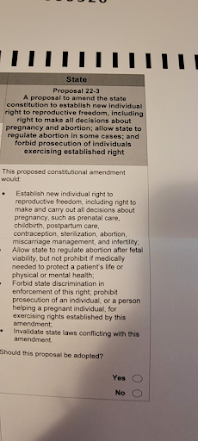
                                                            (Click on it to enlarge.)

We are voting "No" on Proposal 22-3. This is because we are against killing innocent, defenseless human beings.

We are troubled by the term "reproductive freedom," We see this as a euphemism for "freedom to kill your innocent, defenseless child." We disagree that our freedom should be employed to do that.

We believe the conceptus (the fertilized egg) is an innocent, defenseless human being. We see the term "viability" as irrelevant, and arbitrary, to the basic humanity of the conceptus.

We believe, if someone gets pregnant, that the conceptus is, precisely, their child, and that they are to love, nurture, and care for their child. As many do. (Sadly, not all do. And sadly, there are cases of incest, rape, and unwanted pregnancies. See how Francis Beckwith addresses these tragic situations - here.)

We believe the core issue is this: Is the conceptus a human being, or not? We believe it is, and remain confounded and unconvinced by any who think otherwise.

We believe the matter of allowing persons freedom to kill innocent, defenseless human beings is a moral, not a political, issue.

It is because of this that we conclude the following: It is morally wrong to take the life of an innocent, defenseless human being. We believe anyone who agrees with that statement will vote "No" on Proposal 22-3.

Abortion is the unjust taking of human life. This has been our position for decades. 

***
And...

When Does a Human Life Begin?


(Frost on car window)

"An amicus curiae (literally, "friend of the court"; plural: amici curiae) often referred to as amicus brief is defined as the legal brief where someone who is not a party to a case assists a court by offering information, expertise, or insight that has a bearing on the issues in the case. The decision on whether to consider an amicus brief lies within the discretion of the court. The phrase amicus curiae is legal Latin and its origin of the term has been dated back to 1605-1615. The scope of amicus curiae is generally found in the cases where broad public interests are involved and concerns regarding civil rights are in question." (From Wikipedia)

One of the legal briefs accepted by the Supreme Court in the Dobbs case regarding abortion rights concerned the following.

(From the brief.) 

"Amici curiae are biologists who work at colleges, universities, and other institutions in 15 countries around the world.

The fertilization view is widely recognized—in the literature and by biologists—as the leading biological view on when a human’s life begins... An international survey of academic biologists’ views on when a human’s life begins reported 96% of 5,577 participants affirmed the fertilization view. 

Fertilization, generally, marks the beginning of a sexually reproducing organism’s life and, specifically, marks the beginning of a human’s life, as it is the point at which a human first comes into physical existence as an organism that is biologically classified as a member of the Homo sapiens species."

When someone asks me why I am against abortion, my response is: Because I am against killing an innocent, defenseless human being.


***
And...


Sunday, November 06, 2022

Life Is a Series of Interruptions

(Monroe sunset)


Today in America, and around the world, we are still experiencing the Great Interruption. Normal life is no more.

Or, perhaps, normal life is a series of interruptions. And these interruptions, as the apostle Paul thought, can actually work to advance the Gospel. (See here, e.g.)

Jesus told Peter that, one day, there will be a Great Interruption. In John 21, after Jesus tells Peter to "Feed my sheep," we see one of the most non-seeker friendly passages in the New Testament. Jesus forewarns Peter:

""Very truly I tell you, when you were younger you dressed yourself and went where you wanted; but when you are old you will stretch out your hands, and someone else will dress you and lead you where you do not want to go.” Jesus said this to indicate the kind of death by which Peter would glorify God. Then he said to him, “Follow me!”" (John 21:18-19)

And Peter followed Jesus.

A real following after Jesus, a real "moving with the Spirit," involves being led by the Spirit into places where we would not want or choose to go. It involves being interruptible, for the sake of the Good News.

Our lives and our plans will often get interrupted by the Spirit, who is non-programmable and unpredictable. Henri Nouwen once said he used to get upset at his life being interrupted, until God told him his life was a series of interruptions.

To be interruptible. That is one mark of true servanthood. 

I've met many church people who you would never ask to do anything. Your request is a great inconvenience in their plans. You hear it in their voices, and see it on their faces. 

I have also met Spirit-led people who are eminently interruptible, willing to follow the Spirit wherever he leads them, to include being led to places where they would not choose to go.

Thomas Merton wrote: "What am I heading for? Where am I going? The answer to that one is: I don't need to know...  God knows what he wants to do with me. Rest in his tremendous love - to know the savor and sweetness of God's love expressed from moment to moment in all the contacts between him and your soul... Rest in that union. It will feed you, fill you with life. He will lead you into perfect solitude in His own good time. Leave it all to Him. Live in the present." (A Year With Thomas Merton, July 3)

Be free from the terrible burden of always having to have things go your way. 

Follow the Spirit in all things, even small things, for the sake of His Kingdom and glory.

Discern how the inconveniences of today can advance the cause of Christ. 

Pray "God, interrupt me. Inconvenience me for your glory."

Saturday, November 05, 2022

Guidelines for Civil Discourse #5 - Understand Before You Evaluate

(Lake Erie, Monroe, MI)

(I'm re-posting this to keep it in play.)

One evening, when we were younger, I came home from work and heard my sons talking with Linda. It sounded like they were arguing with her. I felt anger, strode into the living room, and took charge.

"Stop arguing with your mother!" I said, in a commanding voice.

All three of them stopped, looked at me, and one said, "You don't even know what we are talking about!"

Fools find no pleasure in understanding 
but delight in airing their own opinions.
Proverbs 18:2

I judged, without first understanding. That's foolish. (I evaluate my philosophy students on their understanding, not their agreement or disagreement with the arguments I present. I tell them, you cannot evaluate until you first understand. Otherwise, they are just airing their opinions.)

Proverbs 11:12 counsels:

Whoever derides their neighbor has no sense, but the one who has understanding holds their tongue.

Understanding breeds compassion. Compassionate people "feel with" the other person, and thus weigh their words.

Judging without understanding is divisive. In all things worth knowing, understanding precedes evaluating. This always takes more time. This is where we go slow. Remember that the relationship is more important than the outcome.


The good doctor examines before diagnosing.

The auto mechanic diagnoses before estimating.

The builder surveys before constructing.

The counselor listens before helping.

The smart consumer researches before purchasing.

The lawyer studies before presenting.

The police officer investigates before citing.

Whoever is patient has great understanding,
but one who is quick-tempered displays folly.
Proverbs 14:29

Folly brings joy to one who has no sense,
but whoever has understanding 
keeps a straight course.
Proverbs 15:21

The one who has knowledge 
uses words with restraint,
and whoever has understanding 
is even-tempered.
Proverbs 17:27

By wisdom a house is built,
and through understanding it is established.
Proverbs 24:23

The beginning of wisdom is this: Get wisdom.
Though it cost all you have, get understanding.

Friday, November 04, 2022

The Ontological Argument for God's Existence Revisited


(Somewhere in Ohio)

When I taught philosophy of religion at Monroe County Community College (18 years) I would open with Anselm's Ontological Argument for God's Existence. (See here.) The argument goes:

1. I have an idea of a being a greater than which cannot be thought.

2. Therefore, God exists.

Note that premise one is not about a really great being. It's about a greatest possible being; viz., a being a greater than which cannot be logically conceived.

Occasionally, I would introduce students to Alvin Plantinga's Modal Version of the Ontological Argument for God's Existence. One form of which, is this.

1. It is possible that a logically necessary being exists.

2. Therefore, God exists. 

Occasionally, I continue reading about this fascinating argument. 

See the recent edition of Philosophy Now - "The Ontological Argument Revisited." 

Thursday, November 03, 2022

Pray for the "No" of Christ to Be Formed in You


(Sunset on a Lake Michigan beach)


The making of a man is making your body
do what it doesn't want to do.

Robert Bly

Way back in the 1970s, when Linda and I were newly married, she received a phone call from a friend who led a Christian band. Our friend was a great speaker and evangelist. His band was popular, having made some albums. 

I was out of the house when he called. When I got home, Linda told me he had called. "He's inviting you to be the guitarist for the band." Their guitarist left the band, and they needed a new one. 

"What did you tell him?", I asked.

"I told him you don't want it."

After thinking for a moment, I said to Linda, "You're right."

God was calling me to be a student. And a pastor. And yet, when we turned on the TV a week later and saw the band playing before 50,000 people in a stadium, with Billy Graham the speaker, I has a fleeting doubt pass through my mind, waving as it went by.

Don't say yes to every opportunity. I want my yes to mean yes. This is about discernment, about what God wants me to do.

The mature person flourishes in life as they are able to wield the powerful word "No." The Jesus-idea is that, as we connect to him as a branch connects to a vine, we bear "fruit," part of which is awe-inspiring "self control." (Galatians 5:23) People drop their jaws and stare in wonder as people say "No" to mere self-gratification.

A Spirit-led, self controlled person is a free person. They have grown in their humanity and are empowered to say "No" to eating the wrong things, to spending money they don't have to buy things they don't need, to entering every open door, to affirming every idea, and to engaging in sexual behavior as the objectification of other persons.

"No" is the ultimate boundary word. The ability to wield this word will not come from hearing will-power slogans like "Just say 'No'." Authentic, boundary-setting 'No-ability" must become one's heart, one's inner being. This happens as Christ is formed in us.

Just because a door opens, it does not mean you are to walk through it.

Think of Jesus after he fed the 5,000. The people rushed after him to make him an earthly king. Jesus exercised self control and refused. His 'No' was not only for him, but for the sake of others; indeed, for the sake of the whole world.

This is a narrow road, said Jesus, and few take it. But it is the road to freedom. M. Scott Peck described The Road Less Traveled as "gratification delay." "No" is, perhaps, the ultimate other-centered word.

Pray for the "No" of Christ be formed in you, and go free.

The Bondage of Controlling Other People

(Monroe County)

Some people are control freaks, others are controlees. Many marriages are the coming together of these two types. Every control freak needs a controlee, and vice versa. There are a lot of "master/slave" marriages out there.

We all struggle with the control thing. I know I have. "Control" is the antithesis of "trust." Trust is huge in the Jesus-life, and life in general, since we control so very, very little. Keith Miller writes: "control is the major factor in destroying intimate relationships." (Compelled to Control: Recovering Intimacy in Broken Relationships, 7) This includes our relationship with God, because without trust it is impossible to please Him.

Why do we do this? Why do we try to control others, even while we can't control our own selves, being out of control and lacking self-control? Miller writes:

"The fear of being revealed as a failure, as not being "enough" somehow, is a primary feeling that leads to the compulsion to control other people. When we were children, the fear of being inadequate and shameful was tied to our terror of being deserted or rejected and we had little control over getting what we needed. To counteract that basic terror, we have evidently been trying all our lives in various ways to "get control" of life. This includes controlling other people." (14)

God wants to free us from the terrible burden of always having to get our own way. "Walking in freedom" and "controlling other people" ("always getting our own way") are antithetical.

I'm praying to be less controlling, and more trusting in God when it comes to others. 
Plus, we really cannot control another person, right? A controlling master might get a slave's body to obey, but they will never capture their heart.

***

Note: If you are a controlee who cannot set boundaries, you must read Boundaries: When to Say Yes, How to Say No.

Tuesday, November 01, 2022

Trust as the Cure for Anxiety and Fear


(Fall colors, on the river, in my back yard)

In 2016 I purchased a new chair for my home office. I like it. It's comfortable. It's solid. 

I trust it. 

It has held me for six years. I have no anxiety or fear in regard to it. 

The more trust, the less fear. Where there is trust, there is the absence of anxiety. It would be contradictory to say, "I trust the chair I'm sitting in, but am afraid it won't hold me." 

Trust overwhelms and is dismissive of anxiety and fear. 

There are objects of significant trust, and objects of insignificant trust. Objects of significant trust affect us; objects of insignificant trust have little or no effect. I may not trust the motives of the present King of France, but my mistrust does not cause me anxiety or fear because I am unaffected by his actions. But, my mistrust of our economy can cause me to wonder whether or not I will have sufficient funds to meet my needs in retirement. (BTW - there is no "present King of France." Many fears come as a result of mistrusting nonexistent objects.)


The person filled with anxiety and fear is the person who does not 
trust, or whose trust is misplaced. A wife should trust her husband. If the husband cheats on her, she loses trust. She is consumed by uncertainty. When the foundation gives way, trust goes with it.

Ultimately, who or what shall we trust? If atheism were true there is no one, or nothing to trust, in the end. (For an example of this see atheist Julian Barnes, Nothing to Be Frightened Of, with the emphasis on the noun "nothing.") 

But because God exists, and is who he is, in God I have trusted, for over fifty years. 

There is a cumulative effect that results from a lifetime of trusting in God. A psychological confidence, an existential certitude, emerges. The one who places their trust in God experiences less anxiety. It is like the confidence one gains as a result of sitting in the same chair for years, and finding that, through it all, it still holds.

I have met many people who experience this. I have been at the bedside of God-trusters as they lay, dying. You have to be there to see the reality of this, and the certainty of their faith.

Therefore...

Trust in the Lord with all your heart. 
Don't lean on your own understanding. 
In all your ways acknowledge God. 
And God will make straight your paths.

Proverbs 3:5-6

Monday, October 31, 2022

Transcendent Peace Overwhelms Anxiety


(Green Lake Conference Center, Wisconsin)

(I preached, yesterday morning at Redeemer, on the fruit of the Spirit that is peace. Here's the sermon link - "Transcendent Peace Overwhelms Anxiety.")


Jesus says, in John 14:27, "Peace I leave with you; my peace I give you. I do not give to you as the world gives. Do not let your hearts be troubled and do not be afraid." How shall we understand this?

When the disciples heard Jesus talk about the kind of peace "the world gives," they would have thought of the Pax Romana, the "Roman Peace." The world, so far as they knew it, was at peace. But this peace was far from satisfying, since it was acquired through war, and maintained by power and control. In addition, Israel and other nations were occupied by foreign armies and governors. 


From a Roman standpoint this looked good. But this is peace maintained by military might. 


It reminds me of when I was teaching in Singapore, arguably the most peaceful Asian country there is. I was told it was safe to walk the streets of Singapore at any time, day or night. The crime rate was extremely low. But, as one Singaporean businessman told me one day, "We fear the police." In worldly peace there is always fear. 

Jesus claims to give peace that is different from this. Jesus' peace must be understood as an overflow of the Trinitarian union of Father, Son, and Spirit. This is a union of love, a togetherness of life and purpose, a sharing in the divine essence. This is real peace, from the perspective of the Godhead. This is the peace Jesus leaves with us. 


Jesus does not say he will strengthen the kind of worldly peace we already have. He is not interested in taking the best political, military-maintained peace-solutions, and tweaking them to perfection. Rather he says, "Here, take my peace. I'm leaving it with you."


"To leave" has the sense of "to bequeath," as when property is transferred to an heir through a will. New Testament scholar Andreas Kostenberger says “Jesus’ parting benediction is more than a “cheap wish.” Jesus’ word is efficacious.” (John, 443) 


Jesus' word effects peace, in us.

This makes sense as we understand that, in John ch.s 14-17, we are invited to nothing less than participation in the Trinitarian union, which I refer to as the Big Dance. In the Big Dance there are beautiful relational manifestations, one of which is peace. 

This is not a theory. It's not a solution to some problem. And, importantly, it is not dependent on circumstances. It is the transtemporal essence of God given, on earth, as it is in heaven.

This is the peace promised to us as we abide in Christ. It is what the Spirit produces, in us, as we live attached to God. 

Thursday, October 27, 2022

Serving Up Peace in Heaven's Kitchen

(Our front porch)


If you are a follower of Jesus, then you are a peacemaker.

Jesus said, "Blessed are the peacemakers, for they shall be called children of God." (Matthew 5:9)

A peacemaker is more than a peacelover. As an analogy, consider food. You are a foodlover. Who isn't? Foodmakers, however, are different. Chefs are fewer yet.

Most love peace. But, as a follower of Jesus, you are a chef who serves up peace in the kitchen called the Kingdom of Heaven.

Why is a peacemaker referred to as a child of God? Because the apple does not fall far from the tree. Like Father God, like child of God.

Some tear down. You build up.

Some destroy. You create.

Some are passive. You are active.

Some weaken. You strengthen.

Some divide. You unite.

Some enslave. You redeem.

Any fool can be a troublemaker. A peacemaker, on the other hand, is an active creator who strengthens relationships. You do this with God. You do this in your family. Such beautiful people seem, to me at least, few and far between.

The peace you have with God and in your family overflows onto your other relationships.

In this, you are like your heavenly Father.