Friday, January 11, 2019

Growing Self-Recession as Progress in the Spiritual Life


Staircase, University of Michigan

In the spiritual life smaller is better. Less of me, more of God.

Learn the joy of living in the background. Be glad to be part of the supporting cast.

One Sunday morning we were worshiping to the song "From the Inside Out." One of the lines talks about "the art of losing myself." I pulled out a 3X5 card and wrote these words down: This is the key to whatever Christ-effectiveness I shall have in this life.

Theistic philosopher Roger Scruton, in The Soul of the World, writes:


"If there is anything that could be called progress in the religious history of mankind, it resides in the gradual preference for the self over the other as the primary sacrificial victim. It is precisely in this that the Christian religion rests its moral claim." (Scruton, 2)


I am to be a living sacrifice, for the sake of others, even my enemies.

A sign of progress in spiritual formation is growing self-recession. As God becomes more and more present, we take on a ministry of absence.

Wednesday, January 09, 2019

Why Is Self-forgiveness Harder than Forgiving Others?

Related image
Warren Dunes, Michigan
In my recent post on self-forgiveness from Everett Worthington's book Moving Forward I looked at the benefits of self-forgiveness. Now I'll consider what makes forgiving ourselves so difficult.

Worthington says there are two kinds of self-forgiveness: decisional self-forgiveness, and emotional self-forgiveness. In the first you no longer seek retaliation against yourself. You choose to not punish yourself for past failings. Instead, you choose to value yourself. 


In emotional self-forgiveness you replace negative, unforgiving emotions with positive emotions toward yourself. "It is emotional self-forgiveness that cools the heat of anger in your heart; it’s what Corrie ten Boom referred to as “the temperature of the heart .” The emotions we use to replace negative, unforgiving emotions are empathy, sympathy, compassion, and love for ourselves." (Worthington, p. 52) 

Why are these things so hard to do? Worthington cites studies showing that forgiving yourself is different from forgiving others. It is harder to forgive yourself than to forgive others. Worthington writes:

"When you attempt to forgive someone else for an offense, you are adopting the viewpoint of the forgiver. The wrongdoer, of course, is someone other than yourself. However, when you try to forgive yourself, you have to operate from two points of view— both forgiver and wrongdoer. Holding contrasting points of view at the same time is a strain. It is hard to bounce back and forth from one perspective to the other." (Ib., p. 54)

In forgiving someone else we are not with them (for the most part) 24/7. But we are with our own selves and thoughts all the time. We can't get away from ourselves. This can make forgiving ourselves harder than forgiving others.

Worthington says self-forgiveness is harder because we have "insider information"; i.e., we have information about who we really are. 


"The fact is, we know too much about ourselves. We know that we are capable of repeating the same wrong even when we know how hurtful it is. We also know that, as much as we profess love for God, we are like Paul who wrote: “I do not understand what I do. For what I want to do I do not do, but what I hate I do” (Romans 7: 15). That is, we know the weakness of our will to do the right thing." (Ib., 55)

Self-forgiveness is different and in some ways harder than other-forgiveness because:

1. We live with ourselves 24/7. That is, we live constantly with the one who has hurt us, which is us.

2. We have insider information about our own self that we cannot have when it comes to others.


***
My two books are:


The Rat-Race and the Tyranny of Quantity


Image result for john piippo tyranny
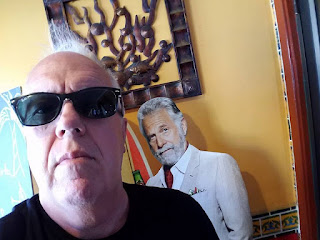
With the world's most interesting man in Redding, California
Thomas Merton writes:

"Let us start from one admitted fact: if prayer, meditation, and contemplation were once taken for granted as central realities in human life everywhere, they are so no longer. They are regarded, even by believers, as somehow marginal and secondary. What counts is getting things done." (Contemplation in a World of Action; published in 1971, posthumously. What would Merton write today)

"Getting things done" - that is the quantitative life. Discerning what one ought to do and what should get done - that's the qualitative life. The former is the "doing" life, the latter is the "being" life. 

Merton says the Jesus-life "aims at a certain quality of life, a level of awareness, a depth of consciousness, an area of transcendence and adoration which are not usually possible in an active secular existence." The authentic Jesus-follower seeks to be free from what William Faulkner called "the same frantic steeplechase toward nothing which is the essence of "worldliness" everywhere." (Ib., 9)

In the qualitative life there is an awareness and perspective, "an authentic understanding of God's presence in the world and his intentions for man. A merely fictitious and abstract isolation does not provide this awareness." (Ib.) In such a life we "escape in some measure from the senseless tyranny of quantity." (Ib., 10)

To live this way is not to escape from the world or be against the world. It is to be for the world in ways the world cannot understand.

What is most needed today for lovers and embracers of Jesus is to discover the inner life in such as a way as to make all of life something that is lived out of a solid, deep, aware, discerning center, which is the human heart morphed into the greater being which is Christlikeness.

Sunday, January 06, 2019

Silence Before God Is Different Than Entertainment In the Church


Button bush, Maumee Bay State Park, Ohio

"Silence is the discipline that helps us go 
beyond the entertainment quality of our lives."
- Henri Nouwen, The Only Necessary Thing, p. 49

For some years I taught a course on prayer in the D. Min. program at Northern Baptist Theological Seminary. One of my students was an African American leader and pastor in Chicago, named Joe. I remember the first day of class, back in 1980-ish. When the students arrived we did a few introductions. Then I sent them out to pray for an hour, using Psalm 23 as their meditative focus.


When they returned from class I asked, "How was that for you?" Joe was crying. He said, "I haven't prayed for an hour in 20 years."


Jump ahead four years. I'm teaching the same class, in the same place. When the D.Min. students arrived, there was Joe. I asked, "What are you doing here? You've already taken this class!"


Joe said, "I wanted to take it a second time. There is still so much for me to learn."


Joe is the only student who has taken my class twice. I asked how he was doing, and how his church was going. Joe shared this. 


"After that class four years ago I went back to my people and preached on a Sunday morning on Psalm 46:10 - 'Be still, and know that I am God.'"


"What happened?" I asked.


"I simply read the verse, then sat down. There was silence for 40 minutes. Finally, one person stood up and spoke a word from God. Then another did the same. We just stayed there, silently, in the thick presence of God. Gradually, one by one, people began to leave."


"How was it, Joe?"


"It was... electric!"


Wow, I thought. Joe has a hopping, dynamic church. What a radical idea God gave him! This story confirmed a number of things I believe about pastoral ministry, and the nature of the church.


  1. This kingdom of God is about God's presence, in which God rules and reigns.
  2. Therefore, desire God's presence, in the first place.
  3. Dismiss the idea that we need to entertain our people, that what our people need is more entertainment so they'll stay with us.
  4. What our people most need is God.
  5. Cultivate a Presence-Driven environment that moves with and responds to God's presence.
  6. Usher people into God's presence. Here is where the "audience" dissolves and engagement with God begins.


I'm now working on Transformation: How God Changes the Human Heart

Thursday, January 03, 2019

Never Work Out Conflict By Texting

Image result for john piippo texting
Maumee Bay State Park (Ohio)

When working through conflict, the best way is face-to-face.

Next best is by phone.

Worst is by texting. It may be worse than doing nothing at all.

NYU psychologist Adam Alter writes: 

"Many teens refuse to communicate on the phone or face-to-face, and they conduct their fights by text. “It’s too awkward in person,” one girl told Steiner-Adair. “I was just in a fight with someone and I was texting them, and I asked, ‘Can I call you, or can we video-chat?’ and they were like, ‘No.’” Another girl said, “You can think it through more and plan out what you want to say, and you don’t have to deal with their face or see their reaction.” That’s obviously a terrible way to learn to communicate, because it discourages directness. As Steiner-Adair said, “Texting is the worst possible training ground for anyone aspiring to a mature, loving, sensitive relationship.”" (Alter, Irresistible: The Rise of Addictive Technology and the Business of Keeping Us Hooked, p. 41. Emphasis mine.)

Marriage and Money

Our home office (our house was built in 1860!)

I knew a man who bought a house for his family to live in, without telling his wife. He just showed up at home and told her, "I bought a new house for us to live in."

Unbelievable. Controlling. Insensitive. Uncaring. 

Back in the 1970s, when Linda and I were newly married, our church family hosted a financial seminar. This was revolutionary for me. Among other things, I learned that...


  • All Linda and I possessed was the Lord's.
  • We were stewards of what God had given us.
  • Part of our stewardship involved having a budget.
  • Linda and I were to work at the budget together, discerning how God wants us to use the resources he has allowed us to oversee.
For one month we carried a notepad with us, writing down every penny we each spent. I found that I was doing a lot of small spending - a cup of coffee here, another cup of coffee there, a candy bar, a newspaper, and a few quarters spent on video games. I found out a great truth: it was possible to know where the money was going

Yesterday, January 2, 2019, we sat together before the computer screen. I pulled up the budget for 2019. We looked at it together. I like working with our household budget, and check it at least once or often more every week. 

We looked at our basic expenses (giving to God's work and the church, mortgage, car payment, utilities, food, medical expenses, etc.). I pulled up our bank account online, so Linda could see how much we currently have.  

Then, we looked at expected income for 2019. We saw that, after expenses, we could project having some extra money. So, we talked about a few things that we discerned God would have us do with this surplus. Linda had two discernments that we began to act on immediately. Both involved maintaining our old house. Later in the day, as we went out to lunch together, Linda shared how thankful she was to God for available resources to put into our home. I agreed.

After the financial seminar in the 1970s one of the things Linda and I agreed on was this; neither of us would spend more than $50 on something unless we both agreed God wanted us to do this. We would discern this together. We are fully committed to these ideas: All we have is God's. We must discern how God wants us to use his resources. We are to discern this together.

These principles apply, whether we have had little, or had much. They have helped us avoid conflicts over money, and have contributed to grounding us in trust, first of the Lord, and secondly of one another.

Wednesday, January 02, 2019

2019 - The Year of Connection, Discipleship, and Reproduction

Detroit

A new year has begun. Your mission, should you choose to accept it, is: Draw close to Jesus and follow his instructions.

Do not disengage from being a disciple and get "too busy for church." 

Be encouraged. You have enough real Jesus-followers in your community to change your county. What is needed is for you to awaken, come to life, and embody a move of God. Therefore, attach yourself to Jesus, now.

Dallas Willard writes:

"Now, some might be shocked to hear that what the “church”— the disciples gathered— gathered— really needs is not more people, more money, better buildings or programs, more education, or more prestige. Christ’s gathered people, the church, has always been at its best when it had little or none of these. All it needs to fulfill Christ’s purposes on earth is the quality of life he makes real in the life of his disciples." (Willard, The Great Omission(Kindle Locations 159-162). 

"The greatest issue facing the world today, with all its heartbreaking needs, is whether those who, by profession or culture, are identified as “Christians” will become disciples— students, apprentices, practitioners— of Jesus Christ, steadily learning from him how to live the life of the Kingdom of the Heavens into every corner of human existence." (Ib., Kindle Locations 164-167)


"It is a tragic error to think that Jesus was telling us, as he left, to start churches, as that is understood today. From time to time starting a church may be appropriate. But his aim for us is much greater than that." (Ib., Kindle Locations 145-146)


What can this mean? It means: Jesus did not say "Go into all the world and start churches." Right? This is hard, because the American way is bigger, bigger, bigger, more, more, more. Yes, Jesus wants all humanity to be saved. But "saved" includes discipleship and spiritual formation into Christlikeness, without which one has committed The Great Omission.


Here is Willard's translation of Matthew 28:18-20:


“I have been given say over all things in heaven and in the earth. As you go, therefore, make disciples of all kinds of people, submerge them in Trinitarian Presence, and show them how to do everything I have commanded. And now look: I am with you every minute until the job is done.”


You are a disciple of Christ. You are the Church. You are a move of God. Reproduce this in someone else. 

Forget the size of your church and focus on what Jesus commanded. Go after making one disciple, from any people group. This is for you, not just pastors. If everyone who claimed to be a follower of Jesus did this, "the outward effect of this life in Christ [would be a] perpetual moral revolution, until the purpose of humanity on earth is completed." (Ib., Kindle Locations 148-149)

Tuesday, January 01, 2019

The Pauline Thinking Cure and Cognitive Behavioral Therapy

Harrison, Michigan (Photo by Josh Piippo)

I am interested in connections between Pauline thinking and Cognitive Behavioral Therapy. 

Paul writes:

"Finally, brothers and sisters, 
whatever is true
whatever is noble, 
whatever is right
whatever is pure, 
whatever is lovely, 
whatever is admirable 
-- if anything is excellent or praiseworthy 
-- think about such things 
and the God of peace will be with you."
Philippians 4:8

Examples of Pauline thinking include the "declarations" given by Steve Backlund of Bethel Redding Church, and the identity statements of Neil Anderson. Both are about thinking on identity truths, using verbal repetition. 

For example, I am God's child and deeply loved by him. As followers of Jesus, that's true, right? So, why not meditate on that truth so that, as Henri Nouwen says, it might descend from our mind into our heart.

I'm now reading The Coddling of the American Mind, by Greg Lukianoff and Jonathan Haidt. They advocate Cognitive Behavioral Therapy (CBT) as a cure for maladies such as anxiety disorder, depression, OCD, anger, marital conflict, and stress-related disorders. CBT is uncannily similar to Paul's instructions in Philippians 4:8.

CBT treats cognitive distortions, such as "I'm no good," "My world is bleak," and "My future is hopeless." (Lukianoff and Haidt, 36) CBT breaks disempowering feedback cycles between negative beliefs and negative emotions.

They write:

"With repetition, over a period of weeks or months, people can change their schemas and create different, more helpful habitual beliefs (such as "I can handle most challenges" or "I have friends I can trust.")" (Ib., 37) This is remarkably like Backlund's identity declarations. (See also James K. A. Smith's excellent You Are What You Love: The Spiritual Power of Habit.)

Cognitive distortions empower negative emotions. Put in a Pauline way, repetitive thinking on "whatever is false" distorts our emotions. Lukionoff and Haidt are concerned over our universities and the cognitive distortions they produce in our students. While to my knowledge neither Lukionoff nor Haidt are Christians, they refer to CBT as the "thinking cure." (See here.) I see the Pauline "thinking cure" of Philippians 4:8 as combating these distortions in ways that are similar to CBT. 

They list nine such distortions. Here they are, direct from the book, with my comments on logical fallacies added. (38). 

NINE COMMON COGNITIVE DISORDERS PEOPLE LEARN TO RECOGNIZE IN CBT

EMOTIONAL REASONING 
Letting your feelings guide your interpretation of reality. 
"I feel depressed; therefore, my marriage is not working out."
(In logic this is an example of the fallacy of false cause.)

CATASTROPHIZING
Focusing on the worst possible outcome 
and seeing it as most likely. 
"It would be terrible if I failed."
(This is similar to the slippery slope fallacy in logic.)
OVERGENERALIZING
Perceiving a global pattern of negatives 
on the basis of a single incident. 
"This generally happens to me. 
I seem to fail at a lot of things." 
(In logic this is called the fallacy of hasty generalization.)

DICHOTOMOUS THINKING
Also known as "black and white thinking," 
"all or nothing thinking," and "binary thinking."
Viewing events or people in all-or-nothing terms.
"I get rejected by everyone," or
"It was a complete waste of time."
(In logic this is called the fallacy of false dichotomy.)

MIND READING
Assuming that you know what people think without having sufficient evidence of their thoughts.
"He thinks I'm a loser."

LABELING
Assigning global negative traits to yourself or others (often in the service of dichotomous thinking).
"I'm undesirable."
"he's a rotten person."

NEGATIVE FILTERING
You focus almost exclusively on the negatives and seldom notice the positives.
"Look at all of the people who don't like me."

DISCOUNTING POSITIVES
Claiming that the positive things you or others do are trivial, so that you can maintain a negative judgment.
"That's what wives are supposed to do - so it doesn't count when she's nice to me."
"Those successes were easy, so they don't matter."

BLAMING
Focusing on the other person as the source 
of your negative feelings; 
you refuse to take responsibility 
for changing yourself.
"She's to blame for the way I feel now."
"My parents caused all my problems."

Lukionoff and Haidt claim that universities encourage students to use the distortions listed above. (40)


A Spiritual Life Without Discipline Is impossible

Image may contain: sky, beach, cloud, outdoor and nature
Bozeman, Montana
For Christmas I received a gift of a book I have wanted to read - Mere Spirituality: The Spiritual Life According to Henri Nouwen, by Wil Hernandez. No Christian author writing on spiritual formation and transformation has influenced me more than Nouwen.

Nouwen deeply informs my praying life. Years ago I chose to find solitary places to meet with God. I disciplined myself to do this, much in the same way I disciplined myself to practice the guitar. In those solitary places God began to speak to me. I write about what I discovered in my book Praying.

Nouwen wrote, "A spiritual life without discipline is impossible. The spiritual life demands a discipline of the heart to assist us to let God into our hearts and become known to us there, in the deepest recesses of our own being." (Hernandez, xx)

I am a disciple of Christ. Just as, for a long period of my life, I was a disciple of the guitar. I disciplined myself to practice. The result was an increase in ability and capacity. Spiritual discipline is like this. It is "the concentrated effort to create some inner and outer space in our lives where obedience can be practiced." (Ib. See also Dallas Willard, The Spirit of the Disciplines. I will explain this in my own words in a book I am now writing, tentatively called Transformation: How God Changes the Human Heart.)

I don't wait for the desire to pray. I pray because I am called, by God, to meet with him and pray. The effect in me, over time, is the increase of desire to pray.

In the Gospels we read that Jesus went to lonely places to meet with the Father and pray. I am a follower of Jesus. He is my exemplar. Therefore, I spend time in what I call the
place of least distraction" and meet with God and pray. I place my physical body and my spiritual self in a space where I can listen and see and feel the presence of God. 


Praying is, arguably, the main way we live like branches attached to the true Vine, who is Jesus. I have learned to do those things that attach me, so God can do in me those things I cannot do for myself and others.

I'm writing these words in the morning of a new year. Why not make this year a time of greater attachment to Jesus? The odds of this happening increase if you begin today. 

I bless you with a discipline towards Christ that furthers the transformation Christ will produce in you!