Thursday, January 23, 2025

Moving From Self-Hatred to Self-Forgiveness


My backyard - a light at the end of the tree tunnel

There are things in my past that I wish I would have done differently, words I wish I would have spoken, and words I wish I would not have said. I'm thinking of one of my past failures right now. The good news is that I am not hating myself for hurting someone years ago.

If you struggle with self-hatred I recommend Everett Worthington's - Moving Forward: Six Steps to Forgiving Yourself and Breaking Free From the Past. Worthington is Professor of Psychology at Virginia Commonwealth University, and a follower of Jesus.

I got this book two years ago and am still slow-cooking in it. I can never hear enough about forgiveness. I need it for myself. And, I need more wisdom in dispensing it to others.

I meet many who cannot forgive their own selves from past failures, whether real or imagined. Un-self-forgiveness is a mental and spiritual assassin. Self-forgiveness, that is rooted in God's great act of forgiveness in Christ, is liberating.

Self-forgiveness will free you from guilt. "Sometimes guilt arises over unrealistic expectations and standards of perfection that none of us can achieve. When you are able to forgive yourself, that weight is lifted." (Worthington, p. 45)

Self-forgiveness will free you from self-blame. "Self-forgiveness frees you from the chattering, accusing voice in your head." (Ib., 46)

Self-forgiveness will free you from stress-related illness. "Self-forgiveness can improve your health, and here’s why. Holding on to self-condemnation elevates your stress, which has been associated with a long list of physical and psychological harm." (Ib.)

Self-forgiveness can liberate you from alcohol misuse. "Forgiveness of the self might be, for alcoholics, the most difficult type of forgiveness to achieve. But if they were able to do so, it could help control their drinking." (Ib., p. 47)

Self-forgiveness can liberate you from accusation. "By bringing our sins to God and receiving God’s forgiveness, we can then forgive ourselves and we can rest in the knowledge that the accusations of Satan are groundless. If we forgive ourselves, we can silence the oppressive voice of the enemy." (Ib., 47)

Self-forgiveness provides freedom for flourishing. "By not being so wrapped up in self-condemnation, you can enjoy more pleasurable and positive experiences." (Ib.)

Self-forgiveness provides freedom for focusing on God. "Instead of being wrapped up in condemning yourself for past failures, you can seek God and enjoy that relationship." (Ib.)

Self-forgiveness provides freedom for focusing on others. "Self-forgiveness allows you to focus on others, with the goal of helping to meet their needs." (Ib., p. 48)

Self-forgiveness provides freedom for health. "Self-forgiveness provides energy and vitality. It supplies both a freedom from the past and a forward-thinking orientation that helps you seek the benefits of exercise, a healthy diet, and energetic work." (Ib.)

Self-forgiveness provides freedom for a better quality of life. "Self-forgiveness can matter greatly in enhancing one’s quality of life." (Ib., 50)

Self-forgiveness provides freedom for peace. "People who continue to wrestle with self-blame are unsettled. They find it difficult to exhale and relax. Forgiving yourself will help you live at peace." (Ib.)

Worthington cites empirical studies that support these conclusions. Why, given the great benefits of self-forgiveness, would anyone choose to wallow in self-condemnation? 
Why is forgiving ourselves so hard? 

Worthington says there are two kinds of self-forgiveness: decisional self-forgiveness, and emotional self-forgiveness. 


In the first you will no longer seek retaliation against yourself. You will choose to not punish yourself for past failings. Instead, you choose to value yourself. 

In emotional self-forgiveness you replace negative, unforgiving emotions with positive emotions toward yourself. "It is emotional self-forgiveness that cools the heat of anger in your heart; it’s what Corrie ten Boom referred to as “the temperature of the heart .” The emotions that we use to replace negative, unforgiving emotions are empathy, sympathy, compassion, and love for ourselves." (Worthington, p. 52) 

Why are these things so difficult to do?

Worthington cites studies showing that forgiving yourself is different from forgiving others. It is harder to forgive yourself than to forgive others. He writes:

"When you attempt to forgive someone else for an offense, you are adopting the viewpoint of the forgiver. The wrongdoer, of course, is someone other than yourself. However, when you try to forgive yourself, you have to operate from two points of view— both forgiver and wrongdoer. Holding contrasting points of view at the same time is a strain. It is hard to bounce back and forth from one perspective to the other." (Ib., p. 54)

In forgiving someone else we are not with them (for the most part) 24/7. But we are with our own selves  and thoughts all the time. We can't get away from ourselves. This can make forgiving ourselves harder than forgiving others.

Worthington says self-forgiveness is harder because we have "insider information"; i.e., we have information about who we really are. "The fact is, we know too much about ourselves. We know that we are capable of repeating the same wrong even when we know how hurtful it is. We also know that, as much as we profess love for God, we are like Paul who wrote: “I do not understand what I do. For what I want to do I do not do, but what I hate I do” (Romans 7: 15). That is, we know the weakness of our will to do the right thing." (Ib., 55)

Self-forgiveness is different and in some ways harder than other-forgiveness because:

1. We live with ourselves 24/7. That is, we live constantly with the one who has hurt us, which is us.

2. We have insider information about our own self that we cannot have when it comes to others.


How, then, can we forgive ourselves? Worthington gives Six Steps to Self-forgiveness. Here you need to read the whole book. But the 6 Steps are:

STEP 1 - Receive God's Forgiveness

  • Go to God for understanding (the task is too big to handle alone)
  • Go to God with regret, remorse, and repentance
STEP 2 - Repair Relationships
  • Take responsibility (you are not the model citizen you'd like to be)
  • Confess to any you have hurt (admitting you're in the wrong goes far in turning things around)
  • Make amends through responsible compassion (thinking of others can help you make things right)
STEP 3 - Rethink Ruminations
  • It's not necessarily helpful to wrestle with the Almighty
  • Adjust perfectionistic standards and unrealistic expectations (Worthington shows how to do this. Getting real about yourwelf moves the process forward.)


STEP 4 - REACH Emotional Self-forgiveness
  • Worthington shows how to move from saying it to feeling it, using the acronym REACH:

1. Recall the hurt. 
2. Empathize with yourself by considering the reasons that you disappointed yourself. 
3. Give yourself the same Altruistic gift you would give other people— understanding and forgiving. 
4. Commit to the emotional self-forgiveness that you experience in order to … 
5. Hold on to self-forgiveness if you ever doubt that you have forgiven yourself. (207)

STEP 5 - Rebuild Self-acceptance
  • Live in the truth that you are deeply flawed and also valuable beyond belief
STEP 6 - Resolve to Live Virtuously
  • Live virtuously, but give yourself room to fail
And through it all, remember Galatians 5:1 - "It is for freedom that Christ has set us free."

The Orwellianism of DEI


                                                            (Lake Erie, Monroe, MI)

(DEI is now struggling.)

D - Diversity.

E - Equity.

I - Inclusion.

DEI.

Sounds wonderful, right? But if you don't march to the anthem of the DEI ideology, then you're ideas are tossed into an Orwellian memory hole.* 

No, DEI does not mean God (like agnus dei).

What is DEI, in our universities?

"DEI is an effort within the administrative authority of the college to shape the whole institution and all its activities consistent with its ideology.

When coming from the college’s administration, DEI practices essentially gatekeep entry to college faculty, staff and students. Requiring DEI statements as part of the faculty employment process dissuades those who think otherwise from even applying. It stifles discourse by keeping dissenting viewpoints from campus in the first place.:

- Wall Street Journal, 2/12/23 - "DEI Spells Death for the Idea of a University"

Such as - "We don't want speakers like you on our campus."

* A memory hole is any mechanism for the deliberate alteration or disappearance of inconvenient or embarrassing documents, photographs, transcripts or other records, such as from a website or other archive, particularly as part of an attempt to give the impression that something never happened.[1][2] The concept was first popularized by George Orwell's 1949 dystopian novel Nineteen Eighty-Four, where the Party's Ministry of Truth systematically re-created all potentially embarrassing historical documents, in effect, re-writing all of history to match the often-changing state propaganda. These changes were complete and undetectable. (https://en.wikipedia.org/wiki/Memory_hole ) 


Tuesday, January 21, 2025

Trump, Dawkins, Sex, and Gender


"President Donald Trump on Monday signed executive orders proclaiming that the U.S. government will recognize only two sexes...

It requires that the federal government use the term “sex” instead of “gender,” and directs the State Department and the Department of Homeland Security to “require that government-issued identification documents, including passports, visas, and Global Entry cards, accurately reflect the holder’s sex.

Across the country, ideologues who deny the biological reality of sex have increasingly used legal and other socially coercive means to permit men to self-identify as women and gain access to intimate single-sex spaces and activities designed for women, from women’s domestic abuse shelters to women’s workplace showers. This is wrong," the order reads. "Efforts to eradicate the biological reality of sex fundamentally attack women by depriving them of their dignity, safety, and well-being." (NBC NEWS)

I agree.

If you don't like this, perhaps take it up with evolutionary biologist and atheist Richard Dawkins. He can handle it. 

He likes to discuss. And, he knows more about genetics than you do. Me too. ( For Dawkins and theistic geneticist Francis Collins in dialogue, go here.)

Dawkins is still the world's most famous intellectual atheist. His book The Selfish Gene has been used in university biology classes.

Dawkins was interviewed by Piers Morgan. The full interview is here. I find it interesting.

Here's a snippet, on sex and gender.

Piers: They (woke-ists) want to de-gender and neutralise language, but they're doing it from a completely false pretext that you can somehow pretend biology doesn't exist, particularly when it comes to someone's sex. A small group of people have been successful in reshaping swathes of the way society talks and is allowed to talk.

Richard: It's bullying. We've seen the way JK Rowling has been bullied, Kathleen Stock has been bullied. They've stood up to it, but it's very upsetting the way this tiny minority of people has managed to capture the discourse to talk errant nonsense.

Piers: What's the answer?

Richard: Science. There are two sexes. You could talk about gender, if you wish and that's a subjective.

Piers: But when people say there are 100 genders?

Richard: I'm not interested in that. As a biologist, there are two sexes and that's all there is to it.

Piers: Why have we lost that ability to actually have an open and frank debate?

Richard: There are people for whom the word discuss doesn't mean discuss, it means you've taken a position.

Again, If you don't like what Richard Dawkins is saying here, I recommend you take it up with him. I simply report this to you. 


A heads-up. To dialogue with Dawkins, you must understand what he means by 'science' and its limits.

Remember also that Dawkins, as a scientist, despises postmodern thinking.

***
See also, 

"Richard Dawkins Says Science Is Pretty Clear About Sex" ("Sex is a true binary, one of rather few in biology.)


Monday, January 20, 2025

Spiritual Formation and the Prayer Life of Martin Luther King, Jr.


I teach spiritual transformation at Payne Theological Seminary. Here are my notes on the prayer life and spiritual formation ideas of Martin Luther King, Jr.


It is a mistake to portray King as a great leader while leaving out his Christian theistic spirituality and deep prayer life. Such things were foundational to King, in his own mind.


SPIRITUAL FORMATION & THE PRAYER LIFE OF MARTIN LUTHER KING, JR.

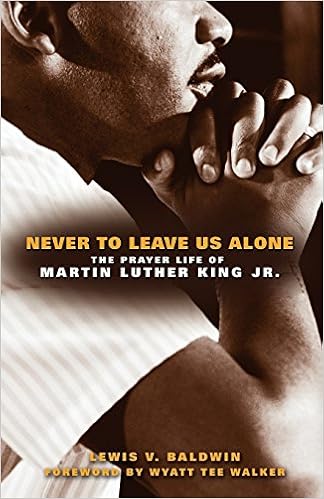
All quotes unless otherwise cited from Lewis Baldwin, Never to Leave Us Alone: The Prayer Life of Martin Luther King, Jr.

See also:


Prayer as a conversational relationship with God.

  • King defined prayer as “the human response to God.” (1)
  • Prayer is a daily conversation and walk with God. (2)
  • King honored his slave ancestors by practicing prayer as “talking with God.” (21)
  • For King prayer was “communion with God.” (28) Because of this prayer is far more than “inspired speech or religiously informed rhetoric.” (28)
  • King described prayer as “intimate conversation with God.” (32)
  • Sometimes God’s communication to the praying person comes as “prophetic revelation.” (33)
  • Sometimes the praying person is given “mystic insight” into the being and nature of God. (34)


If you don’t have a prayer life you have no business being a pastor.
  • “King was thoroughly convinced that it took fervent and persistent prayer to pastor a church, and his own life bore the stamp of that conviction.” (54)
  • King believed that “the need to develop a prayer practice or habit and indeed a vibrant prayer life was axiomatic for the both the pastor and the congregation.” (59)

If you don’t have a prayer life you have no business preaching.
  • King never engaged in prayer-less preaching or prayer-less sermonizing. (6)
  • King was a praying preacher who approached the act of preaching in a prayerful spirit. “Indeed, prayerful preaching is the key to understanding King as a master pulpiteer, and it explains much of the power and creativity he brought to his sermonic discourse and to his art as one who proclaimed the Word as revealed in Scripture.” (39)
  • King was convinced that the ability and energy to preach came from God. Therefore “King made prayer an all-commanding factor in his sermon preparation.” (40)
  • King “prayerfully surrendered to God” as he prepared his sermons. (40)
  • King was “intentional about praying in the privacy of his home, church office, hotel room, and other relatively isolated places in which he found a greater measure of peace, silence, and solace.” (40-41)
  • King depended on “’preparatory prayer’ in thinking through and writing his sermons.” (41)
  • “King never engaged in prayerless sermonizing and/or preaching.” (44)
  • King “literally lived by prayer. Prayer pervaded every corner of his life.” (50)


Prayer as abiding in the presence of God.
  • Prayer became King’s way of expressing himself to God, of experiencing God’s presence and companionship, and of witnessing on behalf of others. (28)
  • King’s “pastoral prayers at Dexter Avenue Baptist Church moved people and were effective because he spent quality time with his parishioners in what he called “the valley” of life.” (58)
  • For King “prayer… was the source of and pathway to a grace-filled life.” (59)

Intellectual ability is not enough.
  • King combined a deep personal piety with intellectual ability and a profound social vision. (1)
  • King never separated intellectual ability, moral responsibility, and social praxis from deep personal spirituality and piety. (5)
  • For King “prayer became a matter of invoking the supernatural and an expression of his humble submission before the omnipotent, omniscient, omnipresent, and omnibenevolent God, without whom the preaching becomes a meaningless play of words.” (42)
  • For King, “the preacher had to pray for guidance to ay what needed to be said and to proclaim what needed to be proclaimed… The thought of sermons having the same effect as water on a duck’s back, which is easily shaken off, bothered King immensely.” (44)
  • “King understood that his seminary training and intellectual gifts, though necessary and significant, could not guarantee what was called in clack church circles “power from on high.” This view helps explain why King, in both his private and public lives, mastered prayer as the art of pastoral conversation with God.” (54)
  • Once King received a phone call at midnight from a racist who verbally degraded him, and threatened to kill him and “blow up” his home. This deeply disturbed him, and he was unable to sleep. “Knowing that the theology he had studied in the corridors of academia could not help him and that he had nowhere else to turn, King had a face-to-face encounter with what he, in the tradition of his forebears, called a “Waymaker,” exposing his fears, insecurities, and vulnerablities with sincerity and humility. Great comfort came as an “inner voice” spoke to King, reminding him that he was not alone, commanding him to stand up for righteousness, justice, and truth, and assuring him that “lo, I will be with you, even to the end of the world.”” (69)


Prayer and Solitude
  • Solitude, getting alone with God, just you and God, was important for King. (69)


Prayer and Personal Transformation
  • King’s prayers highlighted the necessity for the transformation of the soul and uniting the soul with God in heaven. (31)
  • King believed in the power, potential, and possibilities of prayer as a “life-transforming force.” (36)
  • For King, one must “sustain a life of prayer.” This involves “a profound surrender of the self to God, not prayer rooted in self-pride, self-righteousness, and self-centeredness.” (54)
  • “King had a deep appreciation for contemplative prayer and of the potential of the Christian inner life… [He also had] an intense longing for the simple presence of God, a deeper understanding of God’s Word and commandments, and the will and capacity to listen to and obey God. In this regard, solitary prayer was as important to King as communal or group prayer.” (56)
  • In being interested in contemplative prayer King was not stepping outside of his tradition, “for there is a contemplative trajectory in the black prayer tradition that is not ecstatic and theatric.” (57)
  • For King the worship experience also involves “silent communication with God.” (57)
  • “For King, the lives of the ancient Hebrew prophets and of Jesus highlighted the essentiality of contemplative prayer. He say that the prophets and Jesus withdrew at times to quiet places to communicate with God, thus becoming a model for every sincere believer. King also understood that periods of quiet prayer and meditation were necessary for him and his church folk because of the pressures of black life I the South and the hectic pace and rapid change of modern life in a noisy world.” (57)
  • Because “prayer can change the very fabric of reality… prayer was a catalyst for positive change in one’s self and one’s circumstances and that the promises of God are met largely through prayer.” (59)


Prayer and Social Transformation

  • Prayer has a unique role in any serious and legitimate effort to achieve social transformation. (4)
  • “Prayer and praying became for [King] powerful resources in the effort to transform civic and political culture and in the quest for a new nation and a new world order.” (65)
  • Prayer is connected to God’s work in the world. (67)
  • “King made prayer central to the struggle for civil and human rights.” (67-68)
  • King saw himself as essentially involved in a “spiritual movement,” and not simply a struggle for equal right, social justice, and peace.” (68)
  • Because the root, basic struggle is about a total way of life, without prayer’s connection to God “the quest to redeem and transform the moral and political spirit of the nation and of humanity as a whole would ultimately prove futile and perhaps even counterproductive.” (68)
  • “King believed that the more praying there was on the part of committed persons, the stronger the force against evil and the greater the opportunities for creating a better society and world.” (73)
  • “King taught the people of Montgomery that the weapon of prayer was ultimately more powerful and effective than any gun or bomb.” (75)


In prayer, the self gets exposed.
  • In prayer as intimate conversation with God the self gets exposed in all of its nakedness and with all of its perplexities, struggles, and temptations. (32)

Prayer and Healing
  • King saw and practiced prayer “as a dimension of healing ministry.” (59)
  • King “believed… that prayer embodied infinite possibilities for healing.” (59)
  • King lived in a church culture where people “believed that prayer influences God’s dealings with humanity and in which a frequently heard remark was that “prayer changes things.”” (59)
  • Prayer can change the very fabric of reality. (59)

Prayer as a weapon of warfare.
  • Prayer has a place in the struggle against hatred, intolerance, and war.” (35)

Effective prayer
  • King was “convinced that the power of prayer, much like that of preaching, is largely affected by the character and conduct of the person who prays.” (49)
  • “Prayer and a clean spirit are the preacher’s best and most durable weapons when faced with the perilous and capricious nature of life and human existence.” (50)
  • “King was effective because his praying and preaching were effective. True leadership in his case made prayer and preaching indispensable.” (50)

Prayer and Obedience
  • Prayer needs to be combined with intelligence and responsible, positive action. “King wanted his people at Dexter to know that genuine prayer is never an opiate but rather a life-giving power that stimulates effort and energizes the believer for a courageous and persistent engagement with life’s struggles… [King] also repeatedly reminded them that God should never be regarded as some “cosmic bell hop” to be called on for every trivial need and desire.” (61)

Prayer and Theology
  • For King prayer “was a theological activity, or in more precise terms, an exercise in practical theology.” (64)


*****
For King to pray is to engage in a rational activity, a natural activity. Prayer comes out of “a throbbing desire of the human heart.” (34)


“Praying as an act of selfishness was repulsive to King.” (35)

The Source of Martin Luther King, Jr.'s Social Activism

Image result for lewis baldwin king

(I'm re-posting this to keep it in play.)

In George Orwell's book 1984 the main character, Winston Smith, has the job of eliminating politically unwanted ideas, documents, and words, by throwing them down a "memory hole." To rewrite history is to forget history. To do this is "Orwellian."

An example of current Orwellian activity comes from the Freedom from Religion Foundation (Stephen Pinker, Richard Dawkins, et. al.). On their website they write:


The history of Western civilization shows us that 
most social and moral progress has been brought about 
by persons free from religion.

Unbelievable. The social activism of Dr. Martin Luther King, Jr., is but but one powerful counterexample to this unsupportable claim.

Sadly, we will see Orwellian unthinking in today's celebration of Dr. King's  birthday. Which means we will not see the true sources of his social activism.

It is my privilege to teach spiritual formation in one of the nation's oldest African American theological seminaries, Payne Theological Seminary. In my classes I have taught on the prayer life of Dr. King. 

As our nation pauses to honor Dr. King, we will celebrate his great civil and political influence. But we will hear nothing of his own understanding of the source of that influence. The fire burning deep in King’s soul was his relationship with God, fanned by his constant prayer life. Few scholars have attended to this, says King scholar Lewis Baldwin of Vanderbilt University, in his book Never to Leave Us Alone: The Prayer Life of Martin Luther King. Our secular media has thrown King's spiritual life down the Orwellian memory hole. Baldwin corrects this.

I remember reading, for the first time, King’s “Letter from Birmingham Jail.” I knew King was a Christian, but his spiritual life was never talked about in the media. We saw film and photos of King praying in the city streets, but were not told how much this meant to him. His “Letter” greatly moved me. I saw that King was an intellectual, a genius, a brilliant writer, and most importantly,  a fundamentally spiritual being. The social activism of Martin Luther King, Jr., was a function of a life grounded in God and prayer, which he defined as “conversing with God.”

Prayer was more than a theory or some religious thing for King. King had an actual prayer life, contrary to many religious leaders who talk about praying but don’t find time to do it. He saw it as necessary for changing his own life and the prevailing culture. Baldwin, the great King scholar, shows us that King never separated moral responsibility from a deep personal spirituality and piety. Prayer, for King, was conversation with God.

Once King received a phone call at midnight from a racist who called him a “n-------,” threatened to kill him, and “blow up” his home This deeply disturbed him, and he was unable to sleep. He discovered that all the intellectual things he learned in the university and seminary could not help him overcome this. Baldwin writes that King turned to God in prayer, and had a face-to-face encounter with what is, in the tradition of his forebears, called a “Waymaker.” This God-encounter exposed his fears, insecurities, and vulnerablities. He found great comfort as an “inner voice” spoke to him, reminding him that he was not alone, commanding him to stand up for righteousness, justice, and truth, and assuring him that “lo, I will be with you, even to the end of the world.”

It is important to understand King’s position on spiritual things if we want to grasp his societal accomplishments. King, who earned a PhD at Boston University, knew that intellectual accomplishments were not enough to transform self and society. God was needed, and prayer was able to “invoke the supernatural.” Baldwin writes that “King taught the people of Montgomery that the weapon of prayer was ultimately more powerful and effective than any gun or bomb.”

King spent much time alone in prayer. He told students that if you don’t have a deep life of prayer you have no business preaching to others. King saw himself as essentially involved in a “spiritual movement,” not simply a struggle for equal rights, social justice, and peace.

King knew, existentially, that real, true prayer involves “a profound surrender of the self to God, not prayer rooted in self-pride, self-righteousness, and self-centeredness.” That becomes the kind of relationship with God that can transform the fabric of reality.

Leadership is influence. Therefore, King was one of our nation’s greatest leaders. Baldwin brings us to the source of that influence, which was: King’s own soul-receptivity to the powerful, transforming influence of God. “King,” writes Baldwin, “was effective because his praying and preaching were effective. True leadership in his case made prayer and preaching indispensable.”

Martin Luther King, Jr., and Political Amnesia

(Young W. L.'s hands)

True or false: Martin Luther King, Jr., was one of our nation's greatest and most influential social activists. 

True.

But, as Walter Fluker writes:

"Remarkably, few remember the role of the black church in the modern civil rights movement. Most forget, in fact, that Martin Luther King Jr. was a pastor before he became a civil rights leader, and few have ever heard of Howard Thurman and many other illustrious leaders of this tradition who have shaped many of the basic institutions and laws of this nation." (Fluker, Ethical Leadership: The Quest for Character, Civility, and Community, K 282)

The foundation of King's social activism was the ongoing activism of the Holy Spirit in the depth of his spiritual being. Our secular media, however, ignores this, striking King's faith from the historical record and creating a mass of politically correct amnesiacs. 

(Note: Yale University's Miroslav Volf, Flourishing: Why We Need Religion In a Globalized World.) 


Sunday, January 19, 2025

Be a Discerning (Not "Deciding") Church


(Grand Haven sunset)

(I preached on this, this morning, at Redeemer. Go HERE.)

Church leaders either:

1) Make decisions on their own, without consulting God; or

2) Meet with God to discern His good and perfect will.


When our church's leaders meet, we ask questions like these. 

"What is God saying to you, about you?"

"What is God saying to us, about us?"

"What is God doing in us?"

"What do you discern God is doing and saying?"

We are a discerning community, not a group of decision-makers. This is exciting, empowering, and non-striving. We are not trying to make things happen. 

Here are some things about discernment that are important to us.

Defining “discernment”
-      Discernment is the capacity to recognize and respond to the presence and the activity of God—both in the ordinary moments and in the larger decisions of our lives.
Discernment is different than “decision making.”

The word in the Presence-Driven Church is” discern,” not “decide.”
This is not about “decision-making.”
God makes decisions and leads; you and I are to  discern what God has decided.
Biblical examples of discernment.
1 Kings 3:9-14 – Solomon asks God to give him a “discerning heart” to govern God’s people, and to tell the difference between right and wrong.
Psalm 119:125 – The psalmist prays: I am your servant; give me discernment that I may understand your statutes.
Proverbs 18:15 - The heart of the discerning acquires knowledge, for the ears of the wise seek it out.
Daniel 2:21 - God gives wisdom to the wise and knowledge to the discerning.
Hosea 14:9 - Who is wise? Let them realize these things. Who is discerning? Let them understand.
The ways of the Lord are right;
    the righteous walk in them,
    but the rebellious stumble in them.
1 Cor. 2:14 - The person without the Spirit does not accept the things that come from the Spirit of God but considers them foolishness, and cannot understand them because they are discerned only through the Spirit.

How do I become a spiritually discerning person?
Cultivate intimacy with God. 

Discernment is a function of intimacy.

The rule is: The greater the intimacy with God, the more you have discernment.

“Discernment” is a fruit, an inevitable byproduct, of a presence-driven Life.

To discern the mind and heart of God: 
1. Meet regularly with God.
2. Engage with scripture.
3. Root yourself in a community that does the same.


If you don’t have time for this, you will not have spiritual discernment. Prayerless people dwell in the land of unfamiliarity.
There are three Greek words we translate as "discern." The first is in Rom. 12:1-2:


Offer your bodies as a living sacrifice, holy and pleasing to God—this is your true and proper worship. Do not conform to the pattern of this world, but be transformed by the renewing of your mind. Then you will be able to discern and approve what God’s will is—his good, pleasing and perfect will.
This includes not only the mind of each individual but also the corporate mind.

What is fundamentally needed is mind-renewing transformation.
We must live in the rivers of constant spiritual formation and transformation, in order to discern what the will of God is. This is what the whole "church" thing is about.
The Greek word we translate as "discern" in Romans 12 is ἀνακρίνω,v  \{an-ak-ree'-no} - anakrino
1) examine or judge  1a) to investigate, examine, enquire into, scrutinise, sift, question  1a1) specifically in a forensic sense of a judge to hold an  investigation  1a2) to interrogate, examine the accused or witnesses  1b) to judge of, estimate, determine (the excellence or defects of  any person or thing 

A second Greek word is in 1 Cor. 12:10 - 


to another miraculous powers, to another prophecy, to another distinguishing between spirits, to another speaking in different kinds of tongues, and to still another the interpretation of tongues.

Here the word is διάκρισις,n  \{dee-ak'-ree-sis} - diakrisis
1) a distinguishing, discerning, judging
A third word is in Phil. 1:9-11:
9 And this is my prayer: that your love may abound more and more in knowledge and depth of insight, 10 so that you may be able to discern what is best and may be pure and blameless for the day of Christ, 11 filled with the fruit of righteousness that comes through Jesus Christ—to the glory and praise of God.
Here the Greek word is δοκιμάζω,v  \{dok-im-ad'-zo} - dokimazo
1) to test, examine, prove, scrutinise (to see whether a thing  is genuine or not), as metals  2) to recognise as genuine after examination, to approve, deem worthy 

How to become a community of discernment.
Teach your people how to abide in Christ.
If you are a pastor, you must give up control. It’s not about you. It’s about what God is saying and doing in your people.
          
A Discerning Community is a Movement, not an Institution.

We discern what the Spirit is saying to us, and then move with the Spirit.