Saturday, March 30, 2019

Church Life in America as Funny

Image result for john piippo church building
(Monroe)


Linda and I are reading together Francis Chan's Letters to the Church. We really like this book. Several times I have said to Linda, "That's enough reading for me - I can't take any more!" Because it is so spot on.

A main way - arguably the way - to evaluate how your church is going is to read it in light of the Book of Acts. When you look at some churches, you can get this kind of feeling Karl Barth had when he looked at the church in Germany, and then read his Bible only to find "the strange world of the New Testament."

Chan tells a story of when he was in China, visiting underground churches. Young people were sharing stories of being persecuted. They were "praying so passionately, begging God to send them to the most dangerous places... I had never seen anything like it. I still can't get over the fearless passion for Jesus this church embodied." (154)

Then Chan writes:

"As they shared stories of persecution, I sat in amazement and asked for more stories. After a while, they asked why I was so intrigued. I told them the church in America was nothing like this. I can’t tell you how embarrassing it was to try to explain to them that people attend ninety-minute services once a week in buildings and that’s what we call “church.” I told them about how people switch churches if they find better teaching, more exciting music, or more robust programs for their kids. As I described church life in America, they began to laugh. Not just small chuckles; they were laughing hysterically. I felt like a stand-up comedian, but I was simply describing the American church as I’ve experienced it. They found it laughable that we could read the same Scriptures they were reading and then create something so incongruent." (154-155)

Journey to the Center of the Self (The Inner "Mysterium Tremendum")

Image result for john piippo sterling
(Sterling State Park'Lake Erie, through the rain on my car windshield)

It's Saturday morning. I'm going out to Sterling State Park to pray. I'll be there 1-2 hours. When I do this I often ask God to search my heart, and see if there are any ungodly things he wants to free me of. My prayer time is a journey inward, whcich leads to the outward journey.
Henri Nouwen writes:


"Spiritual formation requires taking an inward journey to the heart. Although this journey takes place in community and leads to service, the first task in to look within, reflect on our daily life, and seek God and God’s activity right there. People who dare to look inward are faced with a new and often dramatic challenge: they must come to terms with the inner mysterium tremendum—the overwhelming nature of the inner life." (Nouwen, Henri, Spiritual Formation: Following the Movements of the Spirit, K 195)


"Mysterium tremendum." 


I first encountered this term in Rudolf Otto's classic The Idea of the Holy. "Mysterium tremendum" (MT) refers to an experience of awe, even fearfulness, in the encounter with God.


MT is, for Otto, a non-rational (= non-discursive) experience. "Non-rational" does not mean "irrational," but rather an experience that cannot be captured in the steel nets of logical language. It cannot be discoursed about; hence, it is a non-discursive experience. Put more simply, there's way more in the experience than can be captured by intellectual reason. Surely the real encounter with the Living God has this quality.


Otto coins the term "numinous" to refer to the non-discursive experience of God. "Numen," for Otto, refers to God. A "numinous" experience is a way of speaking of a God-encounter that cannot be fully captured by human reason. Such experience is what Paul Ricoeur and others call a "limit-experience," containing a "surplus of meaning." (On Ricoeur and limit-experiences see, e.g., here, p. 66)


Picking up on Otto's language, C.S. Lewis writes:


"Suppose you were told that there was a tiger in the next room: you would know that you were in danger and would probably feel fear. But if you were told "There is a ghost in the next room," and believed it, you would feel, indeed, what is often called fear, but of a different kind. It would not be based on the knowledge of danger, for no one is primarily afraid of what a ghost may do to him, but of the mere fact that it is a ghost. It is "uncanny" rather than dangerous, and the special kind of fear it excites may be called Dread. With the Uncanny one has reached the fringes of the Numinous. Now suppose that you were told simply "There is a might spirit in the room" and believed it. Your feelings would then be even less like the mere fear of danger: but the disturbance would be profound. You would feel wonder and a certain shrinking–described as awe, and the object which excites it is the Numinous. " (C.S. Lewis, The Problem of Pain)


Nouwen uses "mysterium tremendum" metaphorically to refer to the encounter with the depths of one's own being, "the overwhelming nature of the inner life," and God and God's activity happening there. Referring to another book I read a long time ago, this is what Morton Kelsey called the "adventure inward." Call this the Journey to the Center of the Self. Entrance into the inner sanctuary, the temple within ("You are a temple of the Holy Spirit"; "Christ in you, the hope of glory").


Here is where spiritual formation takes place. "Spiritual formation requires taking an inward journey to the heart." (Nouwen) The inward journey is dangerous and exhilarating, as much so as interstellar space travel would be. This is how those who have made the journey and lived to write about it describe it.


Dare to travel inward. Adventure deep, led by God's Spirit. 


  1. Look within.
  2. Reflect.
  3. Seek God and God's activity there.
Steps 1-3 are the necessary preconditions for adventuring outward and seeing earth, through heaven.

***
My two books are:

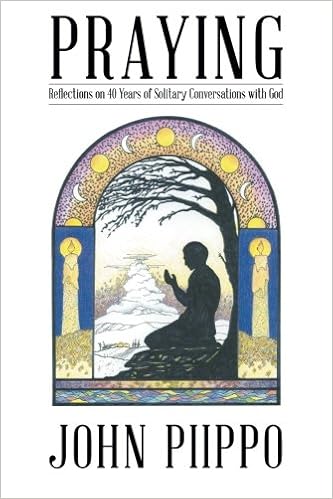
Praying: Reflections on 40 Years of Solitary Conversations with God (May 2016)

Leading the Presence-Driven Church (January 2018)

I am now writing:

Encounters with the Holy Spirit (I'm editing this collection of writings from my HSRM colleagues. Should be out in June!)

I've begun writing...

Transformation: How God Changes the Human Heart

Then... 

Technology and Spiritual Formation

Then...  Linda and I plan to co-write our book on Relationships

Thursday, March 28, 2019

My Two Books (and Four More to Come)


Image result for john piippo books

My two books are:

Praying: Reflections on 40 Years of Solitary Conversations with God (May 2016)

Leading the Presence-Driven Church (January 2018)

I am now writing:

Encounters with the Holy Spirit (I'm editing this collection of writings from my HSRM colleagues. Should be out in June!)

I've begun writing...

Transformation: How God Changes the Human Heart

Then...

Technology and Spiritual Formation

Then...  Linda and I plan to co-write our book on Relationships

Image result for john piippo books

Wednesday, March 27, 2019

Easter Was Not Borrowed From a Pagan Holiday

(Downy woodpecker in my backyard.)

Someone asked me a question about Easter - was "Easter" originally a pagan holiday? The answer is: "No."

See "Was Easter Borrowed From a Pagan Holiday?" (The historical evidence contradicts this popular notion.)

The Irrelevancy of the Non-Praying Church

(Redeemer sanctuary. 3 PM. 3/21/19)

For decades I have taught pastors and Christian leaders how to have a praying life. I develop this in my book Praying: Reflections on 40 Years of Solitary Conversations with God.

Pastors and Christian leaders are irrelevant and inauthentic if they do not have a Jesus-type praying life (found, e.g., here). This is because praying is talking with God about what you and God are doing together. To not pray is to be out of touch with what God is thinking and doing.

I'm re-reading Francis Chan's Letters to the Church. Chan says the same thing here.

"Is prayer something you do only before you eat or something your church does only when it needs to transition out of the sermon while the band walks onto the stage? Would you say that prayer plays any meaningful role in the life of your church? If prayer isn’t vital for your church, then your church isn’t vital. This statement may be bold, but I believe it’s true. If you can accomplish your church’s mission without daily, passionate prayer, then your mission is insufficient and your church is irrelevant." (Chan, p. 62)

Saturday, March 23, 2019

The More Westernized a Person Is, the Less They Pray

Image result for john piippo prayer
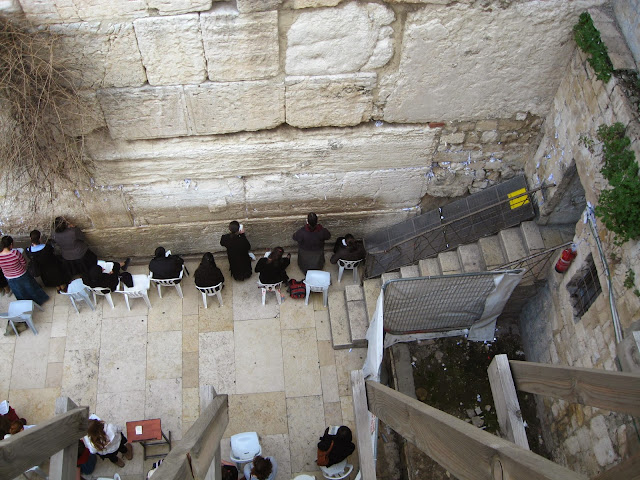
(Praying at the Western Wall, Jerusalem)
In the process of encouraging people to pray as conversation-with-God, I often hear the following, from Western Jesus-followers: "I don't think I have time to pray 30-60 minutes a day, 5 days a week." If the Jesus-follower is from a Third World country, like ancient Israel in the time of Jesus was, they have time to pray. What's going on? 

My answer is: the more Westernized a person is, the less they take time to meet and talk with God; the less Westernized a person is, the more they take time to meet and talk with God.

I estimate that 80% of European and North American pastors and Christian leaders do not have a significant prayer life. By this I mean that they do not take time to actually pray, habitually. By "taking time" I mean more than saying a blessing over dinner, or multi-task "praying." By "significant" I mean something like an hour or more a day. Like Jesus did.

My estimate comes from teaching and coaching 3000 pastors and leaders over the past forty years.

The statistics flip for pastors and leaders from Third World contexts. 80% of them have a significant prayer life. When they attend my prayer and spiritual formation seminary classes they already have a quantitative prayer life in place. They pray... a lot. The European and North American clergy, on the other hand, find themselves "too busy to pray." They find it very hard to "fit in" times of actual praying. Why is this so?

The reasons Westernized Christians don't significantly pray and Third World Christians do, include these.


  1. SENSE OF NEED: More access to human helping agencies lowers the desperation level. But when I was, e.g., teaching and speaking in India, the lack of access to medical care, education, jobs, etc. was massive. One could only turn to God, in prayer. So in India I found pastors who were praying people. The less felt need there is, the less one prays; the more felt need there is, the more one prays.
  2. NEED TO CONTROL: Westernized Christians live under the general cultural illusion that they are in control of life; Third World non-westernized Christians live in a cultural world where human control is minimal at best; hence, they appeal to God (or gods, or spirits) for help. The more one feels in control of life, the less one prays; the less one feels in control of life, the more one prays.
  3. TIME: The more stuff a person has, the less they pray. This is because much of their life is dictated by their stuff, which demands much time protecting, arranging, storing, repairing, cleaning, cultivating, etcing. Stuff demands time. On the other hand the less personal ownership, the more actual time to pray. The busier one is the less one has time to pray; the less stuff one has, the more one has time to pray.
  4. UNBELIEF. Many pastors are secularized. They don't believe. Because if you believed there is a God who interacts with you when you pray, you would pray.
The typical European and North American Jesus-follower has little felt need, is under the illusion that they can control things, and is afflicted with burnout-busyness. As these four elements converge, the God-relationship is virtually gone.

James Houston writes: "To pray is to declare loyalty to a spiritual reality above and beyond the human realm of self-effort and control." Will it be heart-loyalty to "things above" or "things below?" The answer to this question will determine whether or not a Christian prays.

***
See my book Praying: Reflections on 40 Years of Solitary Conversations with God.

Personalizing 1 Corinthians 13:4-7

Linda, in Ann Arbor


Jesus fully demonstrated the kind of love we read of in 1 Corinthians 13:4-7. We could plug in ‘Jesus’ for the word ‘love’ and arrive at this:

Jesus is patient, 
Jesus is kind. 
Jesus does not envy, 
Jesus does not boast, 
Jesus is not proud. 
Jesus does not dishonor others, 
Jesus is not self-seeking, 
Jesus is not easily angered, 
Jesus keeps no record of wrongs. 
Jesus does not delight in evil but rejoices with the truth. 
 Jesus always protects, 
Jesus always trusts, 
Jesus always hopes, 
Jesus always perseveres.

1 John 3:2-3 says: Dear friends, now we are children of God, and what we will be has not yet been made known. But we know that when Christ appears, we shall be like him, for we shall see him as he is. All who have this hope in him purify themselves, just as he is pure.

How do we purify ourselves, as Jesus is pure? Write your name in the blank space. This is your destiny, if you are in Christ. 


 _____________ is patient, 

_____________ is kind.

_____________ does not envy, 

_____________ does not boast,

_____________ is not proud.

 _____________ does not dishonor others,

_____________ is not self-seeking,

_____________ is not easily angered,

_____________ keeps no record of wrongs.

 _____________ does not delight in evil but rejoices with the truth.

 _____________ always protects,

 _____________ always trusts,

_____________ always hopes, 

_____________ always perseveres.

 
I am carrying this with me today. As I read my name in the blank spaces I sometimes think, "This is ridiculous. I am so far from this..."
 
Yet as I read and re-read this, understanding that this is my eternal future in Christ, that one day I shall be like Him, I find myself encouraged, even empowered.
 
Try it as a spiritual discipline for awhile. Bring any revealed impurity to God. Allow God's Spirit to get his hands on you, and form you into greater and greater Christlikeness. (Galatians 4:19)

***
My two books are:

I'm working on:

How God Changes the Human Heart

Technology and Spiritual Formation

I'm almost done editing Encounters With the Holy Spirit.

Linda and I then plan to write our book on Relationships

Friday, March 22, 2019

Empowering Women for Ministry

Image result for john piippo women
(With Linda, who is a powerful Christian leader!)
My 5/14/17 sermon "Empowering Women for Ministry" is HERE.

What about the two problem passages?

See HERE, and HERE.

F.F. Bruce on Women Leaders In the Church

Three church women
All of us who went to an evangelical theological seminary in the mid-to-late 20th century faced the writings of New Testament scholar F.F. Bruce. And let's be honest here. Anyone who goes by "F.F" (or "C.S." or "W.H." or "J.P." or "N.T.") must be smart. 

Bruce's The New Testament Documents: Are they Reliable? was read by all of us budding young scholars. My copy of Bruce's commentary on the Gospel of John is falling apart. This is due to much use, not poor binding. And his book on the canon of Scripture was, as far as I could tell, the only and best book of its kind at the time.

Bruce was a humble and quiet man. This is how New Testament scholar Scot McKnight describes him when they met. Bruce had just finished his commentaries on Galatians and Philippians. McKnight waited for an opportune time to ask the great NT scholar THE QUESTION. McKnight writes:

"I asked him about women in the church. My question was something like this, “Professor Bruce, do you think women should be ordained?” His response I shall remember forever. He said, “I don’t care much for ordination. But what I can say with regard to the exercise of women’s ministries in the church, is this: I am for whatever brings freedom in the church. I am for whatever brings the freedom of the Spirit in the church of God.”" (McKnight, Galatians, Kindle Locations 5804-5807)

Initially McKnight thought Bruce's response was nebulous, full of holes and replete with problems. And probably correct. McKnight writes: "His answer is very biblical, very Pauline, and very much like Galatians. In fact, his answer is so much like Galatians that his answer must be right." (Ib.)

And uncommon. Yet Bruce's answer "corresponded to Paul's view of the essence of Christian living." His answer was uncommon because Paul's view "is a view that few are willing to live with."

There is a vast open-endedness in the Pauline view of Christian freedom, especially as it is presented in Galatians.

***
NOTE: There's no "ordination" in the New Testament.

Thursday, March 21, 2019

Four Seminars in New York City

Image result for john piippo new york city
(New York City)
When Linda and I travel to New York City to speak at Faith Bible Church and teach at Faith Bible Seminary, I'll also be giving four evening seminars, one of them (Relationships) with Linda.

My seminary class is June 2-6 - Leading the Presence-Driven Church. Students can prepare by reading my book in advance. (See HERE.)

My four seminars are:

5/31 (Friday)
7:30 - 9:30pm
How to Respond to Same-Sex Marriage
Defending the biblical view of marriage as between a man and a woman and how to respond to this issue.
6/4 (Tuesday)
7:30 - 9:00pm
Relationships
How to have healthy relationships with friends, family, and in marriage.
6/5 (Wednesday)
7:30 - 9:00pm
The Authority of the Bible
Is the Bible God’s Word, from God? I share why I believe it is, and how I arrive at this.
6/6 (Thursday)
7:30 - 9:00pm
Technology and Spiritual Formation
Showing how technology does and will affect our formation into increasing Christlikeness.

Wednesday, March 20, 2019

Submit to God In the Present Moment

(Bangkok Train Station)
Greg Boyd, in his brilliant little book Present Perfect, writes:

"One of the reasons why many contemporary Western Christians place so much stress on hearing sermons, engaging in Bible studies, reading books, and attending seminars and conferences [is because] we believe that acquiring information is the key to helping us grow spiritually and solve our personal and social problems." (98)

While sometimes information does help people grow, and sometimes helps us solve problems, knowledge "does not on its own empower us to become more Christlike. When it comes to living in the Kingdom, moment-by-moment, our typical Western confidence in information is misplaced." (98-99)

In the West we are massively informed."We have more data, more information, than Christians at any time in the past. But it is not evident that we are more spiritually mature than Christians in the past. Many have written about how the lifestyle and core values of Western Christians are no different from pagan, worldly non-Christians. And this, in spite of all our Christian bookstores and books and websites and seminars and conferences and Bible studies. We have a problem. It isn't due to a lack of information."

Greg asks, "Why do so many Christians today spend more time listening to sermons or reading books than they do feeding the hungry, housing the homeless, welcoming outcasts, visiting prisoners, or engaging on other activities Jesus said should characterize Kingdom people?" (98) The answer lies in the great gap being knowing about the Kingdom and knowing Jesus and living out the Kingdom.

Greg writes: "all the information in the world is worthless if it distracts from the simplest thing in the world, which is practicing the presence of God in the present moment." (100)

Submit to God now, in the present moment. As we do this God's "life flows in and through us," and "transforms us in a way no amount of knowledge can." (101)

(See also the writings of James K. A. Smith, who debunks the Western Enlightenment idea that we are, primarily, what we think.)

***
My two books are:
Praying: Reflections on 40 Years of Solitary Conversations with God
Leading the Presence-Driven Church.
I'm working on:
How God Changes the Human Heart
Technology and Spiritual Formation
Linda and I then plan to write our book on Relationships

Monday, March 18, 2019

A Letter to Women

Image result for john piippo abide
(Warren Dunes State Park, Michigan)
This post is for the women who attended our conference this past weekend. 

You just had a beautiful, powerful time together. I have heard from many of you, about great things God was doing in you. Praise God! 

Now, it's Monday morning. The conference is over. But the Holy Spirit is not over. What do you do today? Here are my thoughts - blessings!

1. Continue to abide in Christ. Live an abiding life. Connect, today and tomorrow, with Jesus. For how to do this, read John chapters 14-15-16, slowly. 

For my counsel on this, read "How to Experience God's Presence," which is chapter six of my book Leading the Presence-Driven Church

2. Take alone-time with God. Read from the four Gospels. Open your Bible to the book of Proverbs, and slow-cook in the wisdom deposited there.  

Check out Dallas Willard's excellent devotional guide Hearing God Through the Year. Anyone who wants to learn and grow in hearing God should get this book!

3. Reflect on the things God told you and accomplished in you on the weekend. For me, the days after an intense God-conference are for deepening the truths I heard and received. Some of these are reminders, course-correcting truths. There are also some new insights given to me. Write them down in your journal. Carry them with you during the week. Meditate on them.

4. Share with others what God is doing in you and saying to you. Listen to others as they share with you. This is always so encouraging!

Abide in Jesus. Pray. Listen. Reflect. Ponder. Obey. Move forward. Expect.  

Something new, something good, something powerful, is happening in you. 

You are not the same as you were last week. 

That's called transformation.

Thursday, March 14, 2019

BEGINS TONIGHT! Women - Treat Your Soul to Three Days of Empowerment

March 14-16
Arise & Thrive: Called by His Spirit
Women's Conference
Don't Miss It!
"Arise & Thrive" is God's timeless invitation to His daughters to fulfill their divine destiny. Grab hold of this awesome opportunity -- a conference that will be a spiritual locomotive for going forward. Come expecting impact in your life to arise and advance and experience God's freedom, love, power and healing released in you... Expect a transformative shift in your heart and mind as the truth of God's purposes and plans for you His daughter frees and changes you. We will gather to worship, learn, pray, and most importantly to encounter God together!  
Monroe, Michigan
Conference hosts:
Holy Spirit Renewal Ministries & Redeemer Fellowship Church 

Conference site:
Redeemer Fellowship
5305 Evergreen, Monroe, MI 48161
March 14-16, 2019
Doors open Thursday, Mar. 14th @ 6 pm.
Hours: Thurs. 7-9 pm, Friday 8:45 am-9 pm, Sat. 8:45 am-4 pm.
Register now and bring a friend, family member, prayer group, bible study group, teen girls, home-school teens, women's ministry leaders...all women welcome...ages 12 to 112! Help us spread the word so others will know of this life-impacting opportunity. You can make it happen for the other women in your life. Registration cost is incredibly low -- $55 and includes two lunch meals!
Reason to Attend...?
God will be there!!
Be prepared for impact from heaven as you press into the Lord at Arise & Thrive: Called by His Spirit!
Featuring:

Larry Sparks - revivalist, conference speaker, publisher for Destiny Image, and author of Arise: A Prophetic Call for Women to Receive Swords, Mantles, and Kingdom Assignments

Lynn Coleman - minister and seminar speaker, teaching about "Worship and the Brain." You will be amazed and your worship paradigm will never be the same!!

Aurora Newton - minister, counselor, CEO and founder of Assert Now, Inc. with training programs designed to educate awareness, equip prevention, and empower restoration from physical, sexual and emotional abuse.

Panel of Experts - Will address hot button topics and urgent women's issues! Q&A will make it real for you.

Women of HSRM - Our renewal movement leaders will move you during "Snap Shots" -- our version of TED Talks -- 20 minute shots of hope, joy, truth, amazing testimony and profound life-experience, carefully crafted by the Holy Spirit.

Prayer and prophetic ministry - Redeemer Fellowship's ministry team!
Need Lodging while in Monroe?
There are lots of lodging choices in Monroe but for your convenience a limited number of rooms have been blocked for Arise & Thrive conferees at Holiday Inn Express & Suites Monroe at a group rate of $99/night for room with 2 queen beds. Booking is up to the individual and the two ways to do this are as follows:

1) Call the hotel (734) 639-1701 or IHG Reservations (877) 666-3243 and request to book under the Arise & Thrive Conference to complete the booking over the phone. OR...
2) Visit www.hiemonroe.com and use the group code ATC under the "more options" option after selecting the dates of the conference week/weekend. Follow through the prompted steps of the online booking process.
Donate to Bless Another
Your tax deductible donation of the cost of one or more tickets through our sponsorship plan will allow a woman who would be unable to afford this conference to attend and experience the love of god and his people at this conference. We thank you for your generosity. Bless you!
Holy Spirit Renewal Ministries
Visit with us on Facebook